


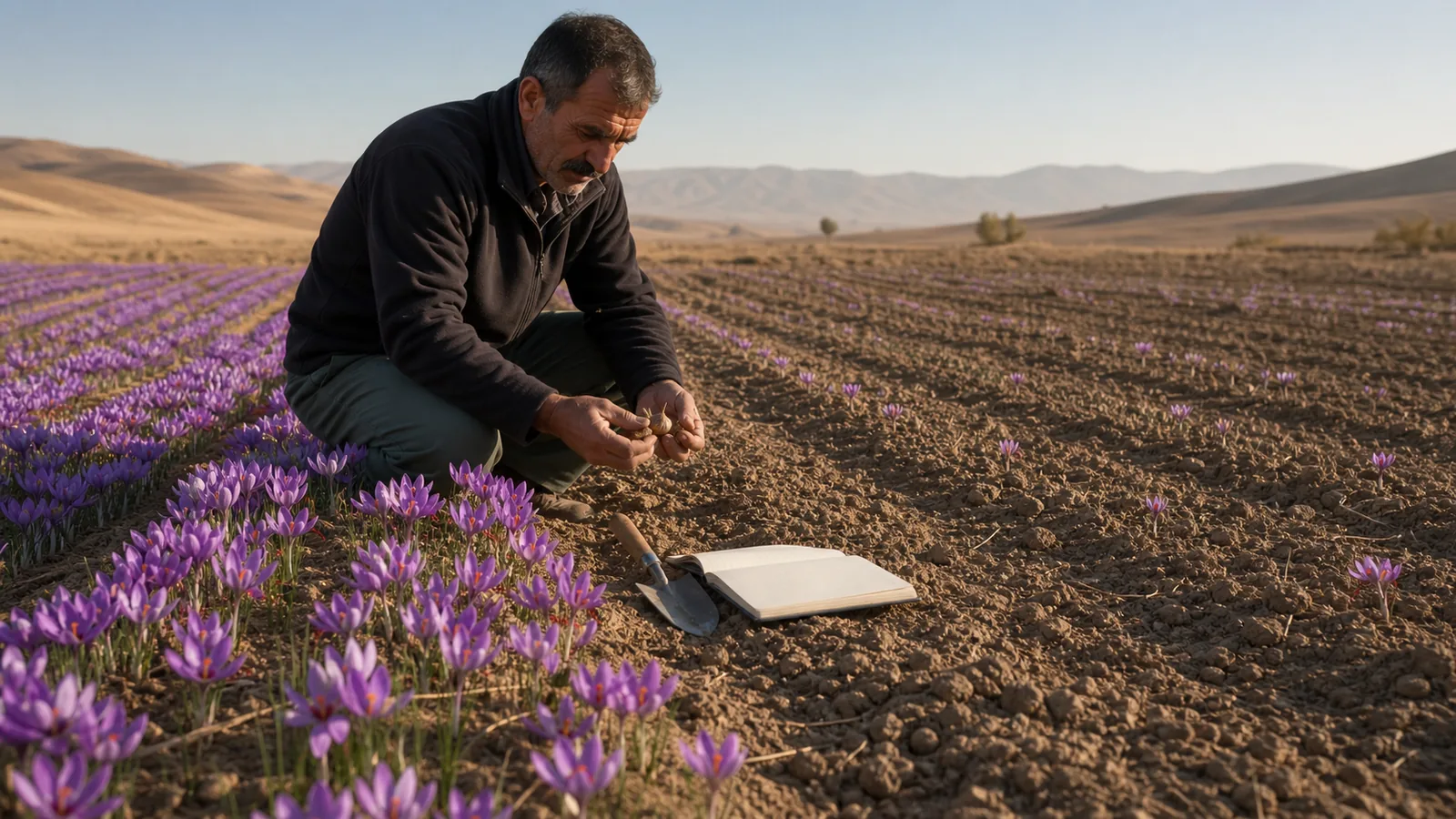
Saffron production in Iran remains the largest national supply in the world, but the number of hectares does not tell the whole story. Yield per hectare has declined over the long term, and drought, heat, field age, corm quality, labour and market conditions can turn a large cultivated area into a disappointing harvest.
The latest national figure cited by Iran’s Agricultural News Agency from the Ministry of Agriculture’s medicinal-plants programme reports about 336 tonnes from 105,000 hectares, an average of 3.3 kilograms per hectare, with 203 tonnes exported for $286 million in the preceding year. Another IANA review recorded 348 tonnes in crop year 1403, down from about 360 tonnes in 1402. These are dated crop-year snapshots, not a permanent annual output.
How much saffron does Iran produce?
A responsible answer needs a year and source. The 336-tonne ministry-programme report and IANA’s 1403 crop-year review differ slightly because reporting periods and estimates differ.
The previous version of this page cited 123,000 hectares in 2022 and 450–470 tonnes annually. Those figures are retained here as an older industry estimate, not presented as the current total. They do not match the newer ministry-linked figures closely enough to combine into one trend line.
Production is concentrated in Khorasan Razavi and South Khorasan, with important local variation inside each province. Qaen, Torbat Heydarieh, Gonabad and other established areas differ in rainfall, water quality, temperature, field age and management. A national average cannot predict one farm.
What is a typical saffron yield per hectare?
Recent national and research estimates cluster around 3–4 kilograms of dry saffron per hectare, but individual fields can fall below or rise above that band. The ministry-linked figure above is 3.3kg/ha. A 2022 technical-efficiency study reported that Iran’s average fell from 6.15kg/ha in 1971 to 3.42kg/ha in 2017; the Agriculture paper links the long decline to both external pressures such as drought and warming and internal management problems.
The old article’s range of 1.5–3kg/ha describes weak fields, not every Iranian farm. Equally, experimental yields above 10kg/ha are not a national baseline. Controlled field studies can identify better combinations of water, salinity management and planting method, but their results depend on local conditions and field age.
For planning, use the field’s dry-stigma yield over several seasons. Flower weight and the best single plot are not substitutes for a repeatable commercial average.
Why has saffron yield declined?
Drought, heat and poorly timed water
Saffron is suited to dry-summer climates, but that does not make flowering independent of water. Soil moisture around root and flower development, rainfall timing and heat events all affect the crop. A dry year can reduce flower initiation, while excessive or badly timed water in poorly drained soil raises disease risk.
Temperature stress matters at more than one stage. Hot conditions during corm development and warm autumn weather can alter flowering. Cold extremes can damage exposed growth. Management therefore has to match local weather rather than rely on a fixed national irrigation calendar.
Old fields and crowded corms
Corms multiply underground. Over time the stand can become crowded, daughter corms remain small and competition increases. A field may occupy the same hectare while producing fewer marketable stigmas. Field age, corm size and density should be recorded together with yield before deciding whether to renovate or lift the corms.
Planting depth, soil and salinity
Planting too shallow or too deep for the soil and climate can affect emergence and temperature exposure. Compaction, weak drainage and salinity further restrict performance. A soil and water test is more useful than a generic fertiliser recipe; excessive inputs do not correct a physical root-zone problem.
Our saffron planting guide explains corm-rate arithmetic, site checks, depth, irrigation and multi-year field planning. Where decline is patchy, also inspect corms and roots for the problems covered in the pest and disease guide.
Training and field-specific decisions
The original article correctly identified a training gap, but no single lesson will double every farm. Growers need practical diagnosis: field history, stand density, corm health, soil, water, weather and harvest records. Demonstration plots are most useful when they compare a change against the farm’s present method and measure dry stigma over multiple seasons.
Harvest labour and processing also limit output
Flowers open during a short autumn period and are still largely picked by hand. If labour is unavailable, flowers wait in the field or in deep containers. Delayed separation and drying may not reduce the field’s biological yield, but they reduce saleable quality and can turn harvested material into a lower-value grade.
Expansion of area without matching labour, drying and traceability capacity can therefore lower the value recovered per hectare. The end-to-end controls are covered in our saffron processing guide.
When exports fell with production
The assigned source article records an earlier downturn described by Ali Hosseini of the South Khorasan saffron producers and exporters association. Production had been forecast near 300 tonnes, but the reported harvest was about 240–250 tonnes, roughly 20% lower than expected. Average yield was put near 3kg/ha and farmers’ production cost near four million tomans per kilogram at that time.
The figures are historical. The cost cannot be compared with today’s toman prices without its date, grade and inflation context.
Hosseini expected exports to finish 20–30% lower. Less than 100 tonnes had reportedly left Iran in 11 months, compared with more than 130 tonnes in the preceding year. He cited several pressures:
- a 5% charge on exports packed above 30 grams;
- foreign-currency repatriation and exchange rules that discouraged many export-card holders;
- higher air transport, packaging and other export costs;
- weaker competitiveness when the permitted currency arrangement did not match commercial reality.
The report claimed roughly 80% of saffron exporters holding commercial cards were deterred from exporting. That is an attributed industry estimate, not a measured share verified here.
World price decline did not mean lower farm costs
In the same period, Hosseini said the international price had fallen from about $2,300 per kilogram to $1,000–$1,300 as exchange rates changed, even while production and export costs rose by more than 50%. The episode shows why export value can deteriorate at the same time as a crop becomes more expensive to produce.
The earlier destination article later quoted domestic bands of 65 million tomans for one cut, 87–88 million for loose saffron and 102 million for premium product. Those were a different market snapshot and are not current prices. A live offer needs grade, batch evidence, quantity, packing, destination and date; use the saffron price request page rather than applying old numbers.
Production, exports and stocks are different measures
It is tempting to divide exports by production and call the remainder domestic consumption. That can be wrong because saffron can carry from one crop year into the next, customs and harvest periods differ, and informal trade may not appear in the same dataset.
The recent ministry-linked report gives 336 tonnes produced and 203 tonnes exported in its stated periods. That supports the conclusion that exports are central to Iran’s saffron economy, but it does not prove that exactly 60% of the same crop was exported. Stock movement and reporting dates must be reconciled first.
What would a credible recovery look like?
A national target such as 1,000 tonnes is an ambition, not a forecast. Raising average yield from roughly 3.3kg/ha requires many farms to improve without exhausting water, increasing salinity or sacrificing quality. Progress should be measured with a smaller set of verifiable indicators:
- dry stigma yield per hectare by field age and province;
- share of planted corms above the agreed healthy size;
- soil and irrigation-water constraints corrected before planting;
- weather, irrigation and flowering records for each field;
- harvest-to-drying time and rejected or downgraded output;
- export weight and value from a defined customs period;
- grower return after labour, water, corm and processing costs.
The fall of “red gold” is not one event and does not have one remedy. Iran still has the farming knowledge, established regions and export base to remain the leading producer. Protecting that position depends on accurate crop-year data, field-specific agronomy, careful processing and trade rules that allow a documented, quality product to reach buyers competitively.

![Exporting Saffron to Turkey + Price Guide [Complete 0 to 100]](https://img.rowhanisaffron.com/20260827003933/saffron-export-turkey-quality-inspection.webp)



