Iranian saffron export barriers were the subject of a 2017 university roundtable preserved on this page. The speakers did not blame a single problem. They described political and customs uncertainty, weak investor confidence, incomplete product information, microbial control and fraud as connected reasons Iran struggled to retain more of the international market.
The discussion was held at Ferdowsi University of Mashhad under the title “Iranian saffron in international markets.” Its claims belong to that time. Some were broad warnings rather than results that can be applied to every Iranian saffron lot. The practical lesson is more precise: market access depends on predictable trade conditions and evidence that the product meets the buyer’s identity, quality, safety and labelling requirements.
What the political-barriers argument meant
Leili Abolhasani, a faculty member in agricultural economics at Ferdowsi University, argued that political conditions prevented Iranian businesses from controlling more of the saffron market. She referred to volatile customs rules and a lack of security felt by foreign investors and export businesses.
“Political reasons” is a wide label. For an exporter, it may appear as difficulty receiving payment, limited banking services, restricted insurance or shipping routes, changing tariffs, sanctions compliance, licensing delays, or uncertainty about whether a contract can be completed. The exact obstacle varies by country, date and transaction.
A serious market plan therefore cannot treat politics as an explanation that ends the analysis. It should identify the rule, authority, cost, lead time and contingency for each target market. A business can rarely remove a political constraint, but it can avoid promising a route or delivery it has not verified.
Why predictable customs rules matter
Saffron is compact and valuable, yet an export still depends on classification, origin documents, invoices, food requirements and border procedures. When customs rules or their application change often, the exporter cannot quote a landed price confidently. The buyer may also be reluctant to invest in labels, promotion or stock.
Stability matters to farmers too. A delayed shipment can leave an exporter carrying inventory and delay payment through the chain. That does not mean every market should use identical rules. It means the applicable requirements should be known before the lot is purchased and packed.
A buyer asking about saffron price in US markets needs more than an Iranian farm-gate quotation. The landed cost can include testing, compliant labelling, freight, insurance, brokerage, duty, storage, distributor margin and exchange-rate risk. A current US price cannot be reconstructed from this 2017 roundtable.
Packaging technology was not the only gap
Abolhasani said saffron packaging requires capable technology, but investors were hesitant when export demand and routes felt insecure. The underlying point is sound: equipment is difficult to finance when the business cannot forecast how finished packs will reach customers.
Still, packaging is not a solution by itself. A useful pack protects the spice from moisture, light, contamination and loss. It carries accurate lot, origin, net-weight and business information for the destination market. The records behind it connect the finished jar to the tested input lot.
The translated report says foreign customers emphasised “composition, calories and saffron.” That phrase is damaged. It likely refers to label composition, nutrition information and product specifications, but the original wording has not been recovered. Exporters should use the actual legal and buyer requirements of the destination rather than guessing from this sentence.
The “most polluted saffron” claim needs boundaries
Elnaz Milani, a food-science researcher in Razavi Khorasan, discussed a commissioned project intended to produce saffron with a low microbial count. She cited a 2009 paper that compared samples associated with Iran, Greece, Italy and Spain and said the Iranian samples had the highest microbial load while the Spanish samples had the lowest.
That limited comparison does not establish that Iranian saffron is universally or currently the “most polluted saffron in the world.” The surviving report does not provide the paper’s title, number of samples, sampling design, organisms measured or results by lot. A microbial count is also not automatically evidence that a specific pathogen is present.
The claim is best treated as a historical warning about post-harvest controls. Every lot needs appropriate sampling and testing against its actual specification. Country of origin cannot substitute for a result.
How contamination can enter the saffron chain
Saffron is a dried spice, but low moisture does not make poor hygiene harmless. Codex guidance for spices and dried aromatic herbs—including saffron stigmas—recognises that microbial, chemical and physical contamination can occur from cultivation through harvest, drying, packing, transport and storage.
Milani’s project focused on practical controls: training harvest workers, picking flowers promptly, using clean transfer containers, avoiding large warm piles, separating stigmas under controlled conditions and completing drying carefully. These steps address points where hands, soil, equipment, time and temperature can affect the product.
Gloves are useful only when workers change them at the right time and avoid touching contaminated surfaces. Hand hygiene remains necessary. Containers should be cleaned and sanitised with a validated food-safe procedure, then allowed to dry as required; growers should not spray saffron or baskets casually with alcohol because an old translation mentions it.
“Sterile conditions” is also too strong for ordinary farm processing. The realistic goal is controlled hygienic handling, not a sterile field. A documented hazard analysis should decide where a kill step or microbial-reduction treatment is needed and permitted.
Harvest timing and flower handling
The roundtable suggested collecting flowers while still in bud, early in the morning and before they opened fully. Prompt morning harvest can protect delicate flowers from sun and heat and reduce the time they remain exposed in the field. It is not, by itself, proof of a low microbial count.
After picking, flowers should be moved in clean, shallow containers rather than compressed into a deep, warming mass. Stigmas need timely separation and controlled drying. The operator should record the lot, people, equipment, time and conditions so a problem can be traced and corrected.
The strongest control system measures the result. It verifies moisture and the relevant microbial criteria on a representative sample instead of assuming that a clean-looking process always produced a compliant lot.
What the €70-per-gram story can show
Milani said the project produced samples within the European buyer’s microbial-count expectations and that the company was eventually able to sell saffron at €70 per gram. The statement is retained as an attributed pilot outcome.
It is not a general price benchmark. The report does not identify the date of sale, quantity, pack size, grade, channel, retailer margin or whether €70 was a consumer price. A controlled lot can earn access to a demanding market, but no hygiene programme guarantees that selling price.
Fraud was the other market risk
A food-industry speaker whose name is rendered only as Dr Kocheki said saffron’s high value attracts fraud after the product enters commercial channels. The speaker stressed that the grower is not necessarily where adulteration begins.
Examples included mixing old and fresh saffron without disclosure, adding honey or glycerin to increase weight and moisture, and applying colour. Mixing harvest years is not inherently fraudulent if the product remains genuine and is described accurately; it becomes deceptive when age or grade is misrepresented. Adding undeclared substances to increase sale weight is adulteration.
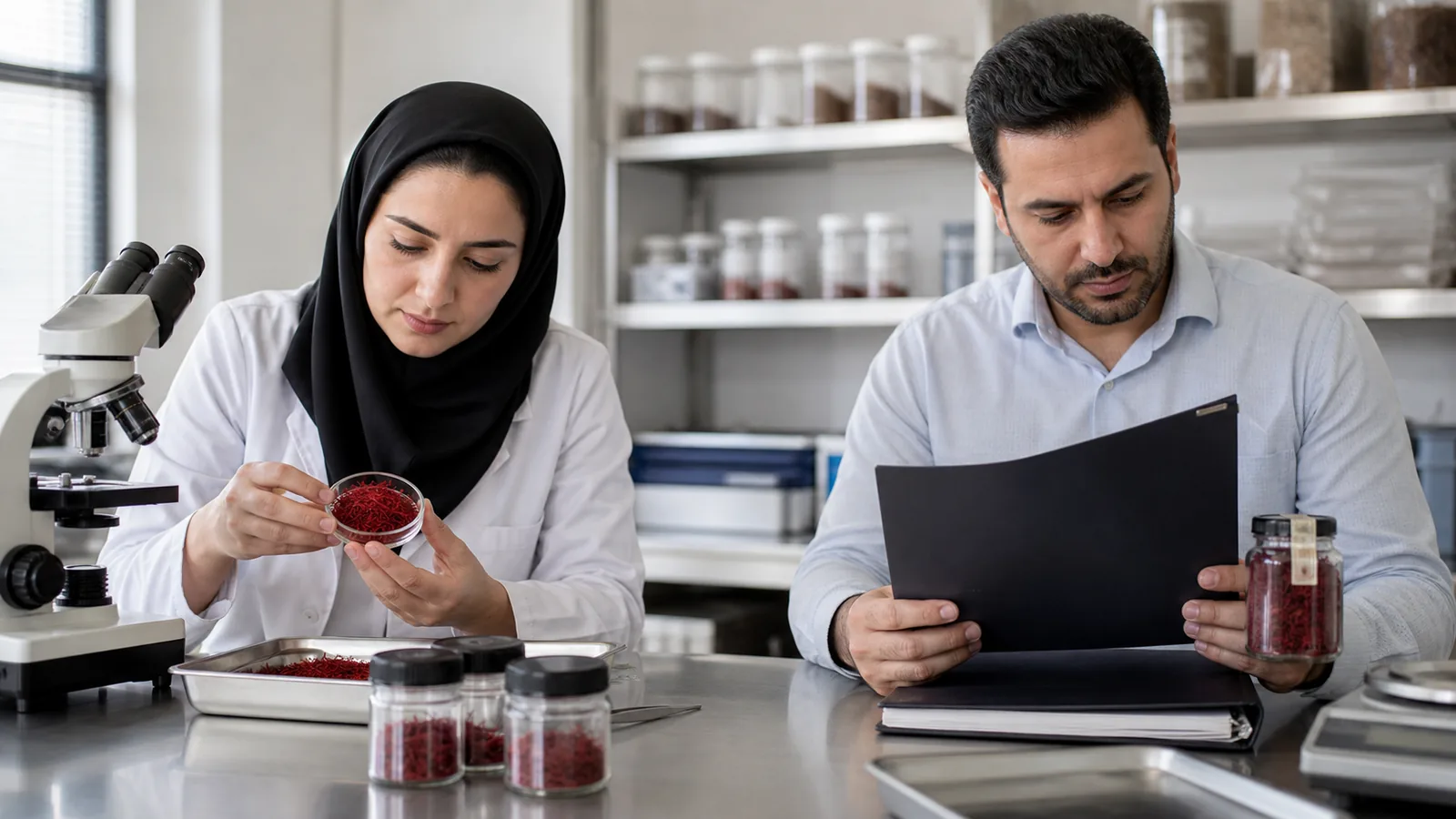
These risks reinforce the need for lot controls after the farm. Seals, weights, moisture checks, supplier approval, representative sampling and records through each repacking stage make unexplained changes easier to detect. ISO 3632 can support saffron specification and testing, while a suspected dye, foreign plant or microbiological hazard may require a different targeted method.
A practical export-readiness system
The roundtable’s separate concerns fit into one workflow:
- identify the legal route, customs classification, payment and sanctions constraints;
- agree the buyer’s identity, grade, safety, residue, microbiological and packaging specifications;
- keep harvest and processing lots traceable;
- control hygiene from flowers and containers through drying and storage;
- sample the lot using a defensible plan and test it with fit-for-purpose methods;
- label origin, net weight and required food information accurately;
- protect the lot against substitution or added weight during transport and repacking; and
- quote only after the landed-cost and delivery route have been checked.
Our guide to buying bulk saffron looks at the buyer’s side of that process. The article on identifying real saffron explains why simple home tests cannot replace batch evidence.
Reading the 2017 debate today
Political and customs uncertainty can restrict a trade route, but market trust is also built inside the supply chain. Predictable documents, hygienic handling, appropriate testing and honest labels are not substitutes for better trade relations; they are the evidence a buyer needs once a route is available.
The original headline remains a fair summary of Abolhasani’s argument. The wider roundtable makes it stronger: Iranian saffron cannot secure a market through production volume alone. It has to arrive as a traceable, compliant lot under terms that both sides can complete.
Sources reviewed
- The April 2017 roundtable report preserved on this URL and attributed there to ISNA, Leili Abolhasani, Elnaz Milani and Dr Kocheki.
- FAO/WHO Codex Alimentarius texts, including CXS 351-2022 for saffron and hygienic-practice guidance for spices and dried aromatic herbs.
- US Food and Drug Administration: Questions and Answers on Improving the Safety of Spices.
- ISO 3632-1:2025: saffron specification and ISO 3632-2:2010: test methods.
Sources were reviewed on 30 August 2026. The comparative microbial and €70 claims remain attributed to the 2017 discussion; they are not current country rankings, safety findings or price quotations.