


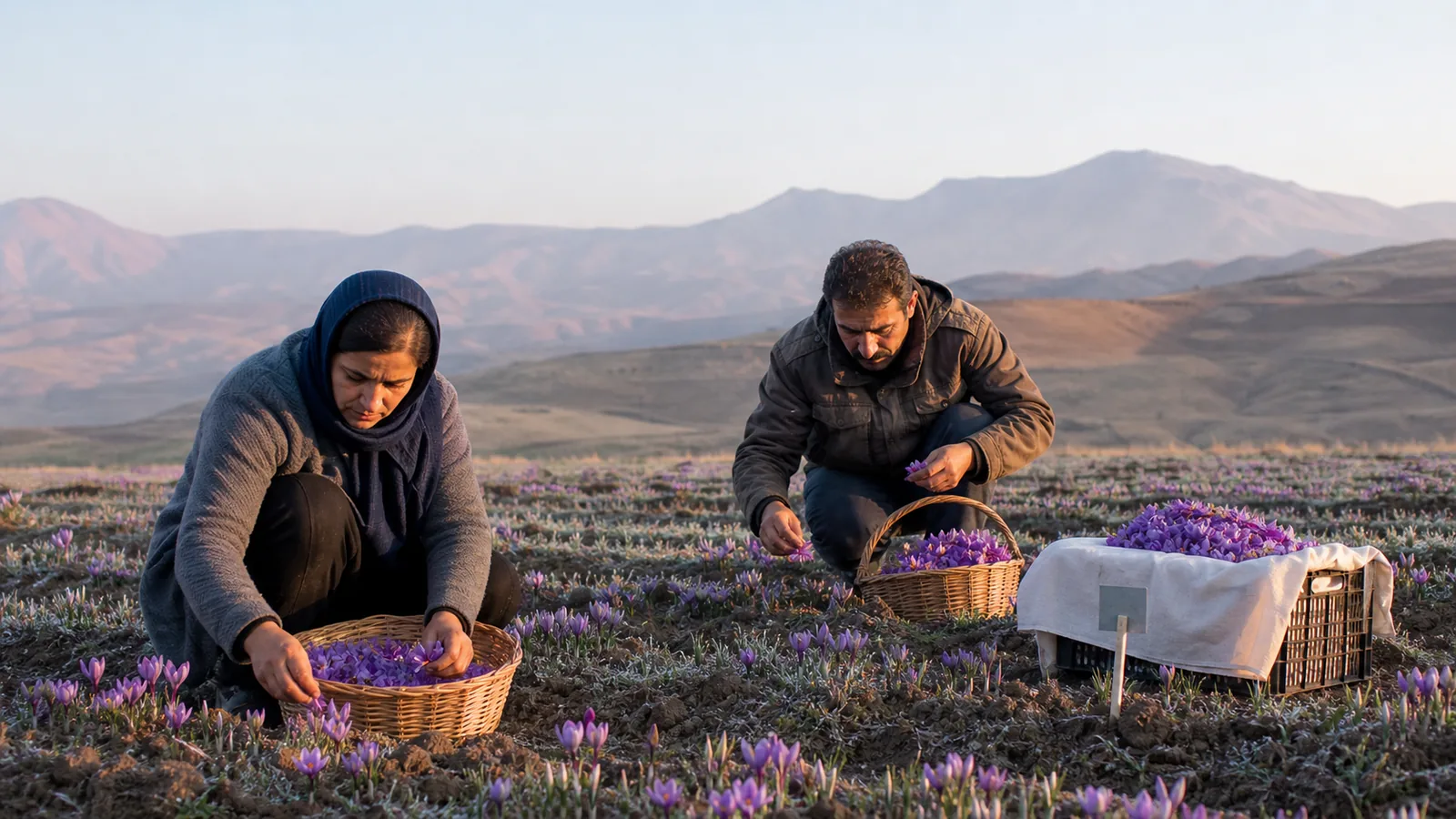
Saffron harvest in Sareyn ended with more than 12 kilograms of dried saffron in the season described by this April 2017 article. Mohammad Ebrahim Mohammadi, then director of the local Agricultural Jihad office, said the crop came from a little over five hectares in Sareyn County, Ardabil Province.
The report is a historical snapshot of a small emerging production area. It does not establish the size of today’s crop, and its “quality” statement was not accompanied by laboratory data. What it does show is why local officials saw saffron as a possible fit for farmers looking for a high-value crop with a different water calendar.
What the Sareyn harvest report said
Mohammadi told the Iranian Students News Agency (ISNA) that harvesting began in mid-October and finished after more than 12 kilograms of dry saffron had been collected. He put the cultivated area at more than five hectares.
If the entire stated area was productive, 12 kilograms from five hectares would imply roughly 2.4 kilograms per hectare. That is only an arithmetic illustration. The article does not say how much land was mature, how much was newly planted, or whether “more than” referred to a final measured total. A responsible yield figure would use harvested bearing area and dry weight from the same season.
The report also did not name the villages, number of growers, field ages or drying method. Those missing details matter when comparing Sareyn with a larger saffron district.
Why a cool district can still grow saffron
Sareyn is known for a cool upland climate. Saffron’s seasonal cycle can fit such conditions because the corm remains dormant through summer, flowers in autumn, develops leaves through the cooler months and returns to dormancy after spring growth.
That general pattern does not make every Sareyn field suitable. Severe winter exposure, poorly drained soil, standing water, salinity, corm disease and badly timed irrigation can reduce establishment or yield. Elevation and slope also create differences over short distances.
A farmer considering saffron should assess the particular plot, not rely on a county reputation. Soil texture and drainage, irrigation supply, winter conditions, healthy corm availability and labour for the short harvest all belong in the decision.
What “low water requirement” should mean
Mohammadi described saffron as a strategic, high-value crop with a very low water requirement and connected it with changes in the regional crop pattern. Saffron can require less irrigation than crops that remain actively growing through hot summer months. It does not grow without water.
The meaningful comparison is a farm’s actual annual irrigation volume and timing. Flowering, leaf growth and replacement-corm development need adequate moisture, while waterlogging can damage corms. Rainfall and soil water-holding capacity change the number and size of irrigations needed.
A lower-water crop also does not make unrestricted acreage expansion sustainable. Farmers still need a realistic water budget and should consider what happens when several dry years occur together.
Harvest quality begins before the flower opens
Saffron flowers are normally collected promptly during the short flowering period, often early in the morning. Cool, timely handling helps protect the delicate flowers and gives workers time to separate the stigmas before they wilt.
Flowers should be placed in clean, shallow containers rather than compressed into warm piles. After transport, trained workers separate the red stigmas, remove unwanted flower material and dry the saffron under controlled conditions. The lot then needs protection from moisture, light, contamination and mixing.
These steps influence the finished spice more directly than a broad claim about regional climate. FAO’s recent work on the Iranian saffron value chain likewise treats harvesting and processing as connected parts of quality and competitiveness.
Flavour and colour need evidence
The 2017 report praised Sareyn saffron for its flavour and colour and appears to say that it had a large sales market. Those were the official’s observations, not a comparative test supplied with the story.
Colouring strength, aroma-related characteristics, moisture and foreign matter can be assessed with defined methods. ISO 3632 provides specifications and test methods for saffron filaments, cut filaments and powder. A result applies to the sample and lot tested; it cannot certify every crop from Sareyn.
The old description also called saffron both edible and medicinal. Its culinary use is well established, and researchers study its constituents, but this harvest announcement identified no clinical evidence, dose or health outcome. It should not be used to advertise treatment or cure.
Why farmers were interested
Mohammadi expected cultivation to continue rising because farmers were interested, the crop had commercial value and local officials considered the conditions promising. A five-hectare base allowed growers to test the crop without assuming that it would perform uniformly across the county.
The real business calculation includes corms, land preparation, irrigation, weed control, harvest labour, stigma separation, drying, packaging and sale. The first year may produce few flowers, so cash flow needs to cover establishment before a mature harvest is available.
A higher value per kilogram does not guarantee a higher return per hectare. Dry saffron yield is small, labour is concentrated, and the price depends on quality, buyer, lot size and market access. Growers need records from more than one season before expanding.
How a small Sareyn crop can keep its identity
Twelve kilograms can disappear easily into a larger regional supply chain unless the lots remain documented. A useful local system records the grower, field, harvest date, flower handling, drying batch, dry weight, sample and buyer.
Several small growers can combine compatible lots for testing and packaging, but consolidation should not erase traceability. The finished pack should lead back to its input lots, and a Sareyn origin claim should not be added to saffron from elsewhere.
Local processing can also reduce unnecessary transport of delicate flowers. If only dried saffron moves, it should travel in sealed food-safe containers under conditions that protect it from moisture and odour.
What this means for a saffron shop in US markets
The legacy URL and one historical search impression refer to a “saffronshop” or saffron shop in US markets, although the article itself reports on farming in Sareyn. The useful link for a US buyer is provenance. A shop describing saffron as Sareyn-grown should be able to identify the supplier and lot behind that statement.
Retail appearance alone does not verify origin, and a provincial harvest total says nothing about the contents of a particular jar. Buyers should check the responsible business, lot number, origin documentation, net weight, storage condition and test evidence appropriate to the order.
Our guide to identifying real saffron explains the limits of home tests. Commercial buyers can use the broader framework in buying bulk saffron.
Reading the 12-kilogram milestone accurately
The 2017 harvest was modest in national terms but meaningful for a district with just over five reported hectares. It showed that saffron could be produced in Sareyn and gave farmers a local result to examine.
The next question was never simply whether acreage would rise. It was whether farms could repeat acceptable yields, handle flowers cleanly, preserve lot identity and find buyers at a price that covered the work. Those are still the measures that turn a promising crop into a durable one.
Sources reviewed
- The April 2017 report preserved on this URL and attributed there to an ISNA interview with Mohammad Ebrahim Mohammadi.
- FAO in Iran: saffron harvesting and processing practices, October 2025.
- ISO 3632-1:2025 saffron specification and ISO 3632-2:2010 test methods.
Sources were reviewed on 30 August 2026. The 12-kilogram and five-hectare figures, start date and quality comments are historical attributed claims, not present production data or a product certificate.

![Exporting Saffron to Turkey + Price Guide [Complete 0 to 100]](https://img.rowhanisaffron.com/20260827003933/saffron-export-turkey-quality-inspection.webp)



