


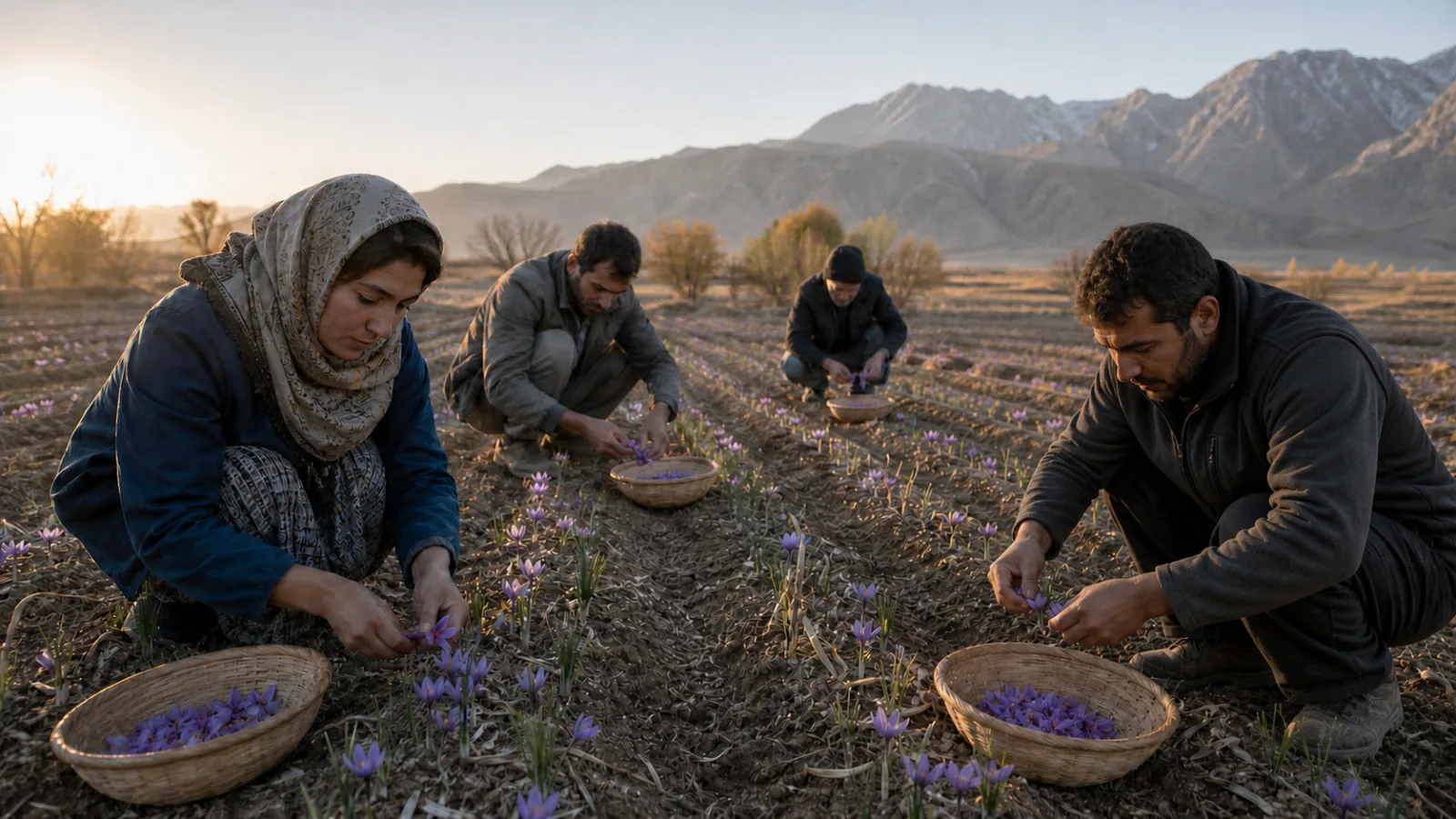
The saffron harvest season in Khorasan, Iran, is in autumn—not spring. Flowering generally begins in October and runs into November, although elevation, temperature, irrigation timing and the year can shift the local peak. Spring is important for leaf growth and replacement corms; the red stigmas are gathered months later.
That timing explains the phrase people search for as Iran saffron harvest season Khorasan autumn. It also explains why harvest labour, drying capacity and prices can change quickly over a few intense weeks.
Saffron Harvest Season in Khorasan, Iran: Autumn Timing and Price Seasonality
When does the saffron harvest start?
FAO visited farms in Fariman County near Mashhad on 15 October 2025 to observe the beginning of that year’s harvesting season. That dated field visit is more useful than treating one calendar date as permanent.
The practical answer to Iran saffron harvest season October November Khorasan is that October and November form the normal window, while individual farms may start earlier or continue later. The older report described flowering from early November to mid-December; that may reflect a particular place or year, but it is not the only Khorasan calendar.
Saffron is an autumn-flowering geophyte. Research on flower formation shows that warm conditions support flower initiation inside the dormant corm and cooler autumn conditions trigger emergence. Leaves then grow through winter and spring before drying as the plant returns to summer dormancy.
Why farmers pick flowers before the day warms
Fresh saffron flowers are delicate and continue to deteriorate after picking. Khorasan families often begin before sunrise or early in the morning, when blossoms are closed or only partly open. The flowers are placed in shallow, clean containers rather than compressed into deep sacks.
Early picking is only the first quality step. Flowers should reach a clean separation area quickly. Workers remove the red stigma from the petals and yellow styles, then dry the selected material under a controlled process. Delay, crushing, contamination or an uneven high temperature can reduce colour, aroma and commercial value.
ISO 21983:2019, confirmed in 2025, provides guidance for harvesting, transportation, stigma separation, drying and storage before packing.
Harvest is still a family and seasonal-labour operation
The original field report described family members sitting around gathered flowers to separate stigmas by hand. Larger farms hired seasonal workers because every new blossom had to be collected during a short window. Some workers were paid according to the weight of flowers picked rather than by the day.
It also recorded the voice of a young seasonal worker in Khaf who was weighing study against immediate harvest income. The translated currency figures were unusable, but the underlying issue remains important: a high-value crop can still depend on short-term, physically demanding work with limited bargaining power.
Needle-like saffron leaves are not the main harvesting obstacle; the challenge is the volume of low-growing flowers and the speed required. Mechanisation has advanced in field preparation, corm lifting, sorting and drying, yet selective flower picking and careful stigma separation are still difficult to automate without quality loss.
How yield develops after planting
Saffron is propagated by corms, not seed. A new field commonly produces less in its establishment year, then improves as daughter corms develop and plant density increases. Eventually overcrowding, disease, declining corm size or soil conditions can reduce yield and make lifting and replanting necessary.
The old page gave a progression from 1–2 kg of dried saffron per hectare in year one, 4–6 kg in year two and up to 10 kg or more later, plus an exceptional claim above 30 kg. Those numbers are not a schedule any field can promise. Corm size and density, location, water timing, temperature, soil, nutrition, weed pressure and harvest management all affect the result.
Likewise, “only three irrigations per year” is a local management description, not universal guidance. Saffron is suited to dry regions, but water quantity and timing must respond to soil and weather.
Fertiliser use does not prove or disprove organic production
The earlier report quoted a worker who had not seen local fields without fertiliser or crop-protection inputs and doubted that flowers were truly organic. That observation cannot establish the status of every farm. Organic production allows specified inputs and requires certification, records and inspections; a flower’s colour or smell cannot verify it.
Manure itself must be properly managed to avoid weed seeds and contamination. Fertility planning should be based on soil, corm needs and local agronomy, not the belief that any fertiliser is harmless because no immediate colour change is visible.
Iran saffron harvest price seasonality
The long query Iran saffron harvest season Khorasan autumn price seasonality connects two real events: supply enters the market quickly, and many growers need cash at the same time. Fresh flowers cannot be stored for long, so farmers without labour or drying capacity may accept an immediate price. Dried saffron offers more time, but storage, financing and market risk remain.
The old report said small farmers sometimes sold cleaned, dried saffron at a 10–15% discount during harvest and that intermediaries could resell later at a higher price. That historic figure should not be assumed in every year. Prices may rise or fall after harvest because of crop size, exchange rates, export demand, regulation, quality, inventories and buyer financing.
It is therefore wrong to promise that saffron is always cheapest in autumn or always more expensive later. A dated price needs the product form, grade, lot size, currency, market level and delivery terms.
Can farmers keep more of the value?
The original account described a village fund: growers pooled saffron, sold when conditions were stronger and kept money in the fund for the following season. Cooperatives or warehouse-receipt systems can give small producers access to testing, secure storage and larger lots, but governance matters.
Members need transparent weighing, representative sampling, fees, ownership records, sale authority and payment rules. Delaying a sale is not automatically profitable; the benefit must exceed storage and financing costs.
Why production leadership does not guarantee export value
Iran produces the large majority of the world’s saffron. The older report argued that bulk Iranian material was packaged and sold under Spanish brands, allowing later businesses to retain branding and distribution value. Re-export and third-country packaging are real value-chain issues, but origin should not be inferred from a national brand alone.
FAO’s 2025 work in Iran connects farming and post-harvest practice with safety, authenticity, traceability, marketing and digital branding. Growers retain more value when an identifiable, well-handled lot reaches a buyer with trusted evidence—not merely when more saffron is produced.
Climate pressure can change the calendar and suitable regions
The old article said production had shifted north from Qaen and parts of South Khorasan toward areas such as Torbat. That broad statement needs long-term local data. Temperature affects flower initiation and emergence, while drought, water access and extreme events affect both yield and corm renewal.
A South Khorasan climate-suitability study projected rising temperatures and more fragmented future suitability in parts of the province. A projection is not proof that one year’s “best saffron” has moved north, but it supports adaptation: local monitoring, suitable corms, soil and water management, and harvest/drying capacity matched to a shifting flowering peak.
How to read a Khorasan harvest report
- Check the farm location, elevation and harvest year.
- Separate flower weight from dried-stigma weight.
- Ask whether yield is per planted or harvested hectare.
- Record first flower, peak harvest and final picking dates.
- State labour and drying method, not just total output.
- Define price by form, grade, currency, date and market level.
- Distinguish a seasonal observation from a long-term climate trend.
Khorasan’s saffron story begins before dawn in autumn fields, but it does not end at picking. Speed, labour, drying, finance, traceability and market timing determine how much of the flower’s value survives. Spring supports the next crop; October and November are when most people see its red-gold harvest.

![Exporting Saffron to Turkey + Price Guide [Complete 0 to 100]](https://img.rowhanisaffron.com/20260827003933/saffron-export-turkey-quality-inspection.webp)



