


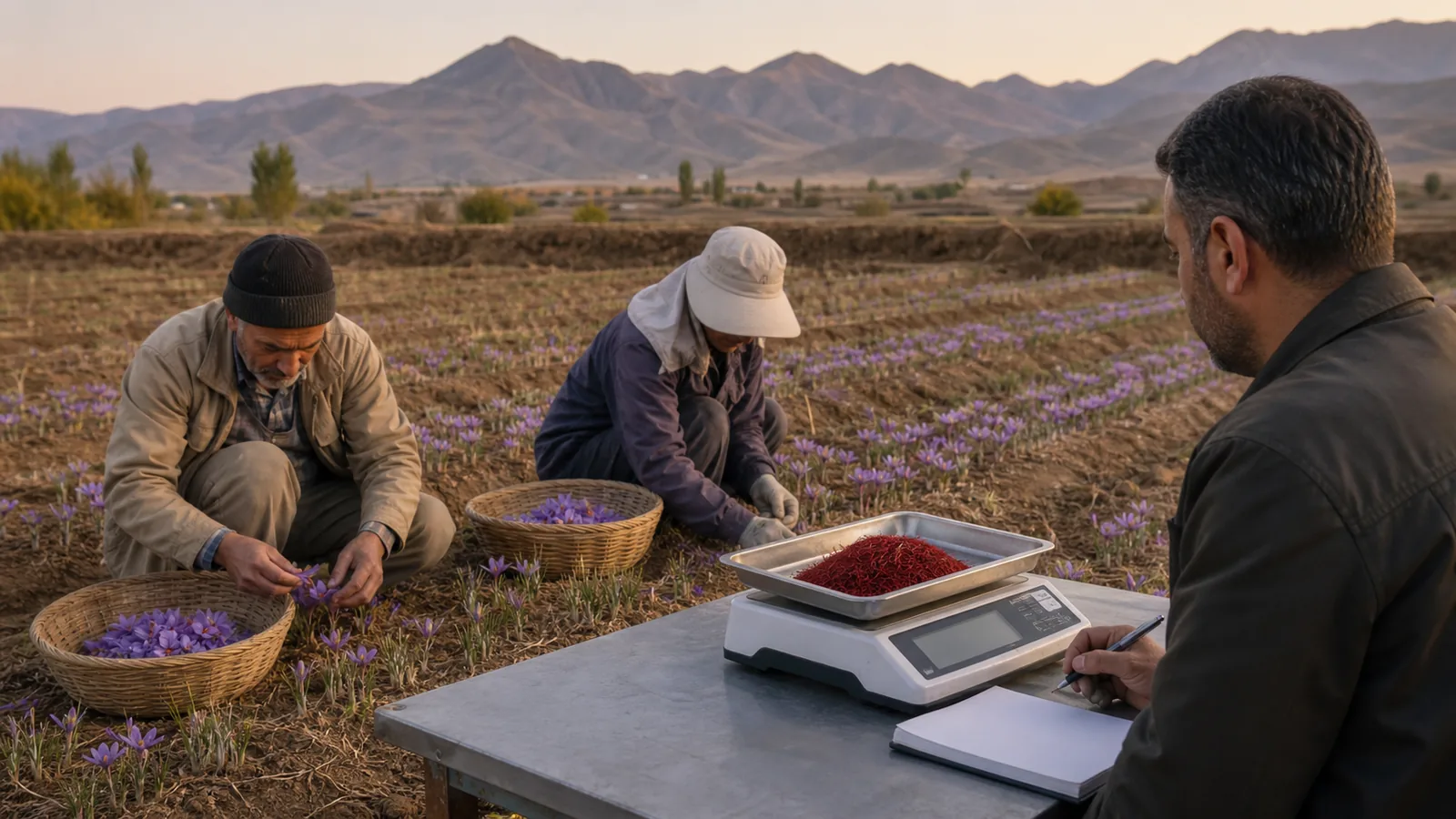
Saffron production in Hamedan passed 270 kilograms in the season described by this April 2017 report. Hojatollah Shahbazi, then director of horticultural affairs at Hamedan’s Agricultural Jihad Organization, called the result unprecedented for the province. The report tied the increase to a larger planted area and a rise in average yield.
Its figures describe a particular harvest, not the current size of Hamedan’s saffron sector. They also contain a few translation and arithmetic problems. This article preserves every meaningful number while separating what the source clearly stated from what cannot be verified.
The 270-kilogram Hamedan harvest
Shahbazi told the Iranian Students News Agency (ISNA) that more than 270 kilograms of dried saffron had been produced in the province. The previous season’s output was reported as 197 kilograms. On that comparison, production rose by at least 73 kilograms.
The provincial saffron area was given as 87.4 hectares, about 30 hectares more than two years earlier. Malayer had the largest district area at 36 hectares, while Kabudarahang was listed with the smallest at 1.7 hectares.
These are dated administrative estimates. “Hamedan” here means the province, not only Hamedan city. The original headline remains unchanged, but readers should not use 270 kilograms as a present production figure or as a forecast for another season.
Why the acreage and yield do not multiply neatly
The report said average yield improved from 3.8 to 4.3 kilograms per hectare. Multiplying 87.4 hectares by 4.3 gives about 376 kilograms, not 270. That does not necessarily mean either published figure was false.
A planted-area total can include new fields that are not yet flowering fully, while an average yield may refer only to mature or harvested land. The report does not state the productive area used for the calculation. A provincial average can also be rounded or assembled before the final harvest total is known.
The safe reading is therefore limited: officials reported more land, a higher average yield and more than 270 kilograms of production. The surviving copy does not provide enough detail to reproduce the calculation. A proper statistical release would identify planted area, bearing area, harvested area and dry-saffron weight separately.
How Hamedan’s saffron area was developing
An earlier report from Iran’s Ministry of Agriculture news service helps establish the sequence. In February 2016, Shahbazi reported more than 63 hectares of saffron in Hamedan Province, with Malayer holding 23 hectares. He gave an average yield of 3.8 kilograms per hectare.
The 2017 account’s 87.4 hectares and 36 hectares in Malayer are consistent with continued expansion, although they should not be interpreted as a survey of the same day. A separate June 2017 report said the area had grown from 33.8 hectares in Iranian year 1386 to 87.4 hectares in year 1395, and gave 207 kilograms—not 270—for the latter year’s production. That difference may reflect timing, scope or revision. It is a reason to attach a source and reporting date to every total.
Later figures cannot repair the old record, but they show that growth did continue. A 2021 account attributed 161 hectares and 548 kilograms to Shahbazi. Those later numbers belong to a different season and do not replace the 2017 report.
Small lots created a marketing problem
A damaged sentence appears to say that the 87.4 hectares were distributed among 229 growers or holdings. It then notes that many individual producers had no more than about two kilograms to sell. The precise count is not clear enough to present as confirmed, but the commercial problem is plausible and important.
A farmer with a small lot may struggle to arrange representative testing, export documentation, packing and direct overseas distribution alone. Combining compatible lots through a disciplined cooperative or processor can create commercial volume, provided each input remains traceable and quality is not averaged blindly.
Shahbazi said much of Hamedan’s saffron was sent out of the province, including to Razavi Khorasan, for packaging. He hoped local processing would be established. Keeping cleaning, testing and packing closer to the farms could support local jobs and retain the product’s Hamedan identity, but only if the facility has reliable supply, quality systems and buyers.
What local processing would need to do
A packaging unit adds value when it performs useful, verifiable work. That includes:
- receiving saffron in identified grower and harvest lots;
- checking cleanliness, moisture, foreign matter and sensory condition;
- taking representative samples for the required tests;
- keeping different origins and grades separate;
- using food-safe packs that protect against moisture and light;
- recording the relationship between input lots and finished packs; and
- labelling origin, net weight and responsible business details accurately.
Machinery alone does not create an export market. The operator also needs regulatory knowledge, working capital, consistent specifications and customers. A pack that says Hamedan should be backed by records showing that the saffron actually came from the province.
Climate suitability is a field-level question
The original report described Hamedan’s climate as suitable for saffron and associated the province with good quality and desirable active compounds. That was an official assessment, not a laboratory result supplied with the article.
Saffron can fit areas with a dry summer, a cool growing season and well-drained soil. Suitability still varies within a province. Elevation, winter cold, soil texture, drainage, salinity, corm health, irrigation timing and harvest labour all influence performance. A province-wide reputation cannot replace a field assessment.
Shahbazi also said Hamedan’s agriculture organisation was working with Razavi Khorasan to improve farmers’ technical knowledge. Exchanging experience makes sense, but recommendations should be tested under Hamedan conditions rather than copied unchanged from another region.
The old income claim needs its missing unit
The translated article says net income exceeded “15 million USD per hectare.” That is not credible in context. The source almost certainly lost a local currency label—likely a reference to 15 million tomans—but the original Persian sentence has not been recovered, and the price year, costs and yield basis are absent.
The figure is therefore retained only as an unresolved historical income claim. It should not guide an investment decision or be converted at a modern exchange rate. Net return depends on corms, land preparation, water, labour, drying, yield, grade and the price actually received.
The report’s broader point was that establishment is expensive in the first year while a healthy field can produce over several subsequent seasons. Even then, costs do not disappear: growers still manage irrigation, weeds, nutrition, pests, harvest and drying, and eventually replace or lift crowded corms.
What this means for saffron companies in USA
The legacy URL refers to saffron companies in USA, although the source article is about Hamedan agriculture. For a US importer or food business, the useful connection is traceability. A claim such as “Hamedan saffron” should be supported by a supplier, lot, harvest information and documents that follow the product through any processing in Khorasan or elsewhere.
Production totals do not establish the origin or quality of a particular shipment. Buyers should agree specifications, sampling, test methods, packaging and record retention before purchase. Our guide to buying bulk saffron provides a practical framework, while the saffron production statistics page helps place provincial numbers in context.
Reading the 2017 milestone accurately
The report documents a real stage in Hamedan’s saffron expansion: more than 270 kilograms reported, 87.4 hectares planted, Malayer leading the province, and an official push for farmer training and local processing. It does not establish today’s production, a guaranteed 4.3-kilogram yield or a dollar return per hectare.
Its strongest lesson is practical. Growth is more durable when acreage, bearing area, yield and lot size are measured separately, and when processing preserves the identity of the small farms behind the total.
Sources reviewed
- The April 2017 report preserved on this URL and attributed there to an ISNA interview with Hojatollah Shahbazi.
- Iran Ministry of Agriculture news service: 63 hectares of saffron in Hamedan, 6 March 2016.
- Medicinal Plants News Network: Hamedan medicinal plants and saffron figures, 18 June 2017; secondary reproduction of an attributed interview.
Sources were reviewed on 30 August 2026. All acreage, output, yield and income figures are tied to their historical reports; none is presented as a current quotation or forecast.

![Exporting Saffron to Turkey + Price Guide [Complete 0 to 100]](https://img.rowhanisaffron.com/20260827003933/saffron-export-turkey-quality-inspection.webp)



