


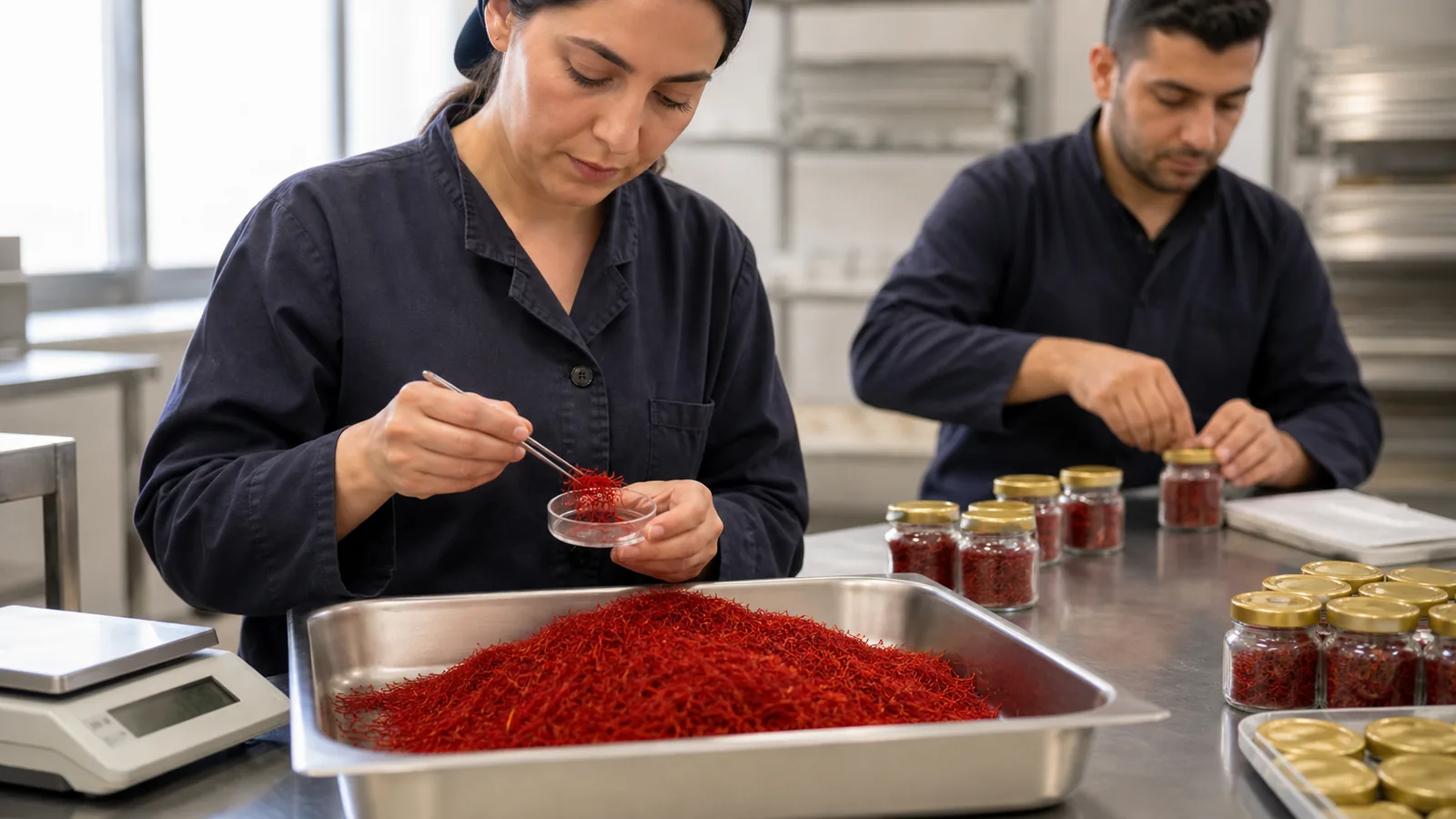
Iranian saffron trade was the subject behind this article’s awkward 2017 headline, “Saffron Products palate others.” The point made by the original speaker was that Iran grew most of the world’s red saffron, yet businesses in other countries could capture part of the value through importing, packaging, branding and re-exporting it.
The surviving English copy mixed production, exports and market share as if they were the same measure. They are not. A country can dominate cultivation without receiving the same share of retail revenue, and a trading centre can export saffron that it did not grow. Understanding where value is added is more useful than turning an old percentage into a permanent fact.
What the 2017 report claimed
A member of Zanjan’s Farmers’ House, whose name is damaged in the translated copy, was quoted in an interview attributed to the Iranian Students News Agency (ISNA). The speaker said Iran then supplied about 94 percent of global saffron production while other producing areas—including Afghanistan, Greece, Kashmir, India and Spain—accounted for the remainder.
The report also mentioned 160 tonnes of Iranian production and described Iran’s share of global saffron trade as 60 percent. Those numbers cannot safely be combined. The text does not identify the harvest year, define “trade share,” name its dataset or say whether the percentage referred to weight, export value or final-market turnover. They should be read as the speaker’s estimates from that period, not current statistics.
Production and market shares also change from year to year. Weather, field area, yield, domestic stocks, border trade and the reporting method can all move the estimate. Our saffron production statistics overview explains why a figure needs a year, source and definition before it is compared.
Why another country can earn from Iranian saffron
Dried saffron leaving a farm is not yet a consumer product on a distant shelf. Before retail sale, a commercial lot may be cleaned, graded, sampled, tested, packed, labelled, promoted, stored, insured and distributed. Each task has a cost, carries risk and can add legitimate value.
Importers in established distribution centres may already have supermarket contracts, multilingual labels, regulatory systems and customer support. They may buy in bulk and sell smaller packs. That does not make the saffron theirs by origin, but it can make their part of the transaction more valuable.
The problem arises when the producing origin becomes invisible, unverified or misrepresented. A label should distinguish where saffron was grown from where it was packed or dispatched. “Packed in Spain,” for example, does not by itself mean “grown in Spain.” A buyer needs traceability for the particular lot rather than an assumption based on the last country in the supply chain.
The historical Afghanistan tariff concern
The old report warned that saffron cultivation was expanding in neighbouring Afghanistan and alleged that Iranian corms were moving across the border informally. It also said Afghanistan enjoyed duty-free access to certain markets while Iranian saffron faced a tariff reported as 38 percent in India.
A 2016 report from Iran’s Ministry of Agriculture news service recorded the same structural concern. An agriculture official said China and India imposed tariffs above 30 percent on direct Iranian saffron while Afghan-origin saffron entered without duty. He also described bulk sales to Spain and the resale of saffron through businesses able to package for European markets.
That evidence supports the existence of a tariff and route-to-market debate at the time. It does not prove that every Afghan shipment contained Iranian saffron or that every Spanish pack concealed its origin. Those are batch-level questions requiring customs documents, invoices, packing records and labels.
Growing saffron and trading saffron are different activities
A production figure measures a crop. An export figure measures declared goods crossing a border. A retail-market figure may measure the value paid by consumers. Each can describe a different participant and a different price.
Re-exporting is normal in global trade. An importer can lawfully test, pack and send a product onward, provided the commercial and food-origin statements are accurate. Gross customs data cannot show whether the same physical lot was imported and then exported, because multiple harvests and origins may pass through the same country.
This is why “Iran produces 94 percent but has 60 percent of trade” is not enough to calculate a lost 34 percent. The numerator and denominator may use different units and markets. A defensible comparison would use the same year, commodity code, flow, weight or value measure, and treatment of re-exports.
Where more value can remain with producers
The 2017 speaker called for stronger support for Iranian growers. Support is most useful when it improves a function the market can verify rather than merely adding an expensive box. Practical areas include:
- healthy, traceable corms and agronomic advice;
- clean harvest handling and controlled drying;
- lot separation and records from farm to pack;
- representative sampling and credible laboratory testing;
- accurate grading, net weight and origin labelling;
- market-specific regulatory knowledge;
- contracts that make quality requirements and payment terms clear; and
- brands that can document, rather than merely claim, their origin.
These steps can create skilled work beyond the short flower harvest. They do not guarantee a higher farm-gate price. Processing equipment needs reliable supply, working capital, quality systems and customers willing to pay for the resulting service.
Packaging is useful only when the evidence travels with it
A consumer pack protects saffron from moisture, light, contamination and loss. It also provides space for a responsible business name, lot number, origin statement, net weight, storage advice and required food information. Those functions matter.
Packaging becomes superficial when the batch behind it cannot be traced. A credible chain connects the grower or cooperative, harvest period, drying record, processor, test sample, exporter, importer and final pack. If saffron is repacked, the new lot records should still lead back to the input lots.
Quality standards describe characteristics of the tested sample, but they do not establish geographic origin on their own. Colour strength cannot tell a buyer which Iranian province produced the flowers. Origin needs separate records and, where applicable, a controlled geographical-indication system.
What Iran’s production leadership does and does not guarantee
Large production provides experience, supply depth and a substantial grower community. It does not make every Iranian lot identical. Field conditions, stigma separation, drying, storage, age and handling still influence the finished spice.
Likewise, small production does not automatically mean poor quality. Afghanistan, Kashmir, Greece, Morocco and Spain have their own cultivation and market histories. A fair buyer judges a defined lot on identity, quality, safety, traceability and truthful origin—not on a national slogan.
For buyers, the practical response is to ask for evidence appropriate to the order. Our guide to buying bulk saffron covers sampling, documents and supplier questions. Our historical review of Iranian saffron re-exports through Afghanistan examines that narrower route without treating allegations as established for every shipment.
Reading “Saffron Products palate others” accurately
The headline should not be read as a claim that other countries have no legitimate role. Testing, packing, compliance, marketing and distribution are real work. Its enduring point is that a producer can lose visibility and bargaining power when those functions—and the customer relationship—sit elsewhere.
A stronger Iranian saffron trade therefore depends on more than tonnes. It depends on reliable field production, defensible quality, efficient export routes, honest origin records and businesses that can serve the final market. When those pieces remain connected, more of the product’s identity and value can remain visible from the red saffron field to the retail pack.
Sources and data note
- The March 2017 report preserved on this URL and attributed there to an ISNA interview with a member of Zanjan’s Farmers’ House.
- Iran Ministry of Agriculture news service: Iranian saffron re-exported from Afghanistan, 2016.
The 94-percent, 160-tonne, 60-percent and 38-percent figures above are historical attributed claims, not current market measures. The sources were reviewed on 30 August 2026. The speaker’s full name could not be recovered confidently from the surviving translation and has not been invented.

![Exporting Saffron to Turkey + Price Guide [Complete 0 to 100]](https://img.rowhanisaffron.com/20260827003933/saffron-export-turkey-quality-inspection.webp)



