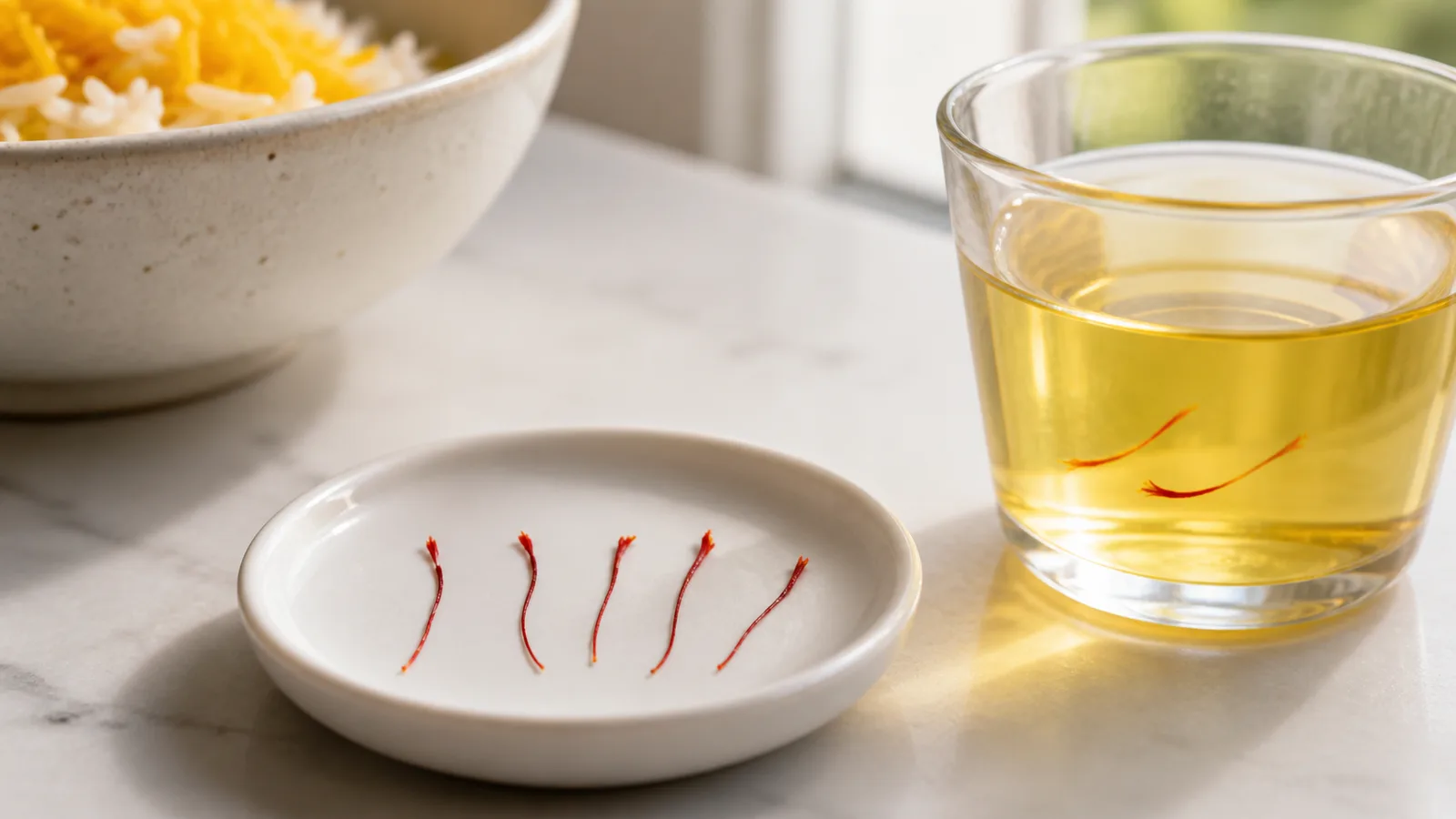
Is saffron pricier than gold? Usually, no—not at current gold prices when both are compared in the same currency and by the same weight. The World Gold Council reported an LBMA Gold Price PM of US$4,391 per troy ounce on 14 August 2026. That converts to about US$141.17 per gram. A saffron package would be pricier than gold by weight only if its net price exceeded that amount per gram on the same date.
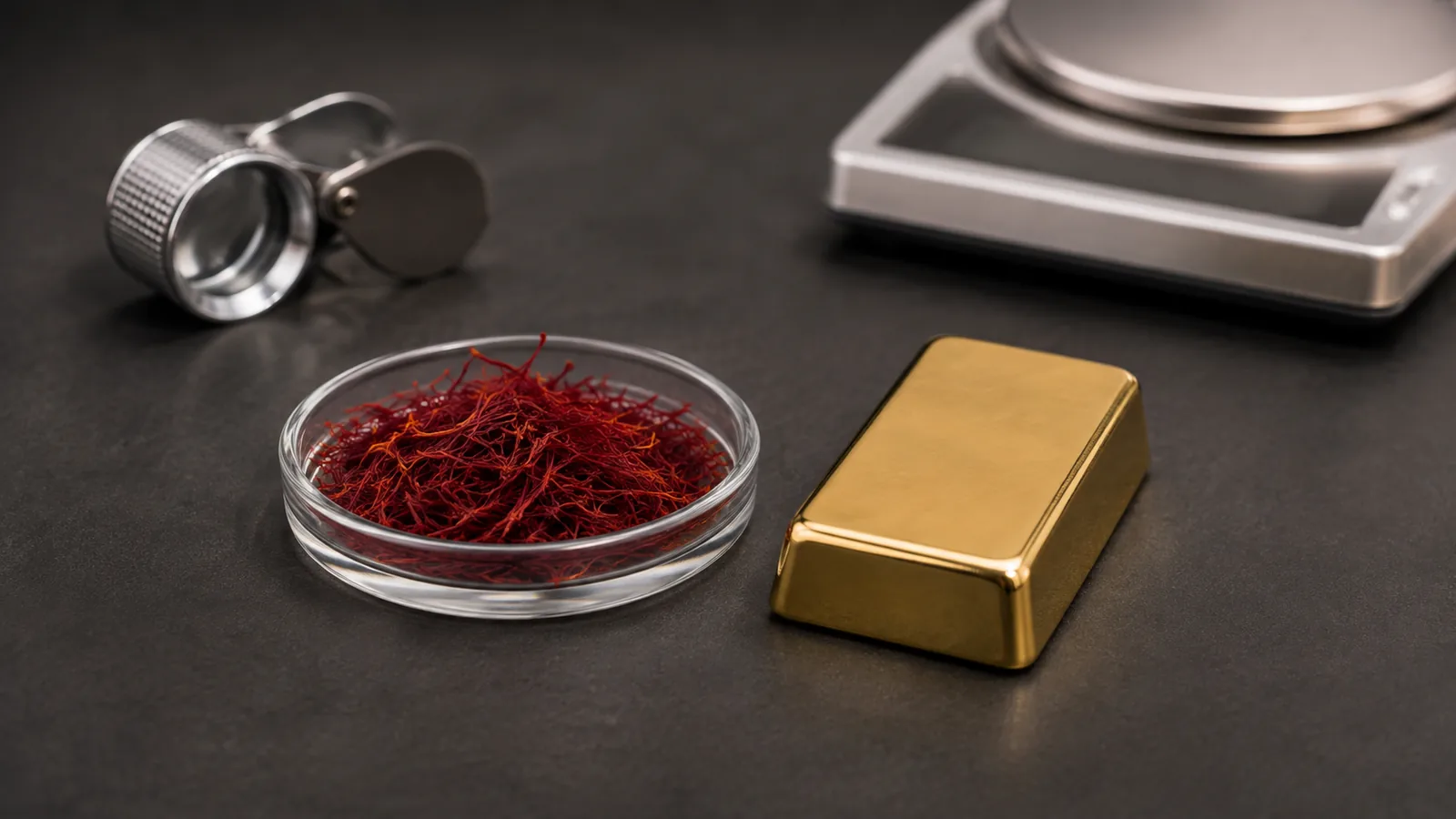
Is saffron more expensive than gold?
Saffron is one of the world’s most expensive spices, but the familiar claim that it is “worth more than its weight in gold” is not a timeless fact. Gold changes price every trading day. Saffron prices vary by origin, grade, freshness, package size, seller and market. The answer can therefore change, and a valid comparison must state its date and method.
Questions such as “How expensive is saffron compared to gold?” and “Is saffron worth more than gold?” need that same calculation. Searches for the cost of saffron vs gold or gold vs saffron price are not separate comparisons: both must put the two materials into the same unit, currency and date.
At the August 2026 reference price above, gold was substantially more expensive per gram than most ordinary culinary saffron listings. An unusually small, highly marked-up saffron package could cross the gold threshold, but that would describe that retail package—not saffron everywhere.
Saffron price per gram vs gold
The World Gold Council’s 14 August 2026 market update reported an international gold price of US$4,391 per troy ounce. Precious metals use the troy ounce, not the ordinary avoirdupois ounce commonly used for groceries.
The US National Institute of Standards and Technology gives one troy ounce as exactly 31.1034768 grams in its precious-metal conversion guidance. The calculation is:
US$4,391 ÷ 31.1034768 = about US$141.17 per gram of gold.
Now calculate the saffron instead of relying on a slogan:
Package price ÷ net grams = saffron price per gram.
For example, a one-gram jar priced at US$20 costs US$20 per gram. A half-gram jar priced at US$30 costs US$60 per gram, not US$30. In both hypothetical examples, gold at the dated reference price is still more expensive. A half-gram package would have needed to cost more than about US$70.59 to exceed the per-gram value of gold at that point.
These examples demonstrate the arithmetic; they are not claims about today’s selling price for a particular saffron product. Check the package’s actual net weight and the current saffron price information, then compare it with a same-day gold benchmark.
Saffron vs gold price per kg
The same comparison can be expressed per kilogram. At US$141.17 per gram, gold works out to approximately US$141,170 per kilogram. Multiply the saffron price per gram by 1,000 to obtain its price per kg.
- A hypothetical saffron price of US$10 per gram equals US$10,000 per kg.
- US$30 per gram equals US$30,000 per kg.
- US$150 per gram equals US$150,000 per kg and would exceed the dated gold reference.
A kilogram comparison is mathematically useful, but consumers rarely buy a kilogram of retail saffron. Very small packs also tend to carry more packaging and retail cost per gram, while bulk transactions have different pricing. Compare like with like and label whether a figure is retail, wholesale or a hypothetical conversion.
Why people say saffron is worth more than gold
The saying captures saffron’s extraordinary value as a food ingredient. It may also reflect a market and period when gold was cheaper or a particular saffron package was exceptionally expensive. It should not be repeated as though the relationship never changes.
Older articles often compare a premium retail saffron price with an outdated gold price, mix euros and dollars, or compare a gram with an ounce. The original version of this article made a simpler mathematical error: it said €30 per gram of saffron was more costly than €55 per gram of gold. Because 30 is less than 55, that example actually showed the opposite.
Gold’s recent movement makes fixed claims especially risky. The World Gold Council reported that gold exceeded US$5,500 per ounce intraday in January 2026 before falling below US$4,000 in late June. Its July 2026 market commentary placed the month-end figure at US$4,027 per ounce. A comparison should therefore show its date rather than silently becoming stale.
Why is saffron so expensive?
Each flower produces very little spice
A Crocus sativus flower produces three red stigmas. After drying, their combined weight is tiny. University of Vermont Extension’s Saffron by the Numbers fact sheet uses approximately 0.006 grams per flower, or around 167 flowers for one gram of dry saffron.
That corrects another common exaggeration. It takes hundreds of flowers—not thousands—to make a gram under this estimate. Thousands become relevant when producing larger retail or wholesale quantities.
Harvesting and separating stigmas require concentrated labour
The flowers arrive in a short seasonal window and must be collected and processed promptly. Each stigma is separated from the flower, then dried and protected from moisture, heat and light. The work is difficult to mechanise without damaging or mixing the delicate material. Our detailed guide to how much saffron comes from one flower shows how this small yield scales into grams, ounces and kilograms.
Commercial production is concentrated in a limited number of growing regions, especially in Iran, with smaller established crops in India and Spain and production elsewhere. Suitable conditions, the short harvest and strong global demand all influence the market, but none creates one permanent worldwide saffron price.
Quality, origin and handling affect the finished value
Saffron prices do not come from labour alone. The proportion of red stigma, thread condition, tested colour strength, aroma, moisture, harvest, storage, origin documentation and authenticity can all affect value. A high price is not proof that the contents are genuine or superior.
The UN Food and Agriculture Organization describes saffron as the world’s most expensive spice and colouring. That defensible category claim is different from saying it must cost more than gold, diamonds or every other substance.
Gold vs saffron in terms of value
Gold and saffron serve fundamentally different purposes. Investment-grade gold is a durable, globally traded precious metal with industrial, economic and historical uses and benchmark prices quoted per troy ounce. It can be stored for long periods, refined and resold. Jewellery may cost more than the underlying gold because it includes design, manufacture, gems and retail margin.
Saffron is a perishable agricultural product bought in small quantities for colour, flavour and aroma. Freshness and storage affect its culinary quality, and the threads are consumed rather than held as a financial asset. Calling saffron “red gold” expresses rarity and labour; it does not make a jar of spice equivalent to bullion.
Medicinal properties are also not a sound basis for a price comparison. Research into saffron and its compounds exists, but a food package’s retail price should not be justified with treatment or cure claims. For buying purposes, authenticity and culinary quality matter. The guide to real saffron versus fake saffron explains what can be screened at home and what requires proper testing.
How to make a fair saffron and gold comparison
- Choose one currency and one date.
- Use a recognised gold benchmark and note that it is quoted per troy ounce.
- Divide the gold price by 31.1034768 to obtain a per-gram figure.
- Divide the saffron package price by its actual net grams.
- Compare equivalent retail or wholesale contexts and identify any tax, packaging or jewellery premium.
This method also answers “Does saffron cost more than gold?” in any local currency, including a saffron price in Pakistan, a zafran price in Pakistan or a price in Europe. Currency conversion alone does not change which item is dearer if both prices are converted at the same rate and time.
The answer in one line
At the World Gold Council’s 14 August 2026 reference of US$4,391 per troy ounce, gold cost about US$141.17 per gram and US$141,170 per kg. Saffron is pricier than gold only when the particular saffron package exceeds those like-for-like thresholds. It remains an exceptionally expensive spice, but gold was the more expensive material in the ordinary comparison.