Saffron can flower in its first autumn, often only several weeks after healthy corms are planted in late summer. That quick bloom is just one part of the story. The leaves keep growing through winter, die back in spring, and the corms rest through summer before starting the next annual cycle.
Saffron Growth Rate at a Glance
In a suitable climate, saffron does not need a full year to produce its first flowers. Late-summer planting can be followed by autumn bloom. Six to eight weeks is a reasonable planning estimate for corms planted at the right point in the season, but it is not a deadline: weather, planting date, corm condition and local soil temperatures can move flowering earlier or later.
The Royal Horticultural Society’s saffron growing guidance recommends planting in late summer and notes that flowers usually appear in October, sometimes later in the first year. Growers should therefore think in seasons rather than count a fixed number of days.
How Long Does Saffron Take to Grow?
If “grow” means seeing the first flower, the answer may be a matter of weeks. If it means developing a productive saffron bed, allow several growing seasons. A newly planted corm has stored energy for growth and may flower soon after planting; over time, it produces replacement corms and smaller cormlets. Some of those young cormlets need two or three years before they are large enough to flower.
This distinction explains why two gardeners can report very different saffron growth times. One may be describing the first bloom from large purchased corms. The other may be measuring how long a small planting takes to multiply into a useful annual crop.
The Saffron Growth Cycle
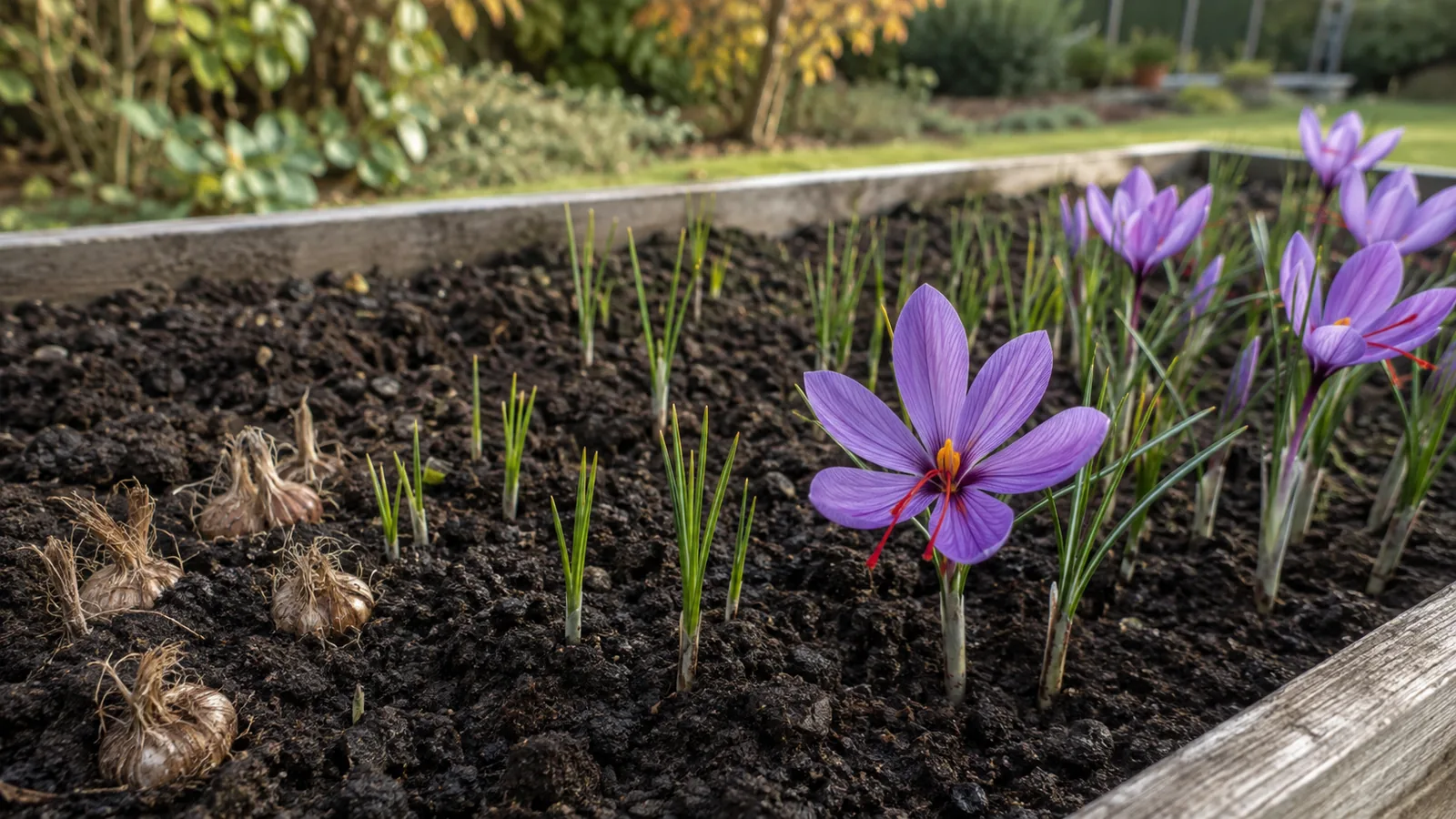
Late Summer: Planting and Root Development
Saffron grows from a corm, a swollen underground stem often casually called a bulb. Plant corms in a bright site with soil that drains freely. Heavy, wet ground is a greater danger than modest dryness because stagnant moisture encourages rot before the plant can establish.
The corm begins rooting underground as conditions change toward autumn. There may be little to see above the soil at first, so repeatedly digging to check it can cause needless damage.
Autumn: When Does Saffron Flower?
Purple flowers emerge in autumn, commonly in October in temperate Northern Hemisphere gardens. Timing shifts with latitude, weather and planting date. Each flower carries three red stigmas, which are the part collected and dried as saffron.
Flowers do not all open at the same moment. During the short bloom, check the bed daily and pick newly opened flowers promptly. Saffron is generally harvested during one flowering period each year rather than as a continuous crop.
Winter to Spring: Leaf Growth
Fine green leaves continue to grow after flowering and remain active through the cooler months. They are feeding the underground corms for the next cycle. Cutting healthy foliage immediately after harvest may reduce the energy available for future growth; leave it in place until it yellows and dies back naturally.
Summer: Dormancy
By late spring or early summer, the foliage disappears and the corm becomes dormant. A bare bed at this stage is normal, not proof that the crop has died. Summer dormancy is also the practical period for lifting, separating and replanting crowded corms where local conditions call for it.
What Temperature Does Saffron Grow In?
There is no single air temperature that makes saffron grow on schedule. The plant follows seasonal changes: warmth and relative dryness during dormancy, cooler conditions that encourage autumn growth, and enough winter light for the leaves. A sunny, well-drained position matters more to a home grower than chasing one precise thermometer reading.
Local climate changes both planting and flowering dates. In very wet regions, a raised bed or container can improve drainage. In unusually severe winters, site selection and appropriate planting depth help protect corms. In warm climates without a distinct seasonal change, flowering may be less predictable.
What Speeds Up or Slows Down Saffron Growth?
- Corm size and condition: large, firm, healthy corms are more likely to flower promptly than small, damaged or desiccated ones.
- Planting date: planting too late gives roots less time to establish before the normal flowering window.
- Drainage: saturated soil can damage corms; a free-draining bed keeps air around the root zone.
- Sunlight: direct sunlight supports leaf growth and the energy stored for the following season.
- Crowding: corms multiply, and an overcrowded bed can produce smaller flowering units and becomes harder to manage.
- Foliage care: allowing leaves to complete their cycle supports replacement corms underground.
The University of Vermont’s North American Center for Saffron provides a detailed saffron production best-practices guide for growers who need deeper guidance on beds, planting material, pests, harvest and post-harvest handling.
Saffron Yield per Plant
A single flower always provides only three stigmas, but a corm may produce more than one flower and its output can change from year to year. For that reason, “yield per plant” is not a fixed number. Corm size, spacing, climate, age and management all affect how many flowers appear.
The harvest also becomes much lighter after the stigmas are dried. Building a meaningful quantity depends on many flowers, careful daily picking and patient expansion of the bed. That labor is one reason the finished spice commands a high price.
When Should You Expect the First Harvest?
Healthy, mature corms planted in late summer may provide a small harvest that autumn. A late planting or smaller corms may produce leaves without many flowers, especially in the first year. That is not necessarily failure; judge the planting across its full seasonal cycle.
For a quick diagnosis, check the basics in order: correct Crocus sativus corms, a suitable planting date, firm planting material, full light and freely draining soil. The related guide on whether saffron is hard to grow covers the practical challenges that matter once the timeline is understood.
How Quickly Does Saffron Grow?
Saffron may bloom roughly six to eight weeks after well-timed late-summer planting, with flowers usually arriving in autumn. First-year flowering can be later or lighter. The complete saffron growth cycle then continues through winter leaves, spring dieback and summer dormancy.
For gardeners, the useful answer is both fast and slow: the first threads can arrive within weeks, while a stronger, self-renewing bed takes several seasons to develop. Protect the leaves, keep the corms out of waterlogged soil and let the plant follow its natural yearly rhythm.