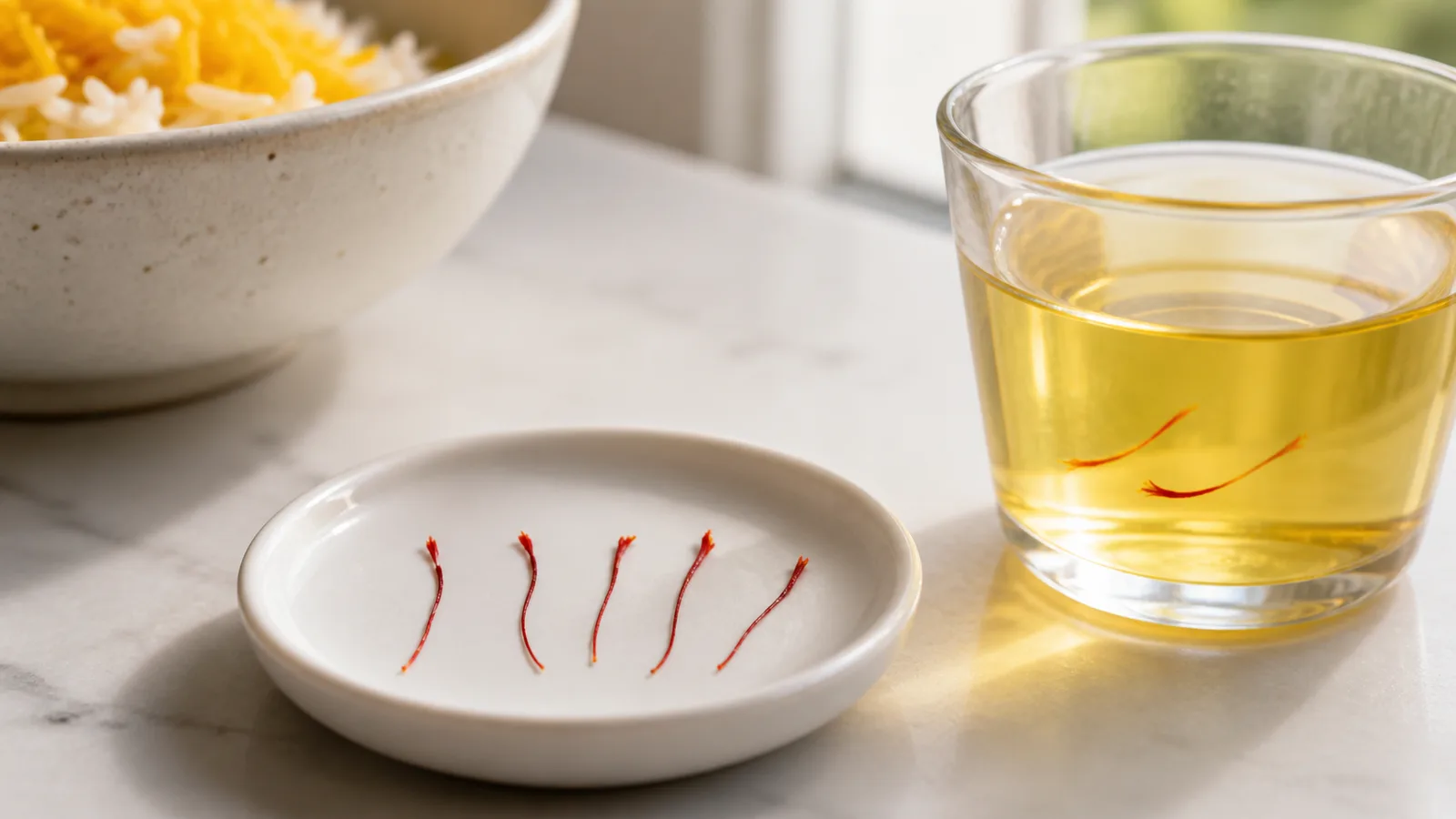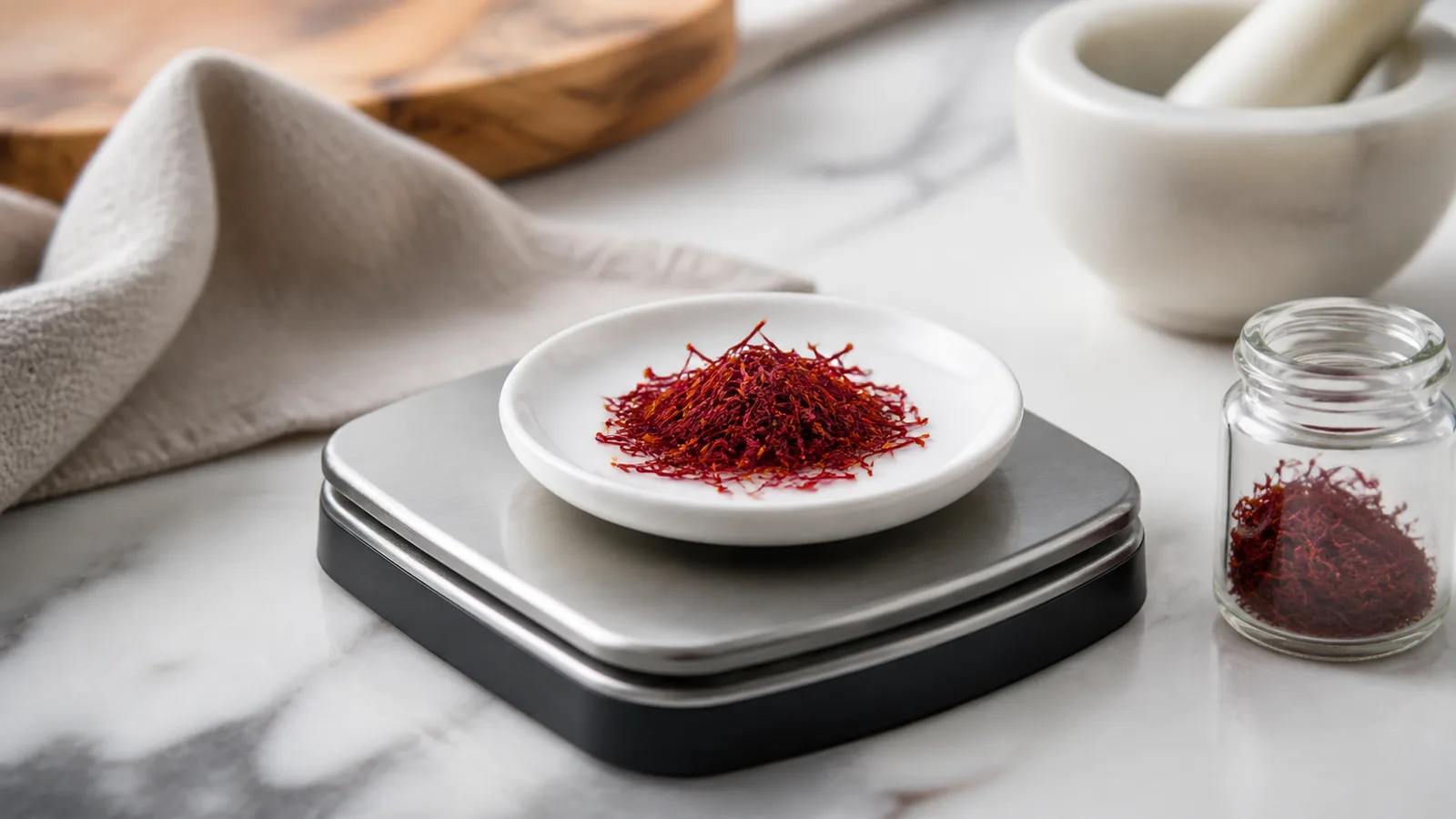
One gram of saffron contains roughly 450 to 500 individual red stigmas, based on the dried stigma weight measured per flower in published field research. You may also see figures around 150 to 200 threads. That lower number can make sense when a seller counts each flower’s three-stigma set, a connected cluster or another heavier piece as one “thread.”
This is the essential point in any saffron weight conversion: weight is precise, but thread terminology is not. A gram always contains 1,000 milligrams. The number of visible pieces can change according to what was counted and how the saffron was processed.
How much saffron is in 1 gram?
Each Crocus sativus flower has three red stigmas. A field study of saffron cultivated at three alpine sites measured about 6.06 to 6.71 milligrams of dried stigma material per flower. Dividing 1,000 milligrams by that range gives approximately 149 to 165 flowers. Multiplying by three produces an estimate of about 447 to 495 individual stigmas.
You can review the measured values in the open-access Agronomy field study. Its results provide a useful evidence-based estimate, not a guarantee for every packet.
Why do thread counts differ?
The word “thread” is used loosely in shops, kitchens and online guides. It may describe:
- one individual red stigma branch;
- all three stigmas from one flower treated as a set;
- two or more branches still connected near the pale style;
- a long intact piece or a short broken fragment;
- a stigma with some yellow style still attached.
This is why the old answer of 150 to 200 threads per gram should not be discarded, but it does need a definition. It is plausible for three-stigma flower sets or relatively heavy clusters. It is too low if every separate red stigma is counted individually.
What changes the number in a real gram?
Length and breakage
Long, intact stigmas create fewer visible pieces than heavily broken saffron. Breakage increases the count without creating more spice. Counting every fragment can therefore make two samples of the same weight look very different.
Attached style
Yellow or pale style adds weight. A gram containing more style may have fewer red stigma branches than a gram made from longer all-red portions.
Moisture and storage
Saffron that absorbs humidity weighs more. Properly dried, well-stored threads are a better basis for comparison. Keep the container airtight, dry and away from heat and light.
Natural flower variation
Flowers and stigmas are biological material, not identical manufactured fibres. Growing conditions, flower size and drying all create normal variation around any average.
Should you count threads or weigh saffron?
Count threads only when a home recipe uses a very small amount and exact repeatability is not critical. A dish for one or two people might begin with several threads, while a family rice dish may use 10 to 15 threads or more according to the recipe and the strength of the batch.
For recipe development, production or any calculation involving fractions of a gram, use a digital scale with 0.01-gram resolution. Place a small cup or weighing paper on the scale, tare it to zero, then add the saffron. Do not put loose threads directly on an unclean platform.
A scale also avoids a common mistake: treating 15 long stigmas as equivalent to 15 short fragments. Weight gives a repeatable amount even when the visible pieces differ.
Useful saffron weight conversions
- 1 gram equals 1,000 milligrams.
- 0.5 gram equals 500 milligrams.
- 0.1 gram equals 100 milligrams.
- 0.01 gram equals 10 milligrams.
These arithmetic conversions are exact. Converting a weight into a thread count is always approximate. It should not be used to translate a capsule or extract dose into culinary strands, because forms and concentrations differ.
How much of a one-gram packet goes into a recipe?
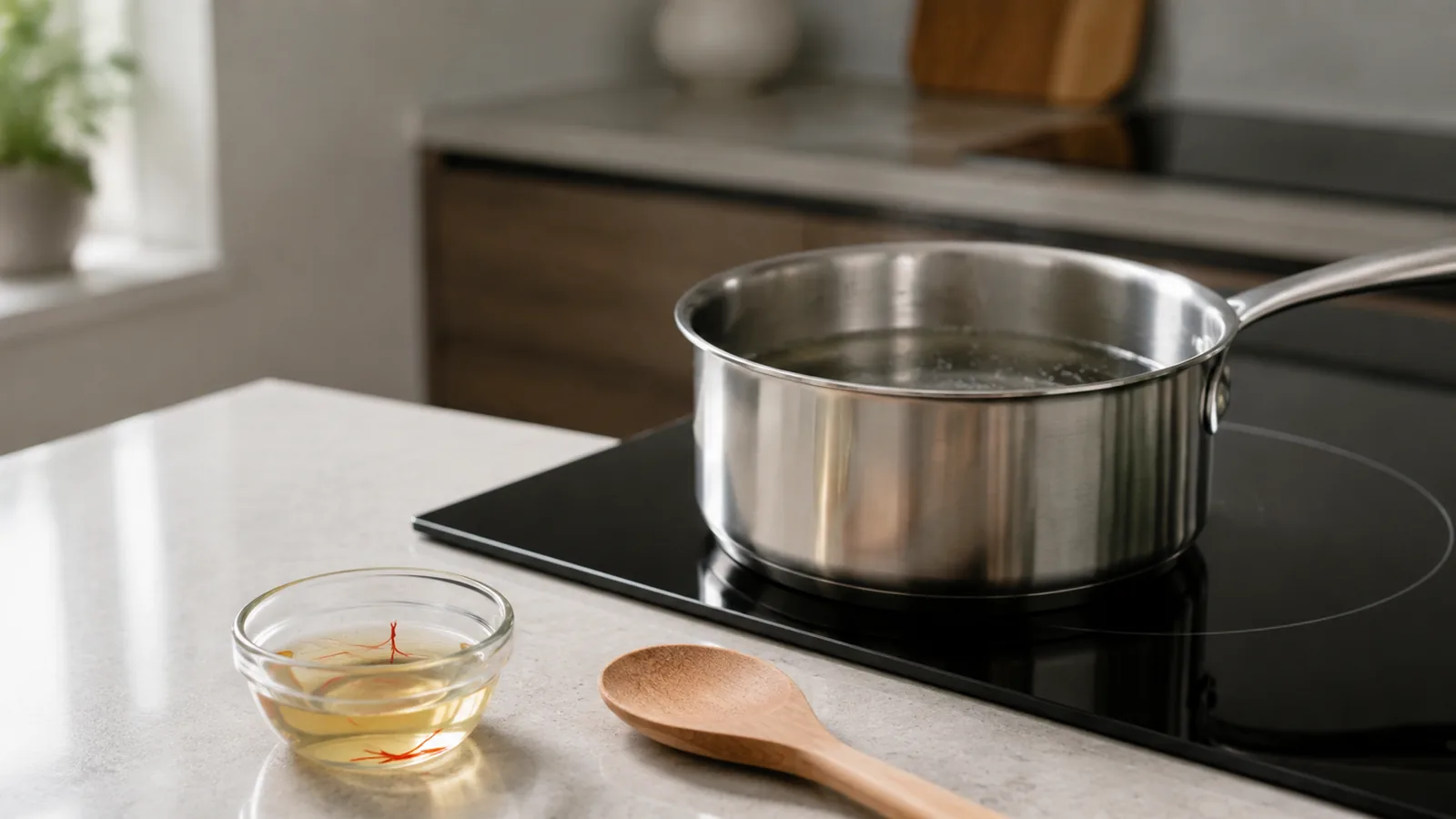
Most household dishes use only a fraction of a one-gram packet. Begin with the amount specified in a trusted recipe or a modest pinch for a family dish. Lightly crush the threads and soak them in warm water, milk or unsalted broth for 10 to 15 minutes. Add both the liquid and softened threads so the aroma and colour spread evenly.
For a small rice dish, the original 10–15-thread example is a cautious starting point, not a rule for every rice variety or serving size. If the flavour is too subtle, adjust the next batch. If it becomes bitter or medicinal, use less.
How long will one gram last?
That depends entirely on your recipes. If each dish uses 0.05 gram, one gram makes about 20 dishes; at 0.1 gram, it makes about ten. Keeping a brief recipe note is more reliable than estimating from the apparent level in a jar.
For a deeper explanation of the competing thread counts, see our guide to how many saffron threads are in one gram. You can also browse our saffron products when choosing a packet for cooking.