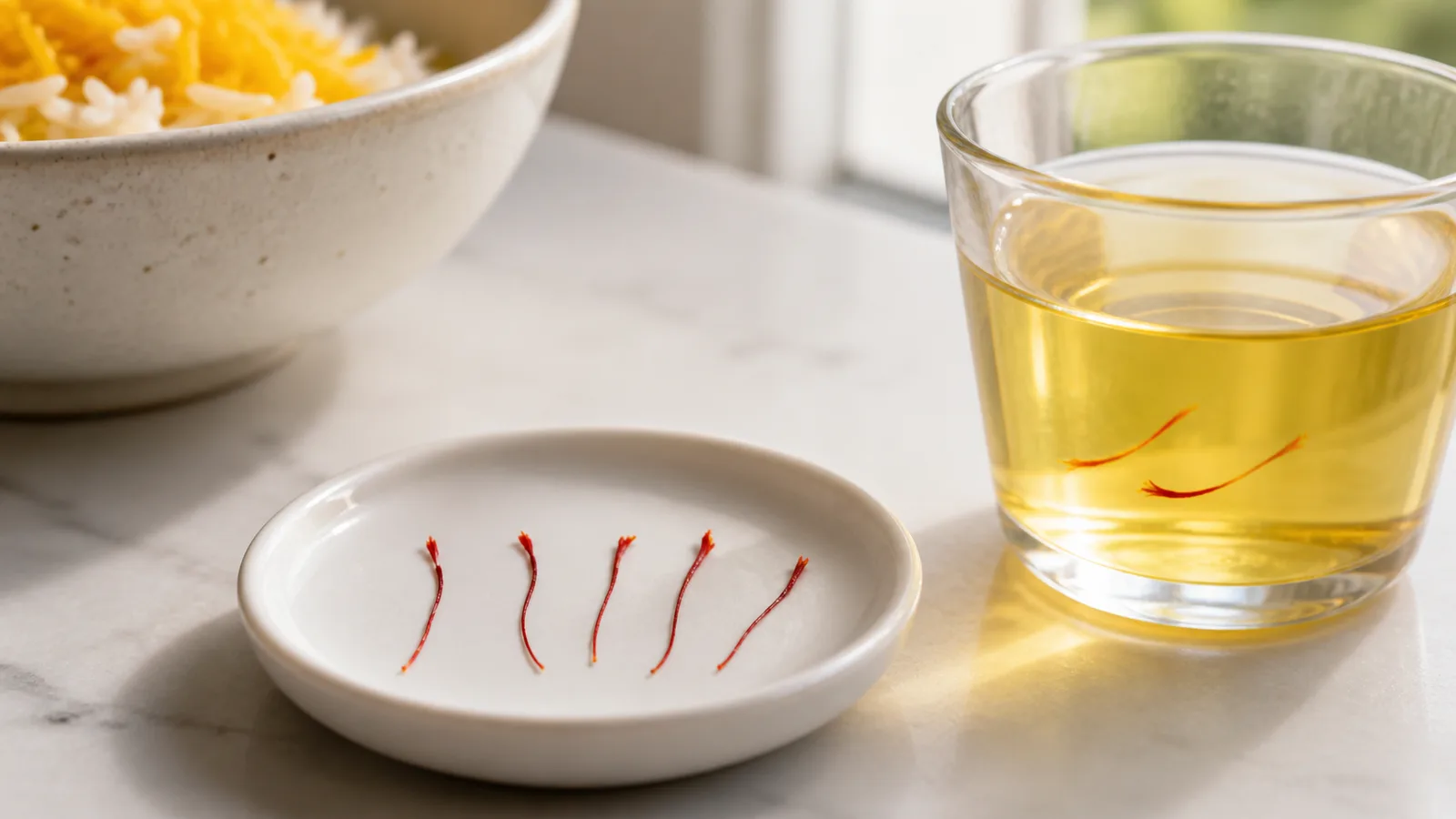
As of 5 September 2026, five grams of culinary saffron in Rowhani’s published range costs from €21.63 for Bunch saffron to €34.11 for Super Negin A. That is about €4.33 to €6.82 per gram; the live product price may change after this review date.
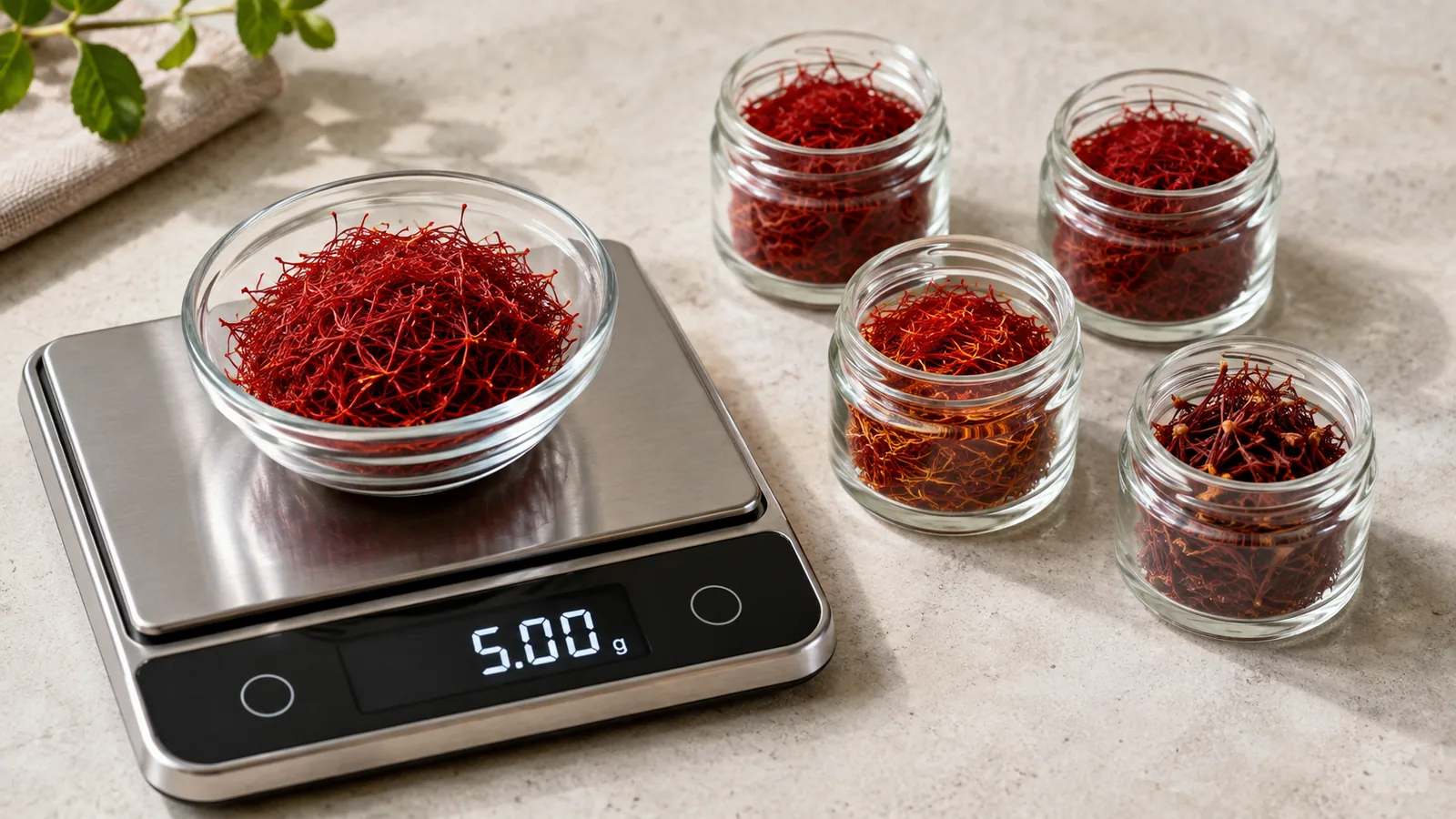
How much is 5 grams of saffron?
There is no single world price for a five-gram pack. The price of 5 grams of saffron depends on the cut, proportion of red stigma to pale style, sensory quality, harvest and drying, origin, testing, packaging and whether the price is retail or wholesale.
For a current Rowhani comparison, the five-gram variants published at the time of review are:
- Bunch saffron: €21.63, or about €4.33 per gram;
- Poushali Saffron B: €24.36, or about €4.87 per gram;
- Sargol saffron: €28.02, or about €5.60 per gram; and
- Super Negin A saffron: €34.11, or about €6.82 per gram.
These are dated examples from this site, not a promise that every seller or future Rowhani price will fall within the same range. Shipping, taxes and currency conversion can change the amount paid at checkout.
Why can two five-gram packs have different prices?
Five grams describes weight, not quality. Saffron is the dried stigma—and, in some recognised styles, a portion of the style—of Crocus sativus. Flowers are harvested and the delicate parts separated before drying. The amount and appearance of the retained flower material affect the commercial cut and the labour needed to prepare it.
The Codex standard for dried saffron recognises filaments, cut filaments and powder. It also sets requirements for characteristic colour, odour and flavour and limits for moisture, foreign matter and defects. That is more meaningful than treating an ornamental package as evidence of quality.
Cut and visible style
Negin and Sargol are red-stigma cuts. Negin generally has longer, intact and separated threads, while Sargol contains red portions that may be shorter or broken. Pushal or Poushali retains a small amount of pale style. Bunch saffron keeps more of the stigma and style together in the traditional form.
A peer-reviewed comparison of Iranian saffron cuts documents these visible differences. It also illustrates an important buying point: a category can describe appearance, but it does not on its own prove freshness, purity or the concentration of aroma and colouring compounds.
Measured quality and freshness
The current ISO 3632-1:2025 specification applies to saffron filaments, cut filaments and powder. Laboratory assessment can support claims about the spice’s physical and chemical condition. Harvest handling, drying, exposure to light, moisture and storage time can still affect one batch differently from another.
A higher price is therefore a reason to ask for better evidence, not evidence by itself.
What is the Iranian saffron price per gram?
“Iranian saffron price” can mean several different markets. A farm-gate price in Iran, a wholesale export or bulk price, a distributor’s price and a small retail pack delivered in Europe are not interchangeable. The currency, cut, grade, order size, packaging, testing, freight and sales taxes all change the result.
The current Rowhani examples above are retail product prices in euros for Iranian saffron cuts. They imply roughly €4.33 to €6.82 per gram for the listed five-gram variants. They should not be described as the general price of saffron in Iran or as a universal Persian saffron price per gram.
Origin names such as Iran or Kashmir can be useful when they are traceable, but origin alone does not set the cost. Two batches from the same region may have different cuts, harvest dates, measured quality and routes to market.
When comparing an Iran saffron price with another offer, put both on the same basis:
- Use the same currency and date.
- Divide the product price by its net saffron weight.
- Compare the same cut and quality evidence.
- Add delivery, tax and payment costs.
- Check whether one quote is wholesale and the other retail.
This prevents a low per-gram headline from hiding a different product or additional costs.
How much does 5 grams of saffron cost in other currencies?
Convert the current euro price at the exchange rate offered by the card provider, bank or payment service when you buy. Exchange rates move, and providers may add a margin. Publishing one permanent dollar, pound or lira figure would soon become misleading.
The durable formula is:
Five-gram local price = current five-gram euro price × current EUR exchange rate
To compare the price of saffron per gram, divide the final amount—including unavoidable delivery or import charges—by five. A Turkish search such as “5 gram safran ne kadar” follows exactly the same method; use the checkout currency and costs rather than an old converted number.
How to judge the quality before buying
Begin with traceability. The pack or listing should identify the product, net weight, business responsible for it and origin. Batch or lot information, a packing or harvest date and a meaningful test report add useful evidence.
Whole threads are easier for a buyer to inspect than powder. Genuine stigmas have a natural shape that widens toward one end; they are not perfectly uniform fibres. Deep red material is typical of red-stigma cuts, but some yellow or pale style is legitimate in Pushal and Bunch saffron. “Bright red, not yellow” is too crude a rule.
Price, aroma and a home water test can reveal warning signs, but none proves authenticity alone. For the limits of kitchen checks and the methods used by laboratories, see our guide to fake and adulterated saffron.
Is buying five grams good value?
Five grams can be a sensible size for a frequent home cook, a keen baker or someone preparing food for a gathering. It may offer a lower price per gram than several tiny packages while remaining manageable to store. For an occasional recipe, however, a smaller pack may keep its aroma better simply because it is opened and finished sooner.
Do not buy a larger amount merely because the unit price is lower. Consider how often saffron is actually used and whether the container will be opened repeatedly. Restaurants and food businesses may use five grams quickly; a household may not.
How to store a five-gram pack
Keep saffron in an airtight container, dry, protected from light and away from heat and strong odours. If it arrives in a clear container, store that container in a dark cupboard or secondary box. Open it briefly, use a dry utensil and close it firmly.
Routine refrigeration is not always helpful because moisture and condensation can become a problem when a cold container is opened. Our storage guide explains when saffron should—and should not—go in the fridge.
What to check before paying
- Confirm that the selected variant really is five grams.
- Read the cut name and understand how much pale style it normally includes.
- Check origin, lot information and the seller’s identity.
- Calculate the final price per gram after delivery and tax.
- Be wary of an implausibly cheap offer or an unexplained “premium” price.
- Buy an amount that can be stored well and used while its sensory quality is good.
The price of 5 grams of saffron is useful only when it is attached to a specific product, date and level of sale. For the Rowhani five-gram cuts reviewed here, the answer is €21.63 to €34.11 as of 5 September 2026. Check the linked product variant for the live price before ordering.