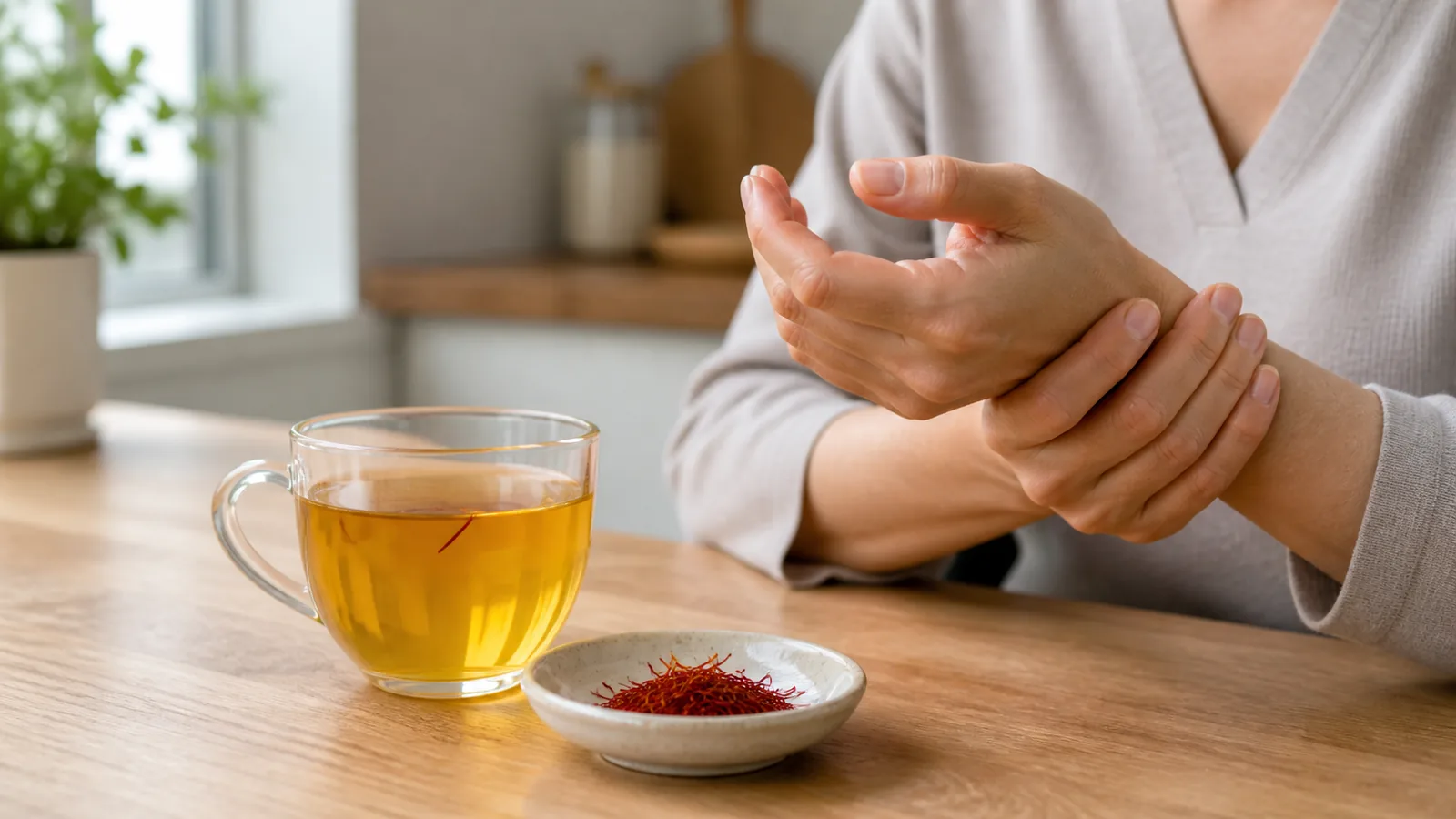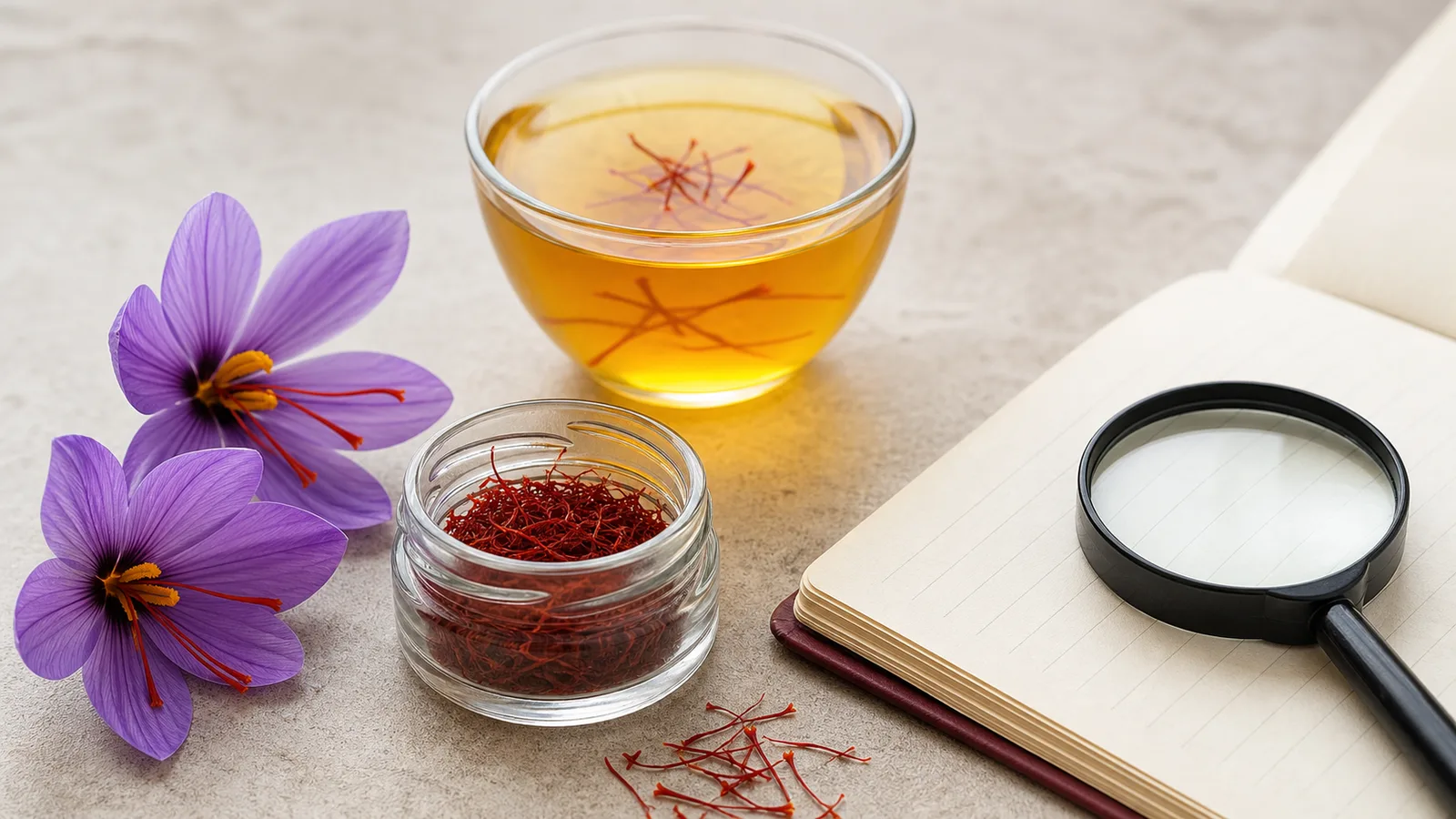
Saffron has medicinal properties worth studying, but it is not a cure-all. Human trials provide promising evidence in a few areas, especially mood and sleep, and early evidence in others. Many popular claims about skin, kidneys, cancer or childhood health come from traditional use, laboratory experiments or simple repetition rather than reliable clinical proof.
The most important distinction is the form. A few threads used in food are not equivalent to a standardised extract in a research capsule. Results from crocin, crocetin or safranal in a laboratory also cannot automatically be applied to a cup of saffron tea.
What gives saffron its biological activity?
The spice is made from the dried red stigmas of Crocus sativus. Crocin contributes much of its golden colour, picrocrocin to its bitter taste and safranal to its aroma. Crocetin is a related carotenoid studied for several possible biological effects.
These compounds can show antioxidant, anti-inflammatory or antimicrobial activity under experimental conditions. Those are mechanisms, not patient outcomes. “Contains antioxidants” does not prove that saffron prevents a disease, detoxifies an organ or replaces established treatment.
Where human research is most promising
Mood, depression and anxiety
Randomised trials and meta-analyses have reported improvements in some depression and anxiety scores compared with placebo. A 2026 GRADE-assessed review of 34 trials found moderate-certainty evidence for reductions in self-reported depression and anxiety measures, but not every clinical scale showed a benefit and results varied substantially between studies.
This makes saffron a possible complementary intervention to discuss with a clinician, not a reason to stop antidepressants, counselling or urgent care. Anyone thinking of self-harm or unable to stay safe needs immediate local emergency or crisis support.
Sleep and insomnia symptoms
Several small trials have tested standardised saffron extracts in adults with poor sleep. Systematic reviews report encouraging changes in sleep quality and duration, although study populations, products and doses differ. The evidence does not support the old promise that saffron syrup “cures insomnia overnight.” Persistent insomnia can have medical, psychological or medication-related causes and deserves proper assessment.
Cognition and Alzheimer’s disease
Small clinical trials, including a 16-week placebo-controlled study in 46 people with mild-to-moderate Alzheimer’s disease, have produced promising results on cognition and memory measures. A broader 2024 neurological review also found favourable signals across cognition and several psychiatric outcomes. These trials are not enough to establish saffron as a treatment for Alzheimer’s disease or dementia, and they do not show that it prevents Parkinson’s disease.
Age-related macular degeneration
A randomised crossover trial in 100 adults with mild-to-moderate age-related macular degeneration found a modest improvement in visual function during short-term saffron supplementation. That is narrower than saying saffron “treats eye diseases.” Sudden vision loss, distortion or new blind spots require urgent eye care; supplements must not delay evidence-based retinal treatment.
Metabolic and heart-related claims
Diabetes and blood glucose
Meta-analyses of trials in people with diabetes or metabolic disorders report small average changes in fasting glucose and HbA1c, while effects on insulin resistance and other measures are inconsistent. A 2025 GRADE-assessed review concluded that observed changes in glucose, liver enzymes and blood pressure were not clinically important. Saffron does not replace diabetes medication, glucose monitoring, food planning or medical review.
The old explanation that manganese in saffron lowers blood sugar was misleading. Culinary portions contribute tiny nutrient amounts, and a nutrient’s presence does not prove a treatment effect. People taking glucose-lowering medicine should discuss concentrated supplements with their clinician because combined effects may alter readings.
Blood pressure, circulation and heart health
Reviews have found small reductions in blood pressure and some blood-lipid measures. The average changes are not a treatment for hypertension, atherosclerosis or heart disease. Nor is saffron established therapy for heart palpitations. Palpitations with chest pain, fainting, severe breathlessness or a sustained abnormal rhythm need urgent assessment.
Claims that saffron works because it contains “high amounts” of potassium, magnesium or iron are also inaccurate at normal culinary intake. It should not be used to treat iron-deficiency anaemia; that requires diagnosis of the cause and an appropriate iron plan.
Weight loss and fatty liver
Some trials report small changes in appetite, waist circumference or body weight, while others find no meaningful change in body mass index. Products, populations and trial quality vary. Saffron is not a stand-alone slimming treatment.
Research on metabolic markers and liver enzymes is preliminary. It does not show that saffron “detoxifies” or cleanses the liver, reverses fatty liver or prevents liver enlargement. Fatty-liver care depends on diagnosis, metabolic risk management and follow-up rather than a detox drink.
Claims that do not have adequate clinical support
Kidney stones and urinary cleansing
There is no dependable human evidence that saffron dissolves or heals kidney stones. Encouraging extra urine is not a safe substitute for knowing a stone’s size, location and composition. Fever, vomiting, reduced urine or severe flank pain needs prompt medical care.
Colds, flu and digestive disease
A hot saffron drink may be pleasant, but it does not cure influenza, a cold or a cough. Saffron is not a rich practical source of vitamin C in culinary portions. Traditional digestive use does not establish treatment for diarrhoea, heartburn, ulcer disease or persistent stomach pain. Those symptoms can have causes that a spice cannot diagnose.
Cancer
Crocin, crocetin and saffron extracts have shown anticancer activity in cell and animal models. Reviews still describe the evidence as a basis for future clinical research, not proof that saffron prevents cancer, stops metastasis or treats a tumour in people. It must never replace screening, oncology care, surgery, radiotherapy or prescribed medicines.
Skin, acne and hair: what the old remedies get wrong
Saffron’s colour and laboratory antioxidant activity have inspired many homemade masks. Good human trials do not establish saffron as a treatment for dark spots, acne, sunburn, baldness or hair loss.
The former page suggested several recipes: saffron with three teaspoons of milk for 15 minutes; saffron with six or seven basil leaves for acne; saffron with one tablespoon of honey for 10 minutes; saffron soaked overnight in full-fat milk after tanning; and a saffron-and-milk scalp mask for 30 minutes. These details are retained here so readers can recognise the claims, not as recommended treatments.
Milk, basil, honey, fragrance compounds and plant material can irritate skin or trigger allergy. Saffron also stains. Do not put a homemade mixture on broken skin, infected acne, an inflamed scalp or a fresh burn. Proven sunscreen, shade and protective clothing prevent ultraviolet injury; severe sunburn or unexplained hair loss needs appropriate care.
Babies and children
The old article recommended small amounts for infant bones, growth, oral health and calmness. Those claims are not supported by good paediatric evidence. Saffron should not be used as a sedative, dental treatment or growth supplement for a baby or child. Infants also should not be given honey before 12 months because of botulism risk.
Culinary use in an age-appropriate family food is a different question from giving tea, syrup, powder or extract for a medical purpose. Parents should ask a paediatric clinician before using any concentrated botanical product.
Saffron safety and pregnancy
Food amounts and medicinal supplementation should be considered separately. A 2026 systematic review covering 102 clinical trials found that saffron preparations were generally tolerated, but adverse events occurred in the evidence base; gastrointestinal problems were the most frequent and were usually mild. Other reviews have reported nausea, dry mouth, headache and reduced appetite. Higher doses or prolonged medicinal use deserve clinical monitoring.
Medicinal quantities should be avoided during pregnancy unless a qualified clinician specifically advises them. The old page warned about miscarriage but gave no usable evidence or safe threshold. For a fuller explanation, read saffron during pregnancy. If too much saffron or extract has been taken, use our saffron-overdose guidance and contact a poison service or urgent clinician rather than waiting for symptoms to pass.
Traditional descriptions such as “warm and dry” belong to a historical medical system. They should not be used to decide who can safely take a supplement or to claim that one body “temperament” makes saffron a weight-loss treatment.
How to read a saffron study
Before applying a headline to yourself, check four details:
- Was the study in people, animals or cells?
- Did it use culinary threads, a defined saffron extract or one isolated compound?
- How many participants were studied, for how long, and against what comparison?
- Was the result a meaningful patient outcome or only a laboratory marker?
The medicinal properties of saffron are a genuine research subject. Respecting that research means keeping its boundaries intact. Promising evidence deserves careful follow-up; it does not need miracle language.
Scientific sources
- Meta-research review and evidence map of saffron health outcomes.
- 2026 GRADE-assessed meta-analysis of saffron for depression and anxiety.
- Systematic review of saffron and sleep quality.
- Systematic review of neurological and psychiatric clinical evidence.
- Randomised trial in age-related macular degeneration.
- GRADE-assessed review in diabetes and prediabetes.
- Review of saffron and crocin research in cancer management.
- Systematic review of adverse events from saffron preparations.