


Exporting 11 tons of saffron to Afghanistan was the headline of an Iranian industry report published in March 2019. The figure came from Ali Hosseini, a member of Iran’s Saffron National Council, who was arguing that delayed customs data made the export market difficult to understand.
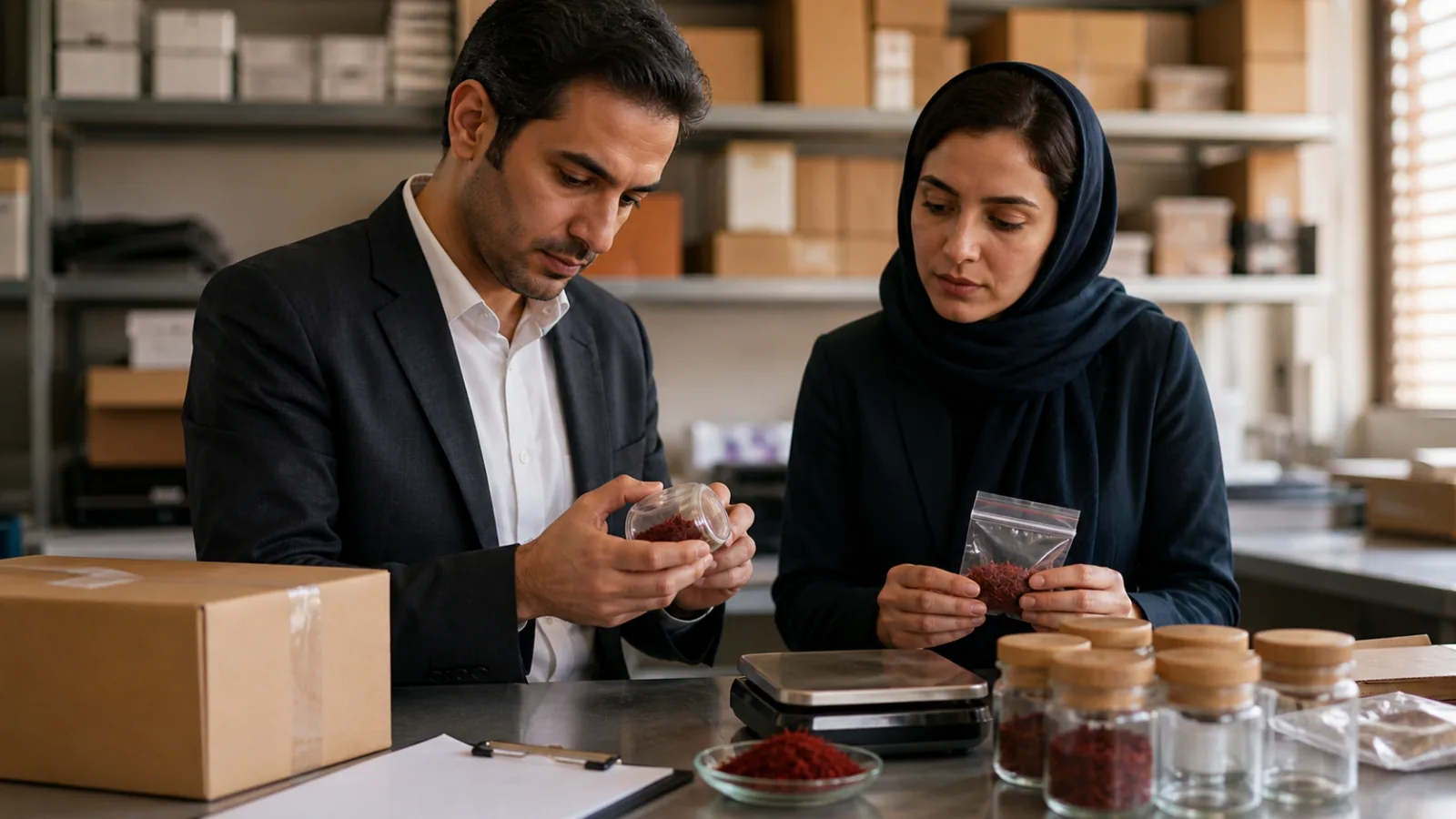
The report matters for a second reason. Iran and Afghanistan are neighbours, but both are saffron-producing countries. A recorded shipment across the border is therefore a trade statistic, not evidence that the receiving country does not grow its own saffron. Production, imports, exports and re-exports answer different questions and should not be mixed together.
What the 11-tonne figure meant
Hosseini said Iran’s official saffron exports to Afghanistan stood at 11 tonnes. He believed the real movement was closer to 14 tonnes once informal trade was considered. The surviving report does not identify the reporting period clearly, provide the underlying customs table or document the additional three tonnes, so 11 tonnes should be retained as an attributed historical figure rather than presented as a current total.
He also complained that the latest national customs release available at the time ran only to November and recorded about 120 tonnes of saffron exports. In his view, a large share of the season’s trade occurred during the following two months. Delayed statistics made it harder for growers and exporters to plan stock, contracts and market timing.
Iran and Afghanistan both produce saffron
Iran is the largest saffron-producing country. The crop has a worldwide reputation and is centred especially in the Khorasan provinces. Afghanistan has a smaller but established industry, with Herat as its best-known production and processing centre. Research has compared saffron grown in districts of Herat with samples from villages around Torbat Heydarieh, confirming that both sides of the border have real production bases.
That distinction helps answer common questions such as “what country is saffron from?” The cultivated saffron plant, Crocus sativus, has a long history across western Asia and the Mediterranean. Today it is grown commercially in several countries. Iran is by far the dominant producer; Afghanistan, India, Greece, Morocco and Spain also produce saffron at smaller scales. A packet’s country of shipment is not necessarily its country of harvest, so origin should be checked on the product documentation.
Saffron production by country is not an export ranking
There is no single, complete, current production table that can safely be reconstructed from customs data. HS code 091020 records cross-border trade in saffron. It does not record flowers harvested on farms, and gross exports can include imported product sent onward.
This is why a country can appear high in an export table despite modest domestic cultivation. Spain, for example, harvested 1.093 tonnes in 2023 according to its agriculture ministry, while reporting more than US$56 million in both saffron imports and exports in 2024. Our analysis of how Spain and the UAE participate in the Iranian saffron value chain explains the processing and re-export role in more detail.
Afghanistan’s trade also needs careful reading. Partner-country records compiled by World Bank WITS show Iran reporting 5,968 kilograms of saffron exports to Afghanistan in 2022. The same database shows other countries reporting imports from Afghanistan in 2023. These flows can coexist because Afghanistan grows, imports and exports saffron, and because partner reports do not always reconcile perfectly.
Why customs timing mattered to Iranian exporters
Saffron is harvested in a short seasonal window, while sales continue throughout the year. An exporter deciding whether to hold stock, accept a contract or enter a new market needs to know how much product has already left the country, where it went and at what declared value. A report several months late can turn market planning into guesswork.
Hosseini said the lack of timely statistics made export planning almost impossible. He also argued that informal border movements made official figures incomplete, suggesting that Afghanistan received two to three times the recorded amount in some periods. The article gives no border-seizure, survey or mirror-trade evidence for that multiplier. It is best understood as his warning about data quality, not a measured constant.
Modern analysis can reduce some of that uncertainty by comparing:
- Iran’s reported exports to Afghanistan;
- Afghanistan’s reported imports from Iran;
- other countries’ reported imports from Afghanistan;
- shipment dates, values, quantities and the customs classification used;
- production estimates from agricultural authorities rather than trade databases.
Differences are a reason to investigate definitions and reporting coverage. They are not, by themselves, proof of smuggling or false origin.
The price sentence in the old report cannot be repaired safely
The final line of the original English translation appears to combine a six-kilogram quantity, a domestic figure of “10.5 million” and a foreign-market range of “700–110 Euro.” It does not identify the currency behind 10.5 million, and the euro range may have been reversed or mistranslated. The units and order are damaged, and no source table survives in the post. Any attempt to turn that fragment into a per-kilogram price would invent information.
A usable historical price needs four things: the date, currency, weight unit and grade or quality basis. For international comparisons it should also identify whether the value is farm-gate, wholesale, customs or retail. Without those details, the honest editorial choice is to preserve the existence of the price discussion while declining to quote a corrected number.
What a transparent Iran–Afghanistan saffron trade needs
Timely customs publication is only the first step. Each commercial lot should retain its country of harvest, producer or aggregator, harvest season, batch number, laboratory result and chain of custody. A buyer then has evidence for origin and quality rather than relying on the country from which the final parcel was dispatched.
Clear records protect both industries. Afghan growers should receive credit for saffron genuinely grown and processed in Afghanistan. Iranian growers should not lose the identity of their crop when it crosses a border. Traders can still combine logistics and reach new customers, but the product story should remain traceable.
The 11-tonne headline is therefore a snapshot, not a timeless market size. Its lasting lesson is that export decisions become risky when official data arrive late, informal flows are guessed rather than measured, and production is confused with trade.
Sources
- The 2019 statements attributed to Saffron National Council member Ali Hosseini and preserved in this post.
- FAO in Iran: Iran at a glance and internationally recognised agricultural products.
- FAO AGRIS: comparison of saffron quality in Herat, Afghanistan and Torbat Heydarieh, Iran.
- World Bank WITS/UN Comtrade: reported saffron exports to Afghanistan in 2022.
- World Bank WITS/UN Comtrade: reported imports of saffron from Afghanistan in 2023.

![Exporting Saffron to Turkey + Price Guide [Complete 0 to 100]](https://img.rowhanisaffron.com/20260827003933/saffron-export-turkey-quality-inspection.webp)



