


Spain and UAE profitable with Iranian saffron is an awkwardly translated headline, but the question behind it remains important: why can more of saffron’s final value stay with processors and traders than with the people who grow it?
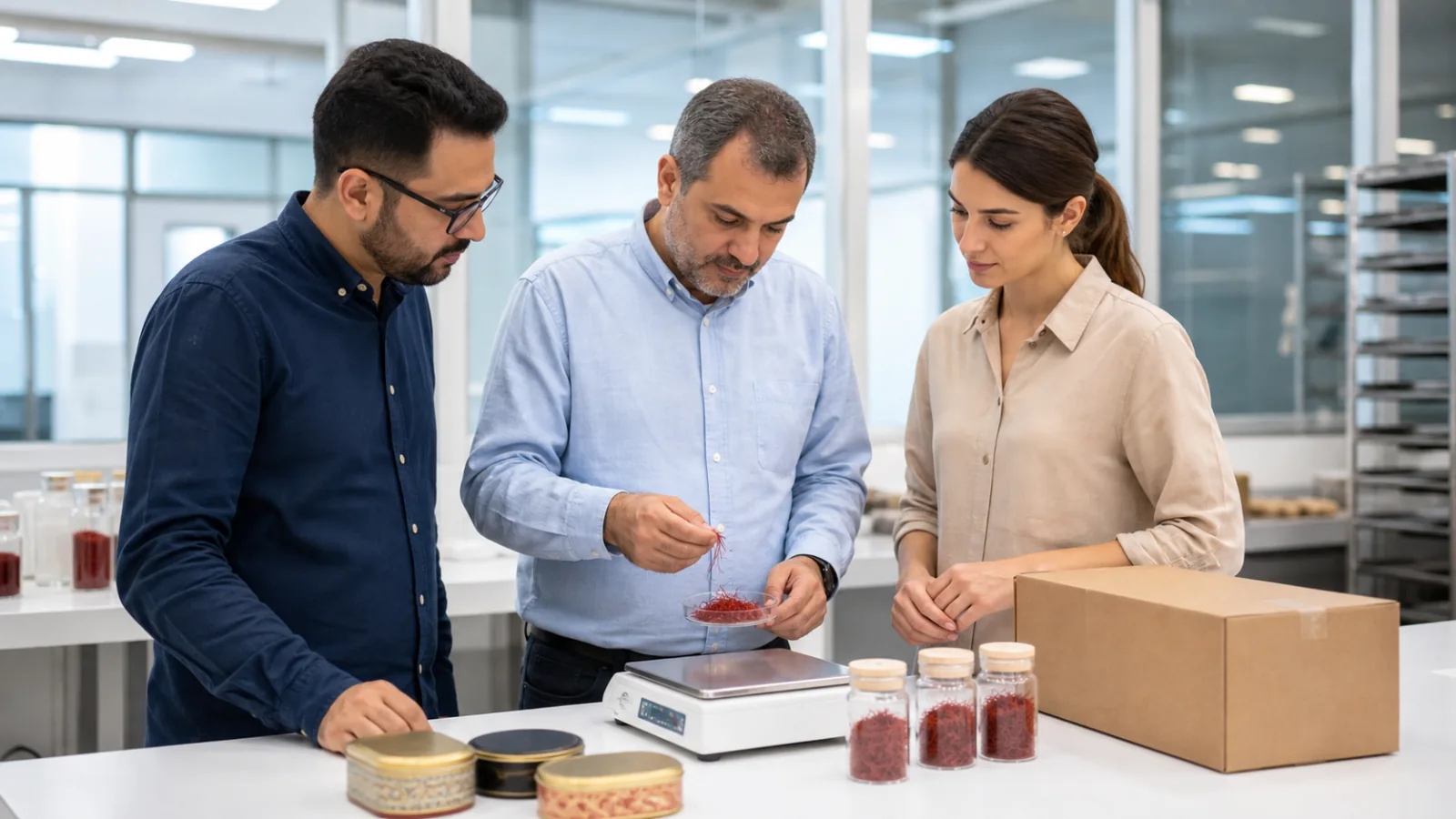
The short answer is that harvest volume and market value are not the same thing. Iran supplies raw saffron at scale, while other countries may earn from testing, sorting, packaging, distribution and long-standing buyer relationships. Spain illustrates the difference clearly. Its agriculture ministry recorded just 1,093 kilograms—1.093 tonnes—of harvested saffron in 2023, yet World Bank WITS data show Spain reporting more than US$56 million in saffron imports and a similar value in exports in 2024.
Those figures do not prove that every Spanish shipment began in Iran, nor do they establish misconduct. They show that Spain functions as a substantial saffron trading and processing centre despite modest domestic production. That is the value-chain lesson Iranian growers and exporters can use.
The Iranian export figures behind the original report
This article began as a 2018 industry report. Mahmoud Bazari—rendered “Bazarry” in the old English translation and then serving in Iran’s agricultural export administration—said Iran had exported 206 tonnes of saffron worth US$286 million in the previous year. He also reported 170 tonnes worth US$250 million during the first eight months of Iranian year 1397, roughly March to November 2018.
The same report described Iran as supplying 96% of the world’s saffron. That should be read as an estimate quoted at the time, not a permanent market share. Production changes from season to season, countries report trade unevenly, and customs exports can include re-exports.
Where the value of saffron is added
Fatemeh Rastgaripour, an agricultural economist associated with saffron research in Torbat Heydarieh, divided the chain into processing, export and production. Her ordering was deliberate. Once the flower has been picked and the stigmas dried, the product can still gain—or lose—considerable value before it reaches a customer.
Processing includes consistent grading, contamination controls, documented lot identity and packaging suited to the buyer. Export adds market knowledge, dependable delivery, contracts, customer service and a reputation that can survive one season’s price movement. Production remains fundamental, but growers capture less of the final price when the later stages are handled elsewhere.
Rastgaripour’s concern was not simply that Iranian saffron lacked an attractive box. She pointed to fragmented buying and distribution, weak coordination among growers, traders and packers, shortages of trained marketing staff, limited access to suitable machinery and packaging materials, and too little information about what different markets expected.
Spain’s production is not the same as Spain’s saffron trade
The query “Spain saffron production tonnes” deserves a direct answer. Spain’s official 2023 total was 1.119 tonnes of biological production and 1.093 tonnes actually harvested from 190 hectares. The figures are explicitly reported in kilograms in the Spanish Ministry of Agriculture’s 2024 statistical yearbook.
Customs data describe a different part of the market. Under HS code 091020, Spain reported saffron exports valued at US$56.22 million in 2024 and imports valued at US$56.34 million. Importing and exporting at that scale while harvesting about a tonne domestically points to an active processing, distribution and re-export role.
The original Iranian report alleged that bulk Iranian saffron was repacked, sometimes blended, and sold from Spain under Spanish presentation. Current trade totals cannot verify that allegation or identify the origin of a particular retail pack. A customs record shows the reporting country, trade partner, value and sometimes quantity; it does not reveal the farm, the contents of a blend or whether an origin statement is lawful. Product-specific claims require traceability documents and laboratory evidence.
What the UAE’s role can and cannot tell us
The United Arab Emirates is a regional logistics and trading hub. The 2018 report said some Iranian saffron was sold there through brokers on short buying cycles and then distributed to Gulf, African and Chinese markets. It also raised concerns about impurities and misuse of Iranian packaging or standards marks.
Those are serious claims, and the old article supplied no inspection records, named cases or laboratory results to substantiate them. They should therefore remain attributed concerns from that historical report, not statements about all UAE traders. UAE customs reporting from 2021 nevertheless confirms that the country participated materially in the saffron trade, reporting about US$10.29 million in exports under HS 091020. That supports the description of a trading hub, not the allegations about individual shipments.
Anyone assessing a suspect lot should look for a purchase trail, country-of-harvest declaration, batch identity, test certificate and intact packaging records. Colour or aroma alone cannot establish origin or prove adulteration.
How more value can stay with Iranian producers
A better response is not to treat every intermediary as a problem. Traders, laboratories, packers and distributors perform useful work. The commercial question is whether Iranian businesses can perform more of that work reliably and be paid for it.
- Preserve identity from field to lot. Grower, harvest date, drying method, grade and laboratory result should travel with the product rather than disappear at the first bulk sale.
- Use measurable quality terms. Contracts should state the agreed grade, moisture and analytical requirements. The Codex saffron standard provides common definitions and quality parameters for dried stigmas and styles.
- Aggregate without erasing provenance. Cooperatives can combine small quantities for testing, storage and negotiation while keeping records for each contributing farm.
- Match packaging to the market. A food manufacturer may want sealed bulk packs and detailed certificates; a retail customer needs a protected small pack, clear origin information and instructions for storage and use.
- Build direct buyer knowledge. Repeat relationships reveal which grades, pack sizes and delivery schedules buyers will actually pay for. They also reduce reliance on opportunistic brokers.
These steps address several production-side problems recorded in the old report. It mentioned illicit movement of saffron corms, growers working individually, weak cooperative participation, reluctance to invest and pressure on cultivated area and output. Better coordination cannot solve every farm constraint, but it can make quality visible and strengthen a grower’s position in the chain.
Iran’s commodity-exchange and warehouse-receipt work offers another route to documented trade. Our review of Iranian saffron’s market and export position explains why transparent specifications and delivery records matter alongside headline export volume.
How to read saffron trade rankings carefully
A country shown near the top of an export table is not necessarily the largest grower. Gross exports can include products imported earlier, and an EU aggregate can overlap with member-country figures. Missing reporters also make a “world ranking” incomplete. Quantity fields occasionally contain reporting or unit anomalies, so value and weight should be checked against the source rather than converted into confident yield claims.
The safest conclusion is narrower and more useful. Iran’s growing regions create the essential agricultural product, but final value also follows verification, presentation, logistics and trust. Spain and the UAE demonstrate how trading centres can participate far beyond their own fields. Iranian producers retain more value when their saffron reaches buyers with its origin, quality and commercial identity still intact.
Sources
- The 2018 statements by Mahmoud Bazari and Fatemeh Rastgaripour preserved in this post.
- Spanish Ministry of Agriculture, Fisheries and Food: 2024 Statistical Yearbook, crop-area and production tables.
- World Bank WITS/UN Comtrade: saffron exports reported for 2024.
- World Bank WITS/UN Comtrade: saffron imports reported for 2024.
- World Bank WITS/UN Comtrade: UAE saffron exports reported for 2021.
- Codex Alimentarius CXS 351-2022: Standard for Dried Floral Parts—Saffron.

![Exporting Saffron to Turkey + Price Guide [Complete 0 to 100]](https://img.rowhanisaffron.com/20260827003933/saffron-export-turkey-quality-inspection.webp)



