


The commercialization of a Saffron Harvesting Machine in Torbat Heydarieh Azad University began with an encouraging university decision in 2019. A machine developed through the university’s knowledge-based and innovation-growth programme was selected as a leading agricultural product, and the team was instructed to take it through the formal commercialisation process.
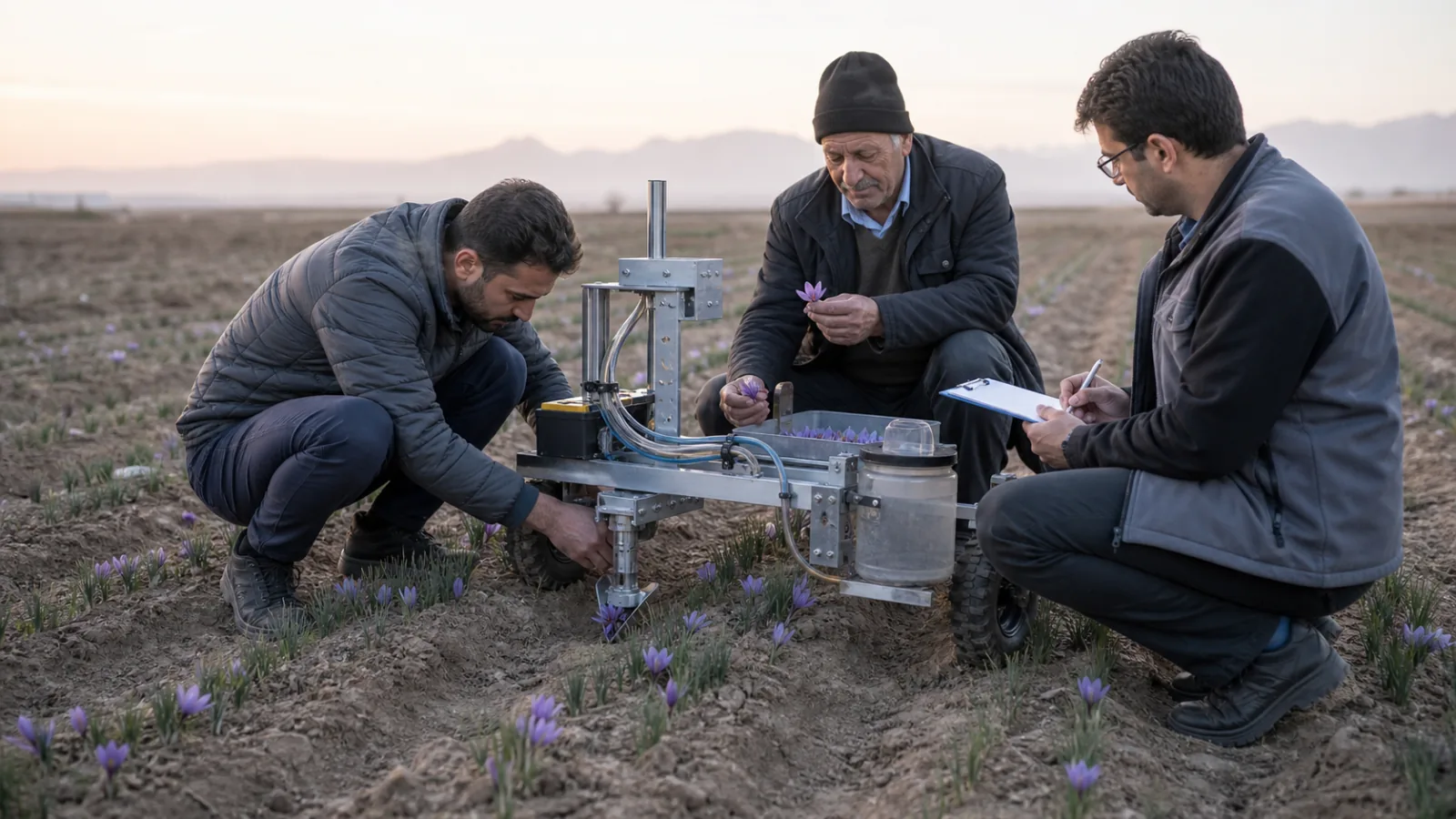
That was a meaningful step, but it was not the same as a market launch. The surviving announcement contains no engineering specification, field-test result, price, production date or evidence that farmers could buy the machine. Those are the questions that must be answered before an award-winning prototype becomes dependable harvest equipment.
What the Torbat Heydarieh announcement said
The saffron harvesting machine came from the knowledge-based companies and the Centre for Growth, Innovation and Acceleration of New Ideas at Islamic Azad University, Torbat Heydarieh. It was presented at the university’s second Fan Bazaar, an event focused on agriculture and natural resources at Tehran’s Permanent Exhibition of Knowledge Economy.
The old translation says the machine “ranked second.” The quoted letter is more precise: it was selected as one of the event’s superior products. The exhibition ran from 13 to 15 Esfand 1397, equivalent to 4–6 March 2019—not 13–15 March.
Najafi, identified in the report as the university’s Director General of Knowledge-Based Economic Affairs and Investment, congratulated the Torbat Heydarieh team and asked that the saffron harvesting machine proceed through commercialisation under university regulations.
An instruction to commercialise is a beginning
Commercialisation usually starts after a promising technical result. The next work is less ceremonial: define the machine, repeat its performance, resolve safety and maintenance problems, establish manufacturing cost and prove that the product solves a farmer’s problem better than the available alternatives.
The 2019 letter did not say whether this machine cut flowers, detached them, lifted them with suction or performed a post-harvest operation. It also did not say whether the system was hand-held, tractor-mounted or autonomous. Calling it a saffron harvester should therefore preserve the project’s name without inventing a design.
Why saffron flower harvesting is difficult to mechanise
Saffron flowers are small, close to the ground and surrounded by narrow leaves. They do not all emerge at the same height or open on the same day. Soil clods, slope, row spacing and morning light change what a camera or mechanical guide encounters. A picker must collect the flower without bringing excessive soil into the batch or damaging leaves and corms needed for the next season.
Published engineering work shows the gap between a concept and a reliable field machine. A 2006 study described a mechanical device that cut and collected saffron flowers and included field tests. Later research on a low-cost semi-automatic gripper reported a proof-of-concept prototype and preliminary field validation, while explicitly leaving design optimisation for future work.
There is also a separate automation problem after picking. A 2009 system used computer vision to find a cutting point and remove the stigma from an individual flower. That is processing, not field harvesting. Combining the two stages in one headline can make a machine sound more complete than it is.
What field evidence a commercial machine needs
A useful trial should compare the machine with trained hand pickers on the same fields and mornings. At minimum, it should report:
- flowers collected per hour and the percentage of available flowers recovered;
- missed, cut, crushed or contaminated flowers;
- damage to leaves, soil surface and future corm performance;
- results across closed, partly open and open flowers at different heights;
- performance on uneven ground and with different row spacing;
- operator time, energy use, cleaning, stoppages and maintenance;
- the time from collection to stigma separation and controlled drying.
A single success percentage is not enough unless the denominator and failure types are visible. A machine that moves quickly but leaves many flowers behind may not help during a short harvest window. One that collects more flowers but mixes in soil or bruises them can shift labour and loss into the processing room.
Commercial questions for growers and manufacturers
Torbat Heydarieh is an appropriate place to test saffron equipment because farms and skilled harvest workers can expose the machine to real conditions. Farmers should be involved before the design is frozen. Row widths, plot size, terrain and access differ, and a machine suited to a research plot may not fit a small family field.
The business case should include purchase or rental price, daily capacity, number of harvest days, operators, spare parts, transport, fuel or batteries, cleaning and expected service life. It also needs a repair path close to the growing region. A lower purchase price has little value if a failed part stops the machine during peak flowering.
Manufacturers must decide whether the machine replaces labour or assists it. A semi-automatic device that reduces bending, carries flowers gently or helps a picker move faster may reach farms sooner than a fully autonomous robot. Our broader review of why saffron harvest mechanisation needs field testing explains that staged approach.
What would show that commercialisation succeeded?
The 2019 recognition should be recorded for what it was: an institutional endorsement and an order to begin the next stage. Evidence of successful commercialisation would be different. It would include a stable production model, documented safety and performance, repeated tests on growers’ fields, support and spare parts, a transparent price and farmers who continue using the machine after the trial.
Without those records, it is safest to describe the Torbat Heydarieh saffron harvesting machine as a promising university project selected for commercialisation—not as a proven product already adopted by the industry.
Sources
- The 2019 Islamic Azad University selection letter preserved in this post.
- Applied Engineering in Agriculture: mechanical device for harvesting saffron flowers.
- Machines: low-cost semi-automatic saffron harvesting proof of concept.
- Biosystems Engineering: automated cutting system for stigma separation.

![Exporting Saffron to Turkey + Price Guide [Complete 0 to 100]](https://img.rowhanisaffron.com/20260827003933/saffron-export-turkey-quality-inspection.webp)



