


Holding greenhouse saffron cultivation workshop in Mahabad was announced as a two-day introduction to aeroponic growing at Islamic Azad University, Mahabad. The event brought an unfamiliar system into a region where employment and water use around the Lake Urmia basin were already serious concerns.
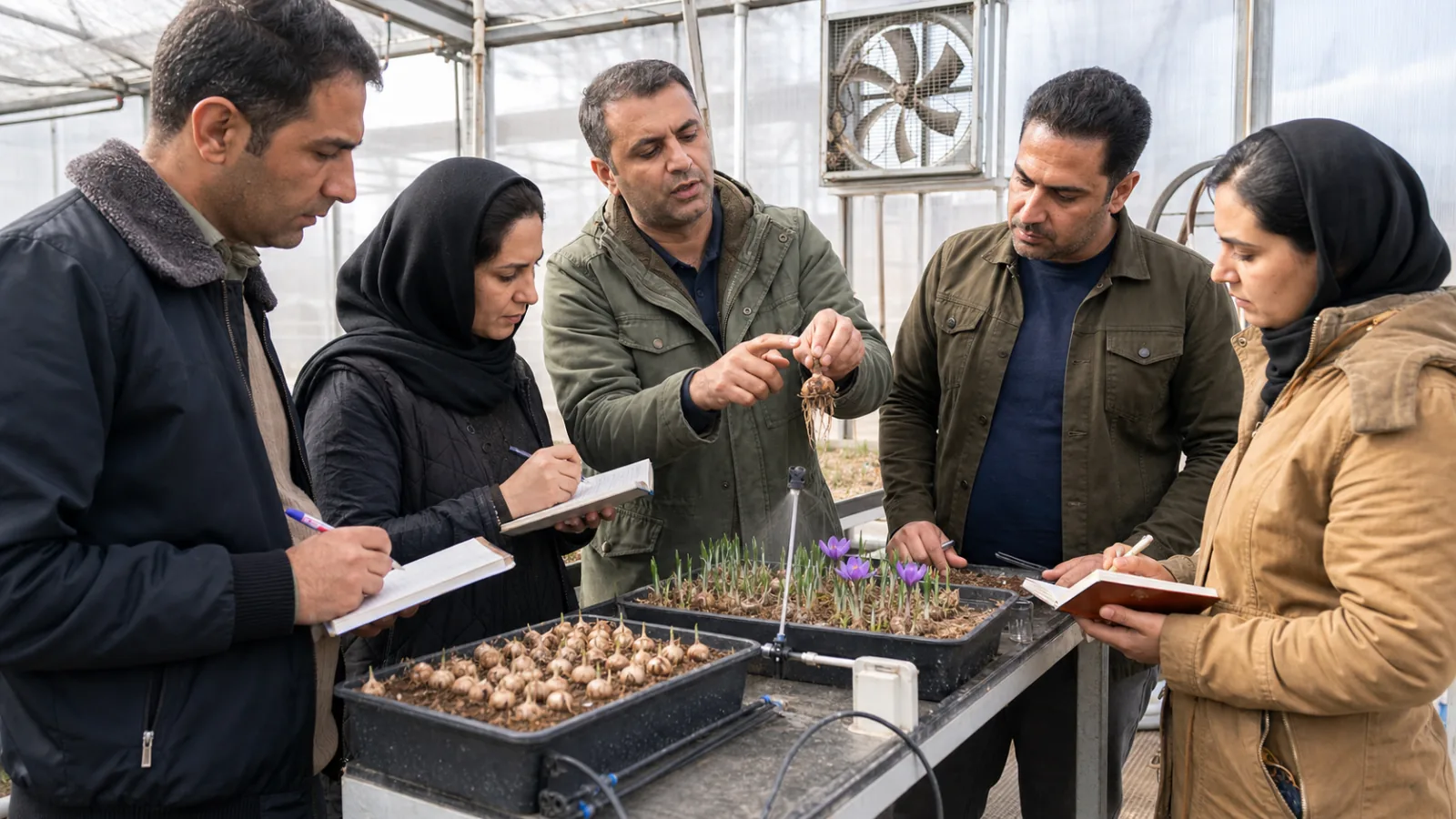
The workshop was a useful starting point, but its promotional yield figures should not be mistaken for results from an independently measured Mahabad crop. Modern greenhouse research shows that saffron can flower under controlled conditions. It also shows why corm density, water, climate control, disease management and full-cycle corm health have to be measured together.
What the Mahabad workshop announced
Organiser Loghman Kohistani described the course as the first greenhouse saffron workshop of its kind at the university. It was scheduled for 14 and 15 Esfand 1397—5 and 6 March 2019—rather than 14 and 15 March, as the old English translation stated.
The programme was organised with the Mahabad offices of Agricultural Jihad and Islamic Azad University. Its stated aims were to support employment, draw attention to protected crops and respond to policies intended to reduce agricultural water demand in the Lake Urmia basin.
Participants were promised theoretical and practical instruction in planting and harvesting saffron using an aeroponic, or “air culture,” method. The archived translation calls it an “Irish” method; that is a translation error, not a separate cultivation system.
Aeroponic does not mean “without water”
Aeroponics holds roots or corms without ordinary field soil and supplies water and nutrients in a controlled mist or spray. Hydroponic systems use a water-based nutrient solution, sometimes with an inert growing medium. Neither method eliminates water. Their potential advantage is control: water can be delivered where and when the plant needs it, with less uncontrolled loss than some field systems.
That control requires equipment and supervision. Pumps, nozzles, timers, tanks, sanitation and backup power all matter. Water quality, nutrient concentration, temperature, humidity and airflow have to be monitored. A failed pump or poorly cleaned system can affect many closely spaced corms at once.
A 2022 peer-reviewed hydroponic study developed a saffron-specific controlled protocol over two crop years. The researchers changed light, temperature, photoperiod and irrigation, then assessed both yield and saffron composition. That is a much higher evidence standard than counting flowers from one promotional demonstration.
What the workshop claimed about space and yield
The workshop advertisement proposed using seven tiers to turn about 30 square metres of floor into roughly 200 square metres of growing surface. It also suggested that unused poultry or dairy buildings, plastic greenhouses, halls, parking areas and rooftops could be adapted.
The stored post claims about 600 corms per square metre and 20–60 grams of saffron, compared with fewer than 80 corms and about 3 grams in field cultivation. A surviving Persian notice phrases the projection differently: 2–5 kilograms of dried saffron from one tonne of 30-gram corms. These were course-promoter claims. The notice does not provide a trial design, harvest records, dry-weight method, quality analysis or independent verification, so the figures should not be used as a business forecast.
For comparison, a 2025 controlled greenhouse experiment tested 67, 100 and 200 corms per square metre in soil beds. Higher density increased dry stigma yield per square metre, but reduced performance per plant and the size of replacement corms. The researchers recommended 100 corms per square metre at 8 cm depth as the best balance in their cooled Saudi greenhouse—not 600 corms as a universal rule.
The two studies used different systems and climates, so neither supplies a guaranteed Mahabad yield. Together they make the important point: more corms and more shelf area do not automatically mean proportionally more saleable saffron.
Can an unused building or rooftop become a saffron unit?
Possibly, but “unused” is not the same as suitable. A former livestock building may carry sanitation, pest and ventilation problems. A parking structure may lack temperature control, cleanable surfaces or reliable water and drainage. A rooftop introduces structural load, weatherproofing, wind, heat and access questions.
Before any conversion, the operator should confirm:
- legal permission, structural capacity and safe access;
- temperature, humidity, airflow and light control across every tier;
- clean water, drainage, food-hygiene surfaces and pest exclusion;
- a backup plan for pumps, ventilation and electricity;
- space for flower handling, stigma separation and controlled drying;
- a safe plan for corm rooting, leaf growth and daughter-corm development after flowering.
A system designed only to force one flowering event may draw on reserves already stored in the corm. Its economics can look attractive until the cost of replacement corms and the next growth cycle is included.
Harvest can be daily, but not careless
Kohistani presented daily access to flowers as an advantage over field cultivation. A controlled unit can make inspection and picking easier, and shelter removes some weather disruption. The claim that flowers can be harvested “at any time of day,” however, should not imply that timing and handling no longer matter.
Flowers still need frequent picking, prompt stigma separation and consistent drying. Labour, cleanliness and the interval between opening and processing affect the usable product. A greenhouse changes the working environment; it does not remove the post-harvest discipline saffron requires.
How to evaluate a greenhouse saffron proposal
A small pilot should record corm source, corm weight, density, growing area on every tier, electricity and water use, labour hours, flower count, dried stigma weight, laboratory quality and the number and weight of healthy replacement corms. Yield should be reported both per square metre of growing surface and per kilogram of corms. Reporting only the building’s floor area makes a multi-tier result look larger without showing the real biological efficiency.
Costs need the same care. Corms, racks, climate equipment, nutrient delivery, sanitation, energy, labour, drying, testing and product losses all belong in the calculation. Compare the complete cycle with a realistic field alternative, using our saffron cultivation checklist for the field-side requirements.
The Mahabad workshop helped introduce growers to a legitimate area of experimentation. Its strongest lesson is the value of practical training. The next step is not to repeat the most optimistic density or yield claim; it is to test a complete system under Mahabad conditions and publish measurements that another grower can reproduce.

![Exporting Saffron to Turkey + Price Guide [Complete 0 to 100]](https://img.rowhanisaffron.com/20260827003933/saffron-export-turkey-quality-inspection.webp)



