


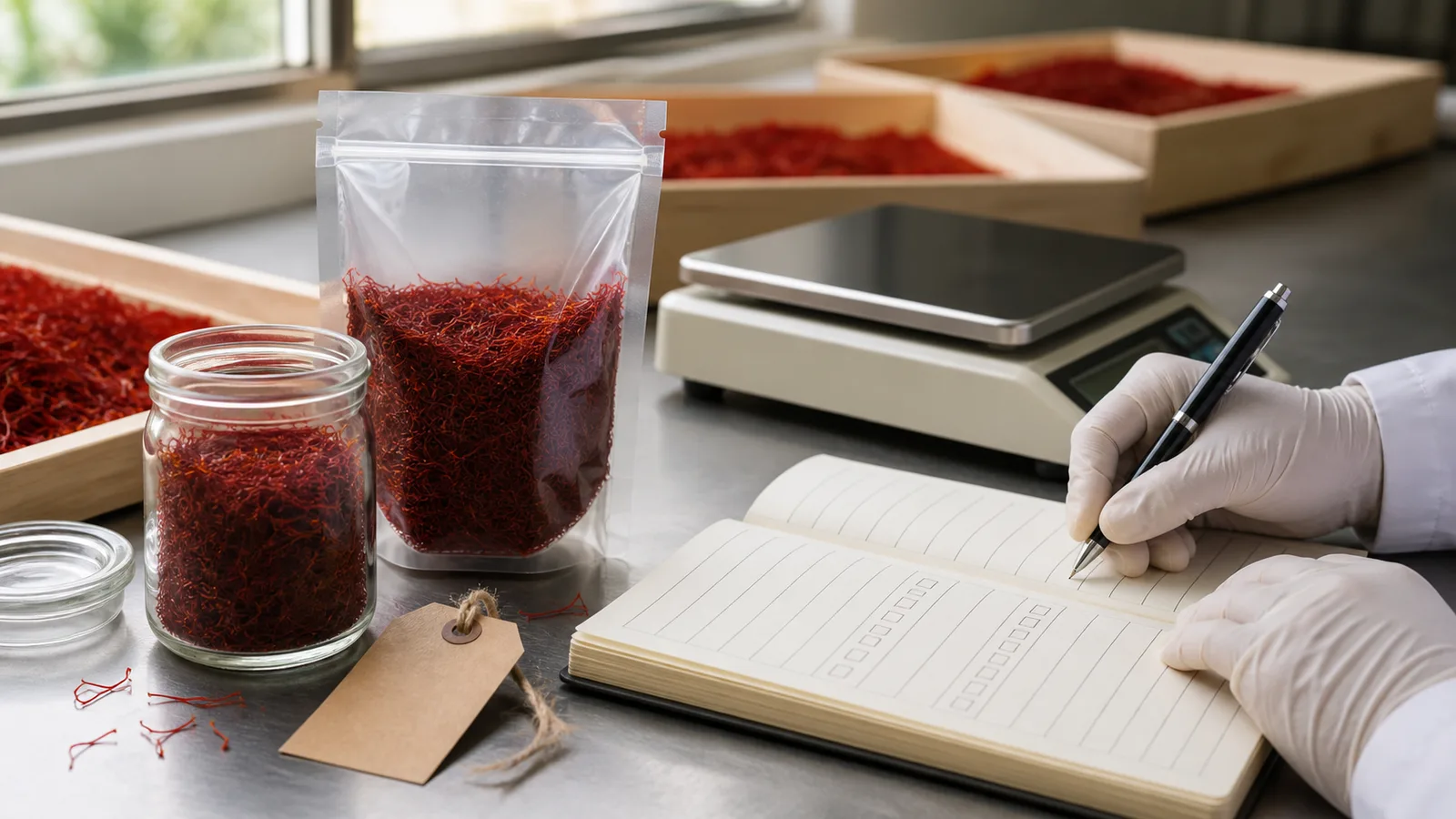
The Saffron Certificate Recognition Plan came from a practical problem in Iran’s saffron trade: growers, buyers and regulators needed a reliable way to connect each lot with the farm that produced it. The proposal was commonly described as giving farms or saffron an “identity card.” In modern food-supply language, it is a traceability system.
The original 2019 report on this page quoted Ali Hosseini, a member of Iran’s National Saffron Council, who said the idea could protect producers, consumers and exporters while producing better statistics about cultivation and output. The plan discussed then should not be confused with a single laboratory certificate, an export document or a quality grade. Those records may contribute to traceability, but none proves the whole journey by itself.
Where did the Saffron Certificate Recognition Plan come from?
It emerged from several weaknesses in the saffron value chain. Iran produced most of the world’s saffron, yet the trade did not always preserve the identity of the grower, village or country of harvest. Small, high-value packs were easy to move through informal channels. Product could also be sold in another country, repacked and marketed under a different commercial identity.
The concern was not merely that Iran’s name might disappear from a package. When a lot loses its documented chain of custody, it becomes harder to:
- confirm where and when it was produced;
- connect a laboratory result to the correct batch;
- investigate adulteration, contamination or a handling failure;
- recall a defined lot without affecting unrelated product;
- pay growers according to documented quality and origin; and
- estimate cultivated area and future production from dependable records.
Hosseini argued in the contemporary report that the infrastructure did not need to be unusually complex. He described a proposed pilot covering 100 villages, supported by straightforward software and hardware and a format prepared through the National Saffron Council. Later accounts continued to describe a 100-village pilot, but the public record reviewed for this update does not establish a single nationwide implementation date. It is therefore safer to treat the 2019 article as a report on an advocated plan, not proof that every Iranian saffron farm subsequently received a certificate.
What a real saffron identity record should contain
A traceability record is useful only when each identifier points to verifiable information. At minimum, a practical system would connect the saleable lot with:
- the grower or responsible farm business;
- a defined plot or production area;
- the harvest season and lot number;
- processing, drying and storage records;
- transfers between growers, processors, laboratories, packers and exporters;
- sampling and test results, including the laboratory and method used; and
- the final packs or bulk consignments made from that lot.
That is different from placing a generic QR code on a box. A code is only an interface. Its value depends on the accuracy, access controls and audit trail behind it. A buyer should also be able to distinguish a producer’s own statement from a test report, an independent certification and an official control document.
Traceability is not the same as saffron quality
A well-traced lot can still be poorly dried, stale or below the declared grade. Conversely, a sample may perform well in a laboratory without having a complete origin record. Identity, quality and authenticity overlap, but they answer different questions:
- Traceability: Where did this lot move, and who handled it?
- Quality: Does it meet the relevant physical, sensory and chemical requirements?
- Authenticity: Is it genuinely saffron, without prohibited additions or deceptive substitution?
- Origin: Is the claimed geographical source supported by records and, where needed, analytical evidence?
The Codex standard for dried saffron sets product identity and quality requirements, while ISO 3632 provides widely used specifications and test methods. Neither turns an unsupported origin claim into fact. For practical household checks, see how to identify healthy saffron; those observations are useful screening tools, not a replacement for accredited testing.
Why the plan mattered to growers
The 2019 article presented saffron as an attractive crop beyond Khorasan because of its value and seasonal water pattern. It quoted a domestic price of roughly 6–11 million tomans per kilogram, depending on quality. That was a dated market figure, not a current price and not a promise of farm profit.
Income depends on yield, labour, corms, water, processing losses, grade, financing and the route to market. Saffron can suit some dry production systems, but saying its water use is “negligible” is too broad. Local soil, climate and irrigation conditions still determine whether expanding cultivation is sensible.
For growers, traceability can make origin and careful work visible beyond the farm gate. It can also reduce disputes if a processor combines lots or a buyer questions a result. Those benefits require fair governance: smallholders must be able to participate without disproportionate cost, and commercially sensitive farm data needs appropriate protection.
Why the plan mattered to buyers and exporters
Saffron’s high value and small physical volume make fraud control important. Informal “suitcase” trade, relabelling and undocumented mixing can weaken both consumer confidence and legitimate exporters. Traceability helps investigators move from a suspect pack back through the supply chain and identify the affected lot.
It does not stop smuggling by itself, nor does it guarantee that another country cannot legally process or re-export imported saffron. The defensible objective is accurate documentation and honest labelling: country of harvest, responsible businesses, lot identity and any processing or packing claims should not mislead the buyer.
How the idea developed after the 2019 report
In 2024, the Food and Agriculture Organization of the United Nations and Iran’s Ministry of Agriculture Jahad launched a technical-cooperation project focused on saffron authenticity and food-supply-chain management. Its stated aims included transparent and reliable supply chains, quality testing, traceability and stronger capacity to respond when problems are detected.
FAO’s 2025 value-chain work added training on production, post-harvest handling, safety, standardisation, digital branding and quality assurance. This is broader than the farm-identity proposal discussed in 2019, but it addresses the same underlying gap: valuable saffron needs evidence that follows it from production to market.
What to ask when a seller mentions certification
“Certified saffron” is incomplete unless the seller says what was certified, by whom and against which requirements. Ask for the lot number, the issuing body or laboratory, the date, the test scope and a way to match the document to the pack. If origin matters, ask whether the record identifies the country or farm of harvest rather than only the packing location.
The strongest system is not the one with the most impressive label. It is the one that lets an authorised reviewer follow the same lot backward and forward, reconcile quantities, examine the relevant evidence and act when the records do not match.
Sources
- The 2019 report and remarks attributed to National Saffron Council member Ali Hosseini, preserved in the previous version of this page.
- FAO: traceability and recalls in food-control systems.
- United Nations in Iran: FAO and Iran saffron-authenticity project, 8 May 2024.
- FAO: quality integrity and value-chain development for Iranian saffron, 25 November 2025.
- Codex CXS 351-2022: Standard for Dried Floral Parts—Saffron.

![Exporting Saffron to Turkey + Price Guide [Complete 0 to 100]](https://img.rowhanisaffron.com/20260827003933/saffron-export-turkey-quality-inspection.webp)



