


Insurance of saffron prices even in the harvest season was the phrase used when saffron options began trading on the Iran Mercantile Exchange in 2019. It described a way for growers to manage the risk of a price fall. It did not mean that the crop or its selling price was covered by an ordinary insurance policy.
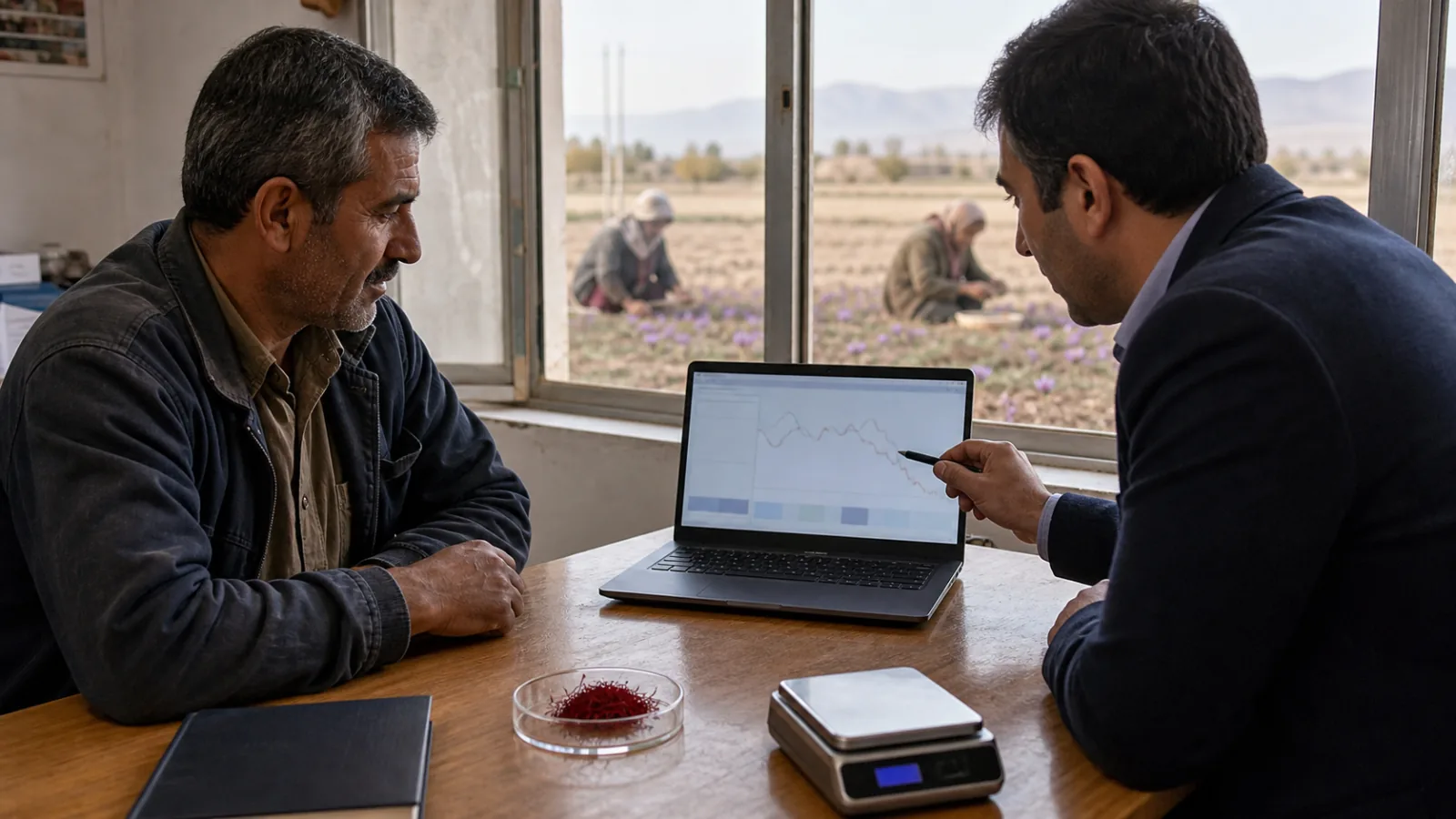
The distinction is important. A grower may use a put option to establish a potential price floor for a defined quantity and grade of saffron, but the protection has a cost and only works when the contract matches the crop and the grower follows its terms.
The 2019 saffron-options announcement
The original report quoted market specialist Hassan Rezaeipour as saffron option trading was being introduced. The launch date was the 12th day of Esfand 1397—3 March 2019—not 12 March, as the old English translation suggested. Contemporary coverage said the first call and put contracts had May 2019 maturities.
Rezaeipour argued that the new contracts could support growers and deepen saffron trading, provided that training continued. Options were still unfamiliar to many market participants. Workshops had therefore been held in Mashhad and Tehran for farmers, brokers and other traders.
He did not expect immediate mass participation by growers. His comparison was the saffron warehouse receipt, another exchange tool that had taken time to become familiar. In his view, continued education by the exchange, the mercantile exchange and brokers was essential before options could become a practical part of farm marketing.
What “insurance” means in this context
An option gives its buyer a right, not an obligation. A put option gives the buyer the right to sell the underlying commodity at a stated exercise or strike price by a specified expiry date. The buyer pays a premium for that right.
The US Commodity Futures Trading Commission describes agricultural options as price-risk tools and makes the same core points: the contract has a strike price and expiry, while the buyer pays a premium. A put is generally useful when its strike price is above the relevant market price, but any benefit must also exceed the premium and other costs.
That is why “price insurance” is a helpful analogy but an incomplete description. It does not insure flower yield, corm health, weather damage, drying loss, product rejection or every possible fall in farm income. It addresses a defined market-price exposure under one contract.
How a saffron grower could use a put option
Imagine a grower expects to have exchange-eligible saffron at harvest. Before the crop is sold, the grower buys a put with a suitable strike price and expiry.
- If the relevant market price falls below the strike, the put may gain value or be exercised according to the contract rules, offsetting some of the weaker cash price.
- If the market price stays above the strike, the grower may allow the option to expire and sell at the better market price.
- In either case, the premium and transaction costs have already reduced the net result.
The simple outline hides several practical checks. The contract’s saffron grade, unit, delivery basis and expiry must match the grower’s real exposure. The position should not cover more saffron than the farm can reasonably supply. A grower also needs to know whether settlement is financial or linked to delivery, how exercise is handled and what happens if the product fails warehouse or quality requirements.
This is risk management, not a guaranteed profit. A poorly matched contract can leave part of the cash-market price movement uncovered. It can also introduce costs or obligations that a first-time participant did not expect.
Why harvest season matters
Saffron flowers arrive over a short period, and growers must make quick decisions about picking, separating, drying and selling. If many sellers need cash at the same time, a grower may fear accepting a weak harvest-season price. Rezaeipour’s “insurance” claim addressed that concern: a put purchased earlier could provide a defined response if the referenced price fell.
The hedge still depends on timing. An option that expires before the grower’s marketing window may offer little help. A contract based on one grade cannot perfectly protect a different grade. Cash prices in a village can also differ from an exchange quotation because of quality, packaging, location, credit terms and immediate buyer demand. Traders call that difference the basis, and it can change.
Price discovery and the cash saffron market
Rezaeipour also said traders in the physical market were watching the exchange board and described the exchange as an accepted pricing reference. That was his assessment at the launch, not proof that every saffron transaction matched one official price.
An exchange can improve price discovery by publishing bids, offers and completed trades under known contract specifications. It becomes most informative when trading is active and the underlying saffron is clearly graded. A thinly traded contract, an unmatched grade or a quote without a completed trade deserves more caution.
The physical side matters too. Standard sampling, approved storage and warehouse receipts help a buyer understand what an exchange unit represents. Our guide to selling saffron through agricultural commodity exchanges explains that warehouse and quality-control layer.
Questions a grower should answer before using an option
Training was central to the original announcement, and it remains the sensible starting point. Before entering a contract, a producer should be able to answer these questions:
- Which saffron grade and contract unit underlie the option?
- What are the strike price, premium, fees and expiry date?
- How much harvest is genuinely available to hedge?
- How is the option exercised or closed, and is delivery involved?
- What approved broker, warehouse and quality documents are required?
- What price risk remains after basis differences and costs?
Current contract specifications and exchange rules should be obtained from the Iran Mercantile Exchange and an authorised broker before any decision. The 2019 contract details in this article are historical and should not be used as current trading terms.
A useful tool, not a promise
The launch was an important step in broadening Iran’s saffron market beyond immediate cash sales. Rezaeipour hoped that active exchange trading could support growers, give traders a transparent reference and, eventually, strengthen Iran’s role in global saffron price discovery.
Those aims depend on participation, reliable grading, liquid trading and informed use. Put options can reduce a specific downside-price risk even during harvest season. They cannot remove every production or marketing risk, and they work best when a grower understands the contract before paying the premium.
Sources
- The archived 2019 statement by Hassan Rezaeipour preserved in this post.
- Forsat-e Emrooz, 12 Esfand 1397: contemporary saffron-options launch coverage.
- US Commodity Futures Trading Commission: Agricultural Trade Options.
This article explains a historical market development and general option mechanics. It is not personalised financial, legal or trading advice.

![Exporting Saffron to Turkey + Price Guide [Complete 0 to 100]](https://img.rowhanisaffron.com/20260827003933/saffron-export-turkey-quality-inspection.webp)



