


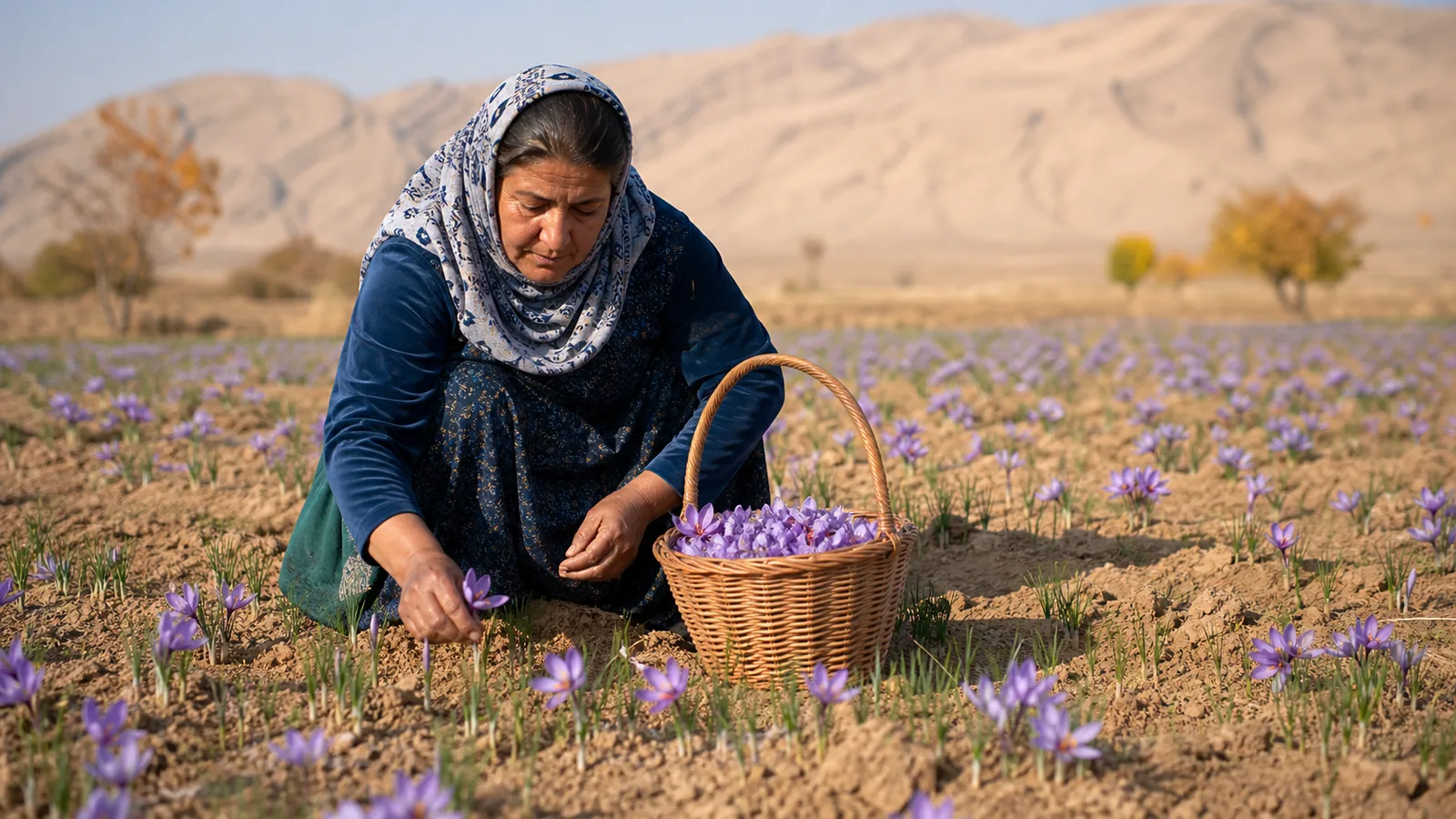
Korkom is a saffron documentary about one woman, one field and a much wider question: can a locally grown crop create income without losing its identity somewhere along the supply chain? The film follows Chenour Mohammadi in Kermanshah as she establishes a saffron plot on her father’s land. Her story connects farm work, water pressure, women’s enterprise and the challenge of making Kermanshah saffron visible in its own name.
This article revisits an interview published in Iran in 2018 with the film’s director, Fatemeh Gholizadeh Atani. Some details below describe what the director said about the film and its production; they are not presented as current production statistics.
What is the Korkom saffron documentary about?
According to Gholizadeh Atani, the film centres on Chenour Mohammadi, a young woman in rural Kermanshah who chose to plant saffron when farming conditions were becoming harder. The director described agricultural work there as traditionally associated with men, which made Mohammadi’s decision socially as well as financially significant.
Mohammadi obtained planting material from Mashhad and used family land for the project. The documentary follows the practical risk behind that choice rather than treating it as an effortless success story. A saffron field needs suitable soil and climate, healthy corms, timely irrigation, careful picking and fast processing. The crop may require less water than some alternatives in a suitable production system, but it is not water-free.
The film’s title carries its subject directly. Korkom is an old term associated with saffron in Persian-language historical sources. That makes it a fitting name for a story concerned with place, memory and the ownership of a regional product.
A Kermanshah story, not only a Khorasan story
Khorasan Razavi and South Khorasan are the best-known centres of Iranian saffron cultivation. The original interview argued, however, that Iranian saffron history and cultivation should not be reduced to those provinces alone. It referred to a broad western-to-eastern geography that included Hamedan, Kermanshah, Boroujerd, Arak and Mashhad.
The most defensible version of that point is simple: Khorasan is Iran’s dominant commercial centre, while saffron can also be cultivated in suitable areas elsewhere. A 2016 land-suitability study mapped favourable conditions in parts of Kermanshah Province, including areas around Kermanshah, Mahidasht, Islamabad, southern Javanrood, Ravansar, Kangavar, Gilan-e Gharb and Sarpol-e Zahab. Suitability varies within a province; the name on a map is not a substitute for local soil, climate and water assessment.
For a broader view of the region’s production history, see our account of saffron production in Kermanshah.
The branding problem the director encountered
Gholizadeh Atani said that making the film revealed a commercial problem: Kermanshah’s saffron lacked a recognised local brand, and some product was sent to Mashhad before reaching the market under another name. Her concern was not about Mashhad’s deserved reputation. It was that a grower’s place of production could disappear before the buyer saw the product.
That observation still illustrates why origin claims need evidence. A regional name on a package should correspond to a traceable supply chain, not simply the location of the packer or trader. Testing, careful post-harvest handling, documented lots and honest labelling matter more than a romantic origin story.
Current work by the Food and Agriculture Organization of the United Nations and Iran’s Ministry of Agriculture Jahad puts the same practical issues—authenticity, quality control, traceability and value-chain governance—at the centre of safeguarding Iranian saffron. FAO reported in 2025 that Iran produces roughly 85–90% of the world’s saffron, while also stressing stronger processing, standardisation and transparent marketing.
Why water scarcity appears in the film
The interview placed Mohammadi’s decision against declining water availability. Saffron is often described as drought-resilient because its seasonal cycle can suit dry regions and its main irrigation demand does not coincide with summer dormancy. That does not justify a blanket claim that the crop needs little water everywhere.
Research on Iran’s saffron water footprint shows meaningful variation between provinces and between green water from rainfall, blue irrigation water and other components. The sensible lesson is to compare crops and irrigation systems under local conditions. A grower considering saffron in Kermanshah still needs a field-level plan for planting date, drainage, rainfall, salinity, frost, corm health and irrigation.
Work, risk and a woman’s place in agriculture
The director said that reaching the village, building trust and filming the work were difficult. The greater risk, in her telling, belonged to Mohammadi: she pursued an unfamiliar crop while navigating local expectations about who should do agricultural work.
That is why Korkom is more than a promotional film about a valuable spice. Its central idea is agency. Mohammadi used a modest plot and a new crop to build productive work for herself and contribute to her family’s income. The documentary shows hope through a concrete decision, not through a slogan.
The film and the Ammar festival
The 2018 report connected Korkom with the seventh Ammar People’s Film Festival and its “resistance economy” programming. Gholizadeh Atani said she valued the festival’s attention to local subjects that other festivals might overlook. She also contrasted the film’s constructive conclusion with documentaries that concentrate only on criticism.
The report states that Chenour Mohammadi received an award at the festival as the documentary’s real-life heroine. Because a stable public festival record for that detail was not available during this update, it remains explicitly attributed to the contemporary report rather than treated as independently verified.
What the story means today
Korkom preserves a particular moment in Kermanshah’s saffron story. Its lasting questions are still useful:
- Can a new crop genuinely suit the land and available water?
- Can women and smallholders share fairly in the value they create?
- Can buyers trace saffron to its real production area?
- Can quality be demonstrated through handling, testing and records rather than branding alone?
A documentary cannot answer those questions for every farm. It can show why they matter. In this case, the person in front of the camera turned an agricultural idea into work, while the person behind it recorded what regional identity and market recognition can mean to a grower.
Sources and further reading
- The original 2018 Iranian news interview with Fatemeh Gholizadeh Atani, preserved in the previous version of this page and attributed there to Jame Jam Online and Mehr News Agency.
- FAO: innovation and quality integrity in Iran’s saffron value chain, 25 November 2025.
- FAO: Iran project to enhance saffron authenticity and traceability, 7 May 2024.
- AGRIS record: cultivable-area zoning for saffron in Kermanshah Province, 2016.

![Exporting Saffron to Turkey + Price Guide [Complete 0 to 100]](https://img.rowhanisaffron.com/20260827003933/saffron-export-turkey-quality-inspection.webp)



