


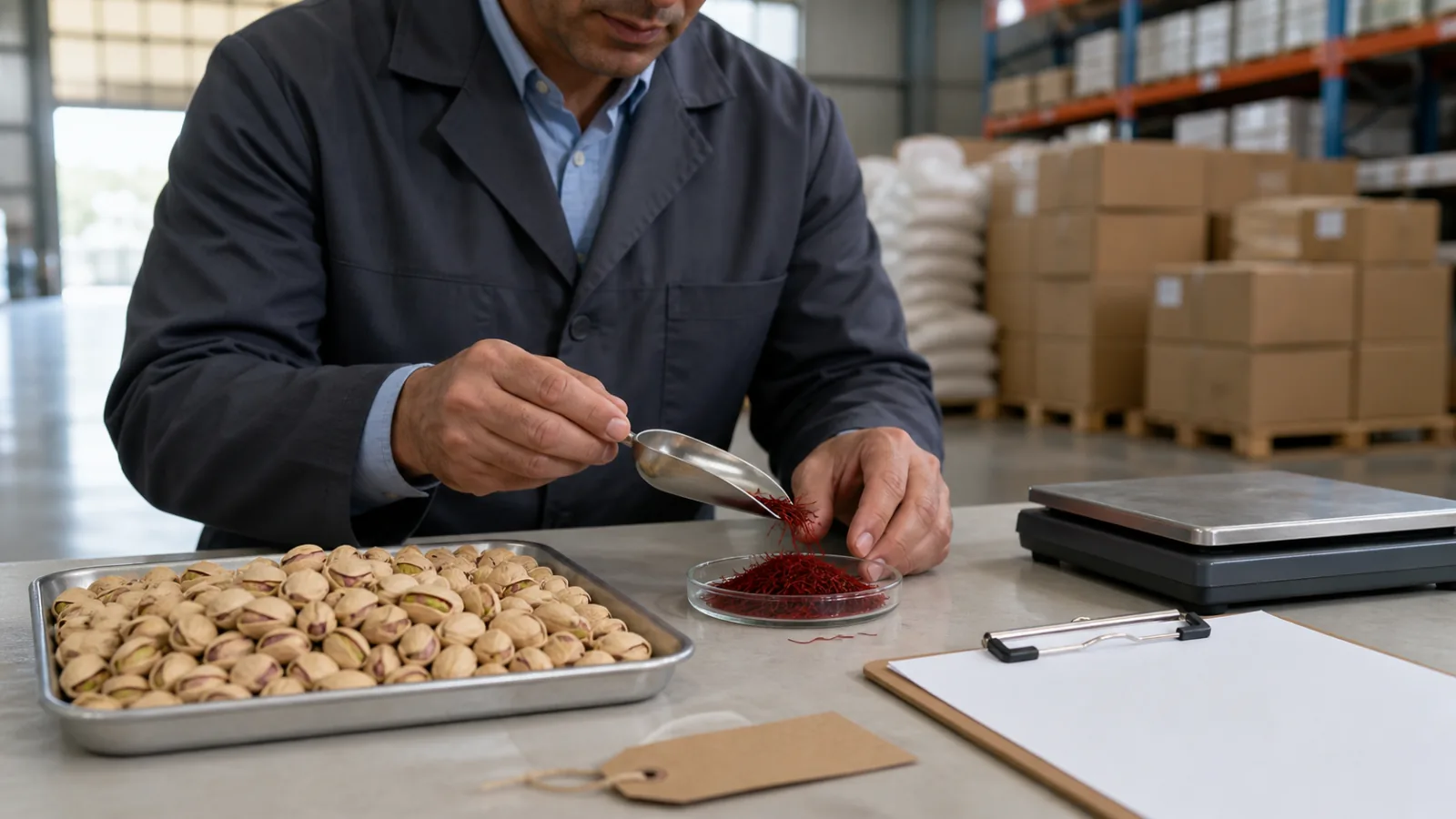
Iranian saffron and pistachio status cannot be reduced to a single production ranking. These two crops share an export identity and were brought into the same Iranian commodity-market programme, but their volumes, quality risks and sales channels are quite different. A useful status check has to separate four things: production, international trade, physical stock held in approved warehouses and financial contracts linked to that stock.
An Iranian Ministry of Economic Affairs and Finance report published in 2017 argued that more organised trading could improve liquidity, price transparency and market access for both crops. It described spot transactions, commodity deposit certificates and the prospect of derivative markets. Those details are historically important; they are not a current list of active contracts, approved warehouses or exchange rules.
The historical production picture
The ministry report described Iran as producing more than 96 percent of the world’s saffron and about 40 percent of its pistachios. It also assigned 38 percent of national pistachio production to Kerman, with Khorasan Razavi and Yazd at roughly 18 percent each.
Those percentages are preserved because they formed the case for organising the two markets. They should not be quoted as today’s shares without a crop year, a defined product and a current statistical source. Harvests move with weather, water, planted area and yield; global shares also change when production grows or falls in competing countries.
The basic contrast remains useful. Saffron has extremely high value relative to its weight and is usually traded in kilograms or small consumer packs. Pistachios move in much heavier lots and require careful control of variety, size, moisture, defects, storage and food-safety parameters. A system that serves both products still needs a separate technical specification for each.
What recent trade data says—and what it does not
World Bank WITS pages based on UN Comtrade show that buyers continued to report substantial imports from Iran in 2024. For saffron under HS 091020, the leading reported markets included the European Union, Spain, China and Italy. For fresh or dried pistachios under HS 080250, leading markets included China, Turkey, India, the European Union and Germany.
These are mirror statistics: the importing country or region reports the trade. They are valuable when a complete Iranian export series is unavailable, but they need careful reading. The European Union total overlaps with its member states, so it must not be added to Spain, Italy or Germany as though they were separate extra markets. Weight and value also answer different questions. A larger kilogram figure does not necessarily mean a better return, and declared value is not the same as a farmer’s price.
The two product pages use distinct customs codes and units. That is one reason a combined headline about “saffron and pistachio status” should never turn into a blended market total.
Why Iran placed saffron and pistachios in one market programme
The 2017 account identified five variables that needed stronger management: product, price, distribution channels, packaging and advertising. Behind that language was a practical problem. Production was spread among many growers, while export buyers required consistent lots, reliable storage and evidence that the goods matched an agreed grade.
Both crops can be stored for a defined period if conditions are controlled. They can also be sampled and graded before sale. That made them candidates for physical exchange transactions and warehouse-backed certificates, with the aim of reducing repeated movement and creating a clearer route from owner to buyer.
The programme’s stated goals included improving liquidity, forming a coherent market, managing price fluctuations, reducing unnecessary intermediation, market regulation and increasing economic transparency. These are aims, not guaranteed outcomes. A market can publish prices and still have thin participation, uneven access or grades that do not match an export buyer’s specification.
How a commodity deposit certificate works
A commodity deposit certificate represents ownership of a specified quantity and grade held in an approved warehouse. The historical article traced its recognition as a securities-market instrument to a decision of Iran’s Supreme Council of Securities and Exchange dated May 12, 2014.
Under the process it described, a saffron or pistachio owner would:
- deliver an eligible lot to a warehouse admitted to the exchange system;
- have the product checked against the warehouse and exchange specification;
- receive a warehouse receipt or commodity deposit certificate linked to that lot;
- obtain the required exchange code and either hold the goods for an allowed period or submit a sale instruction through an authorised broker; and
- transfer the certificate when a transaction was settled, without moving the physical crop after every trade.
The certificate is backed by goods in storage. It is not proof that any saffron or pistachio offered by a seller will be accepted, nor does it guarantee a buyer, a profit or an export-compliant lot.
Where warehouse receipts can help
Good warehousing can reduce unnecessary handling, keep lots under specified conditions and give buyers a clearer record of quantity and grade. A receipt can make repeated transfers simpler because ownership changes without the product travelling from one informal store to another.
A broader group of visible bids and offers may also improve price discovery. Published transaction information gives growers, traders and exporters a reference point that is harder to obtain in a fragmented cash market.
The limits matter just as much. Storage and testing cost money. A grading dispute can delay sale. Small growers may need aggregation or practical access to a broker and approved warehouse. Most importantly, an exchange grade is not automatically identical to every importing country’s food-safety, residue, packaging or labelling rules. Export compliance still has to be checked for the buyer and destination.
Spot goods, certificates and derivatives are different
A physical sale transfers the crop. A warehouse certificate transfers a claim on a defined stored lot. A futures or options contract manages a future price obligation or right under its own contract terms. Calling all three “the saffron stock market” hides meaningful differences in delivery, margin, settlement and risk.
This distinction is essential when researching the saffron derivative market. A quoted futures price belongs to a particular contract, grade, delivery month and settlement method; it is not automatically the cash price of every saffron lot in Iran.
The old programme expected futures and options to develop around saffron and pistachios. A 2019 report from the Standing Committee for Economic and Commercial Cooperation of the Organisation of Islamic Cooperation later recorded depositary receipts and futures for saffron, cumin and pistachios as developments at the Iran Mercantile Exchange. Anyone considering a transaction should still consult the exchange’s current contract specification, warehouse notice and broker requirements rather than relying on that historical summary.
The launch record needs careful dating
The surviving English article says exchange activity began on “February 24, 1395” and “March 16, 1395.” It mixes Gregorian month names with a Persian calendar year, so a precise Gregorian conversion would be guesswork without the Persian original. The dates are retained as recorded and flagged, not silently rewritten.
For pistachios, the report also named the Kerman Chamber of Commerce, Industries, Mines and Agriculture, the Rafsanjan Pistachio Cooperative and two brokerage trading stations in Kerman. It predicted wider exchange-based exports. These references document the programme’s intended direction in 2017; they do not establish the current status of those organisations or facilities.
A better way to assess current status
For either crop, start with a dated question. A grower may need the current approved-warehouse specification and fees. An exporter needs destination-specific quality, food-safety and packaging requirements. A market analyst needs a defined HS code, reporter, period, net weight and trade value. An investor needs the live contract terms and risks.
Keeping those questions separate produces a more honest picture of Iranian saffron and pistachios. Production strength matters, and organised trading can support documentation and price discovery. Neither, by itself, guarantees export quality, broad farmer participation or control of the final consumer market.
Our article on the government programme intended to protect saffron’s value gives a shorter policy-focused account of the same historical initiative.
Sources
- The 2017 ISNA/Ministry of Economic Affairs and Finance account, cited through the archived Khabar Online version of this post
- World Bank WITS / UN Comtrade: 2024 saffron imports reported from Iran
- World Bank WITS / UN Comtrade: 2024 pistachio imports reported from Iran
- COMCEC Capital Market Regulators Forum report on Iranian commodity receipts and futures

![Exporting Saffron to Turkey + Price Guide [Complete 0 to 100]](https://img.rowhanisaffron.com/20260827003933/saffron-export-turkey-quality-inspection.webp)



