


South Khorasan saffron has long travelled beyond Iran in bulk as well as in consumer packs. This article began as a December 2015 report about the province’s place in that trade. Its headline is awkward in English, but the underlying concern was clear: growers and officials feared that saffron leaving Iran without a strong, traceable regional identity could earn more recognition and value after it reached markets such as Spain. Morocco was mentioned in the old report too, although Morocco is in North Africa, not Europe.
The distinction matters. Spain is a major European saffron importer and distributor. Morocco has its own saffron-growing tradition and a much smaller recorded trade with Iran. Neither fact, by itself, proves that a particular shipment from South Khorasan was repackaged or sold under another origin. That conclusion requires records for the lot itself. What the old report does document is an enduring local question: how can more of the work, identity and commercial value remain connected to the people who grow Khorasan saffron?
What the 2015 South Khorasan report said
Javad Heravi, then a representative of South Khorasan in Iran’s parliament and a member of the Education and Research Committee, described raw and bulk saffron exports as a challenge. He argued that cleaning, grading, testing, processing and packaging within the producing region could create skilled jobs while allowing growers and local businesses to retain more value.
The translated report attributed a figure of “300 tons a year” of raw saffron exports to Heravi. That number should be read as a speaker’s broad estimate from 2015, not as a verified customs total. The surviving copy does not specify a calendar year, customs code, destination list or whether “raw” meant unpackaged, unprocessed, or simply exported in bulk. Those missing definitions make the figure unsuitable for current market calculations.
Heravi also said that Iran, despite being the world’s leading saffron producer, had not captured the same downstream advantage as some European businesses. His criticism covered more than the final box: he referred to traditional production and consumption patterns, limited planning, the need for a recognisable brand, and stronger international recognition of Iranian saffron. He described saffron as one of South Khorasan’s four profitable strategic products for developing non-oil exports. Because the crop needs relatively little irrigation compared with many alternatives, he also supported carefully planned cultivation where local water and soil conditions were suitable.
That last point should not be turned into a promise that expanding acreage is always sustainable. A crop can be comparatively water-efficient and still place pressure on an aquifer if fields expand beyond the supply available to them. Farm-level water, soil, corm health and expected yield belong in the decision.
Repairing the province’s 2015 production figures
The old English text was damaged during translation. It says that 53 tons would be harvested from “141 thousand and 31 hectares,” which is not credible for the province and does not fit the sentence around it. The internally consistent reading is a forecast of 53 metric tonnes from 14,131 hectares, seven tonnes more than the figure cited for Iranian year 1393. The statement was attributed to Hashem Valipour-Motlag, then head of the South Khorasan Agricultural Jihad Organization.
The same report counted 35,830 saffron beneficiaries or growers and said Qaenat had the largest cultivated area in the province. These are historical figures, tied to that report and season. They should not be presented as today’s acreage, output or grower count.
Later official provincial reports illustrate why the year matters. For the 2021 season, Iran’s Ministry of Agriculture news service reported 17,152 hectares and a forecast of 56 tonnes for South Khorasan, after about 70 tonnes in the preceding season. Its 2022 report used the same planted-area figure but forecast only 30 tonnes, following a 34-tonne crop. Weather, water availability, flower density and harvest conditions can move output sharply even when cultivated area changes little. A production number without its season is almost meaningless.
Readers interested in the farming side can see our separate guides to saffron production in South Khorasan and the South Khorasan harvest. This page stays with the export, identity and value-chain question.
What trade records show about Spain and Morocco
Current public trade records support one part of the old concern and weaken another. World Bank WITS data, sourced from UN Comtrade, records Spain importing 45,351 kilograms of saffron in 2024. Iran supplied 39,649 kilograms of that total. Spain was therefore a substantial direct market for Iranian saffron in that year.
The corresponding Moroccan record looks very different. Morocco reported 174 kilograms of saffron imports from all partners in 2024. Its entry for Iran was valued at only US$20 and the quantity rounded to zero kilograms. That does not tell us what happened in 2015, but it does mean Spain and Morocco should not be treated as equivalent present-day destinations for Iranian saffron.
Spain also exports saffron. That pattern is normal in international food trade: a country may produce some of a commodity, import more, test or pack it, and distribute it to other markets. Gross import and export tables do not reveal whether the same physical saffron was re-exported, nor what origin appeared on a retail label. They certainly do not identify the Iranian province where a lot was grown.
Morocco is likewise a saffron-producing country. A Moroccan package cannot be assumed to contain Iranian saffron simply because both countries appear in a historic article. Any allegation about changed origin needs batch records, invoices and the label used in the destination market. Without those, it remains an unverified claim.
Bulk saffron is not automatically poor saffron
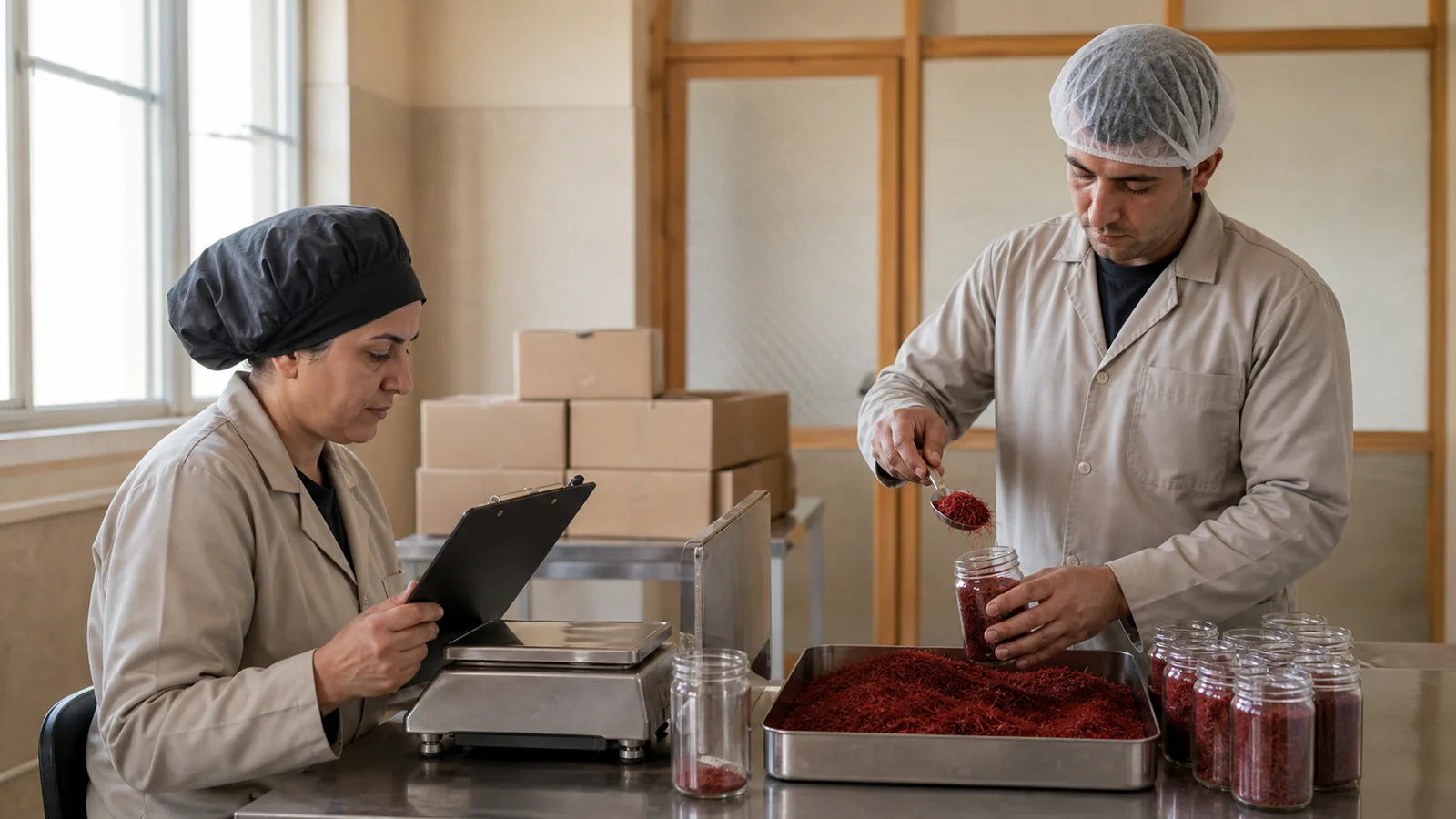
“Raw export” is often used loosely. Dried saffron threads sold in a large food-grade container may already have been cleaned, separated, moisture-controlled and tested. The difference is that the consumer-facing work happens later, closer to the final buyer. That later work can include:
- laboratory checks for identity, moisture, contaminants and colouring strength;
- sorting into a defined commercial grade;
- packing in quantities suitable for households, restaurants or manufacturers;
- creating compliant labels and traceable batch records;
- building distributor relationships, retail presentation and customer support.
Those activities cost money and carry responsibility, so they add legitimate value. The problem for South Khorasan is not that every bulk sale is wrong. Bulk contracts can give producers dependable access to large buyers. The risk is becoming limited to the least differentiated step of the chain, especially when a grower’s location, harvest practices and product quality cannot be followed into the final market.
Packaging alone does not establish quality, and an expensive box does not change origin. Useful local processing pairs presentation with evidence: hygienic handling, a defined lot, defensible test results, accurate net weight, suitable food-contact materials and storage that protects the spice from moisture, heat and light. Our article on saffron processing in South Khorasan looks more closely at those post-harvest steps.
How a South Khorasan lot can keep its identity
A credible origin story begins before the saffron reaches an export carton. Each lot should connect to a grower or cooperative, a farm location, harvest period, drying and handling record, processor, laboratory result and packing batch. Commercial documents then need to carry the same identity through the exporter, importer and any later repacking.
Quality standards help describe the product, but they do not prove geography on their own. ISO 3632 testing can classify saffron through chemical and sensory criteria. A conforming result says something useful about the sample tested; it does not establish that the flowers grew in Qaenat. Geographic identity needs its own controlled specifications, eligible area and chain of custody.
This is also why international recognition must be described precisely. A geographical-indication application, a national registration and an international registration are different stages with different legal effects. Earlier reporting on Khorasan saffron sometimes collapsed them into a single claim. We reviewed that distinction in our article on the Khorasan saffron geographical indication.
Where local processing can make a practical difference
The strongest case for processing near the farms is not a slogan about eliminating intermediaries. It is the ability to do careful work while the lot’s origin is still clear. A local facility can receive flowers or dried threads under known conditions, train staff, keep batches separate and document the path from grower to package. That supports quality control and makes a regional claim easier to audit.
It can also broaden the kinds of jobs attached to the crop. Harvesting is intense and seasonal; laboratory work, packaging design, food-safety management, sales and traceability administration operate on different schedules. Keeping some of those roles in South Khorasan may spread the economic benefit beyond the short flowering season.
None of this guarantees a higher farm-gate price. A processing business still needs reliable supply, working capital, regulatory competence and customers willing to pay for the proposition. The 2015 call for investment was directionally sensible, but success depends on contracts and execution, not machinery alone.
How to read the original headline today
The headline “South Khorasan saffron is exported to Europe are Spain and Morocco” should be understood as a compressed translation of a 2015 debate, not a literal description of geography or proof of relabelling. Spain belongs in the European part of the story and remains a major importer of Iranian saffron. Morocco is a North African producer and trader whose recent recorded imports from Iran are negligible.
The useful lesson is narrower and stronger: origin is protected by records, not assumption. If South Khorasan saffron is to carry its identity and value into another country, the chain must connect the farm, test result, batch, exporter, importer and final label. Better processing and presentation can help, but only when the evidence travels with the spice.
Sources and data notes
- World Bank WITS: Spain saffron imports by country, 2024.
- World Bank WITS: Morocco saffron imports by country, 2024.
- Iran Ministry of Agriculture news service: South Khorasan saffron reports, including the 2021 planted-area and forecast figures.
- UNIDO: Saffron Industry Value Chain Development in Iran, for the wider historical value-chain context.
Historical figures above reproduce or carefully repair the surviving December 2015 report. Trade figures refer to 2024 and were reviewed on 29 August 2026. Gross customs data describes reported trade flows; it is not batch-level proof of provincial origin or relabelling.

![Exporting Saffron to Turkey + Price Guide [Complete 0 to 100]](https://img.rowhanisaffron.com/20260827003933/saffron-export-turkey-quality-inspection.webp)



