


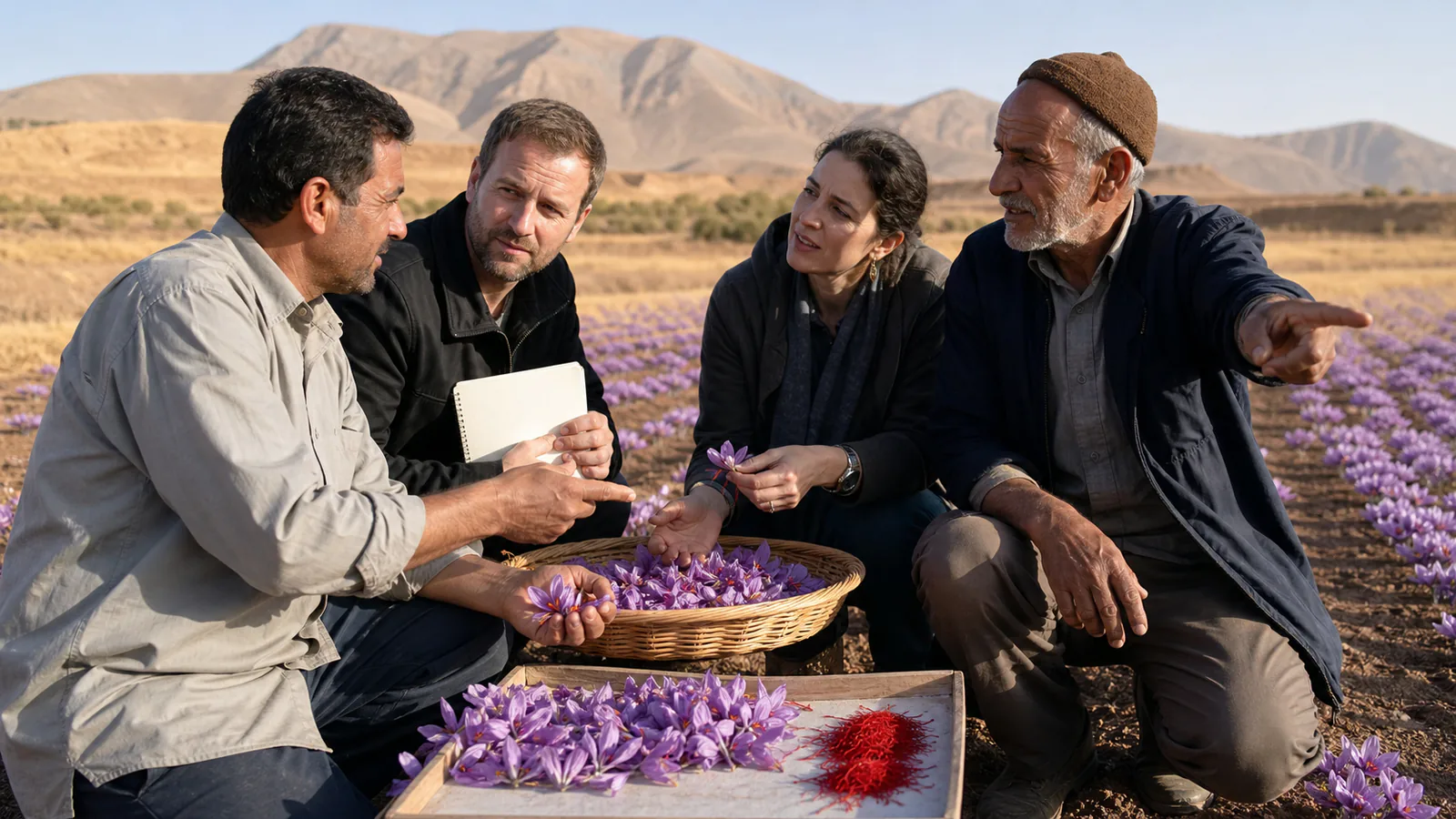
Investors Norwegian and German of South Khorasan province visit the saffron fields is a 2015 account of investment outreach, not a record of completed foreign deals. Norway’s ambassador visited a saffron-growing village, German businesspeople discussed camel-milk processing, and Pakistan’s ambassador reviewed wider economic opportunities. Provincial officials said talks were active, but the article also acknowledged that no formal document had yet been signed for some proposals.
That distinction matters. A diplomatic visit can introduce a region, its producers and possible projects. It does not establish financing, technical feasibility or an operating business. The historical value of this report lies in what South Khorasan presented to visitors: saffron, barberry, jujube, honey, medicinal plants, camel milk and a proposed aquaculture project.
The Norwegian ambassador’s saffron-field visit
Aud Lise Norheim, Norway’s ambassador to Iran at the time, visited South Khorasan during the saffron harvest. Contemporary coverage places her in Ark village in Khusf County, where she joined local growers picking flowers and met villagers. The visit made the province’s best-known agricultural product visible through the people and seasonal work behind it.
The archived article says the provincial Foreign Ministry office invited the ambassador and that the visit helped attract interest from European investors. It does not identify a Norwegian saffron investment or signed contract. The safe conclusion is that the field visit was part of investment promotion and relationship-building.
For a potential partner, the field is only the first link. A serious saffron proposal also needs evidence for harvest labour, hygienic stigma separation, controlled drying, grading, testing, traceability, packaging and routes to market.
German interest focused on camel-milk processing
Mehdi Behdani, described as South Khorasan agriculture’s investment director, said a group of German businesspeople had shown interest in processing camel milk in Birjand. The broken translation refers to formula, powder or extract; it does not provide a reliable final product specification, plant capacity, investor name or signed commitment.
Camel milk can be developed into safe food products, but processing requires a defined product, consistent raw-milk supply, cold-chain control, pasteurisation or another validated process, hygienic equipment, testing and compliant labelling. FAO guidance notes that milk is highly susceptible to microbial and enzymatic spoilage and that camel milk has technical processing characteristics that need to be managed.
The original report also claimed clinics used camel milk to treat many diseases. That statement is not presented as fact here. A systematic review of animal and human trials found important limitations and concluded that camel milk should not replace standard therapy for any human condition. An agricultural processing proposal is not medical evidence.
Pakistan’s ambassador reviewed broader opportunities
Noor Muhammad Jadmani, Pakistan’s ambassador to Iran from 2013 to 2016, also visited South Khorasan and toured several economic sectors. Behdani said provincial officials presented investment packages, especially in agriculture, and that the ambassador expressed readiness to take opportunities back to a delegation.
Pakistan’s Ministry of Foreign Affairs confirms Jadmani’s term in Tehran. The 2015 South Khorasan account, however, does not record a resulting contract, project company or capital commitment. “Readiness to invest” should be understood as interest at the discussion stage.
The province’s border position made regional cooperation a natural subject. A viable cross-border agricultural project would still need clear ownership, permits, banking and payment arrangements, product standards, logistics and a defined customer.
What South Khorasan displayed to visitors
The provincial exhibition, organised with support from the Birjand Special Economic Zone, showcased barberry, saffron, jujube, honey and medicinal plants. National figures including then vice-president Elham Aminzadeh and Mohsen Rezaei were reported among the attendees, along with Turkish visitors and Iranians living abroad.
Behdani said discussions took place with expatriate Iranians, but no official document had been signed at that point. That is a useful boundary. An exhibition can reveal products and start conversations; it is not evidence that a processing plant, export order or joint venture exists.
Saffron and barberry are especially relevant to South Khorasan because both are high-value crops whose final return depends on post-harvest handling and market access. A proposal should show how it will reduce loss, improve consistency, verify origin or reach a buyer—not merely repackage a familiar regional product.
Why the saffron fields were commercially relevant
A field visit lets a potential buyer or investor see harvest conditions, speak with growers and understand the short labour-intensive season. It can also expose weak links. Flowers must be picked and processed quickly; distant or inadequate separation and drying can erode the value created in the field.
UNIDO’s diagnostic study of Iran’s saffron value chain identified fragmentation between farmers, village processors, dealers, packaging businesses and export markets. For South Khorasan, productive investment could therefore include farmer coordination, clean local processing, testing, lot records and direct market relationships.
The strongest project would preserve source identity from a named field through the final pack. That gives an international partner something verifiable to buy and gives growers a better chance of retaining value.
The aquaculture proposal was separate from saffron
The 2015 briefing also discussed raising fish in cages in a reservoir near the Afghanistan border. Behdani said water resources around Birjand were limited but argued that stored dam water might support a pilot. Iranians living in Arab countries, particularly the United Arab Emirates, were reported as interested.
The article does not name a completed environmental assessment, water allocation, species, production licence or signed investor. Cage aquaculture should therefore remain a historical proposal, not be presented as a project that began. Its inclusion shows how broad the province’s investment campaign was, even though it was unrelated to the saffron-field visit.
How to judge whether an investment announcement became real
A later reader should look for evidence beyond a visit or expression of interest:
- a named investor and legally identified local partner;
- a signed agreement with a clear scope, date and value;
- permits and a site appropriate for the proposed activity;
- technical specifications, raw-material supply and utilities;
- food-safety, environmental and labour controls;
- a buyer or market channel; and
- construction, commissioning or verified production.
None of those should be inferred from the 2015 article where the document does not provide them. This protects readers from turning diplomatic language into a financial claim.
What the visits meant for South Khorasan
The Norwegian, German and Pakistani activity placed South Khorasan’s agriculture in front of international visitors. Norheim’s harvest visit was real and documented; German camel-milk interest and Jadmani’s investment discussions were reported by the provincial official. The exhibition and aquaculture proposal added other routes the province hoped to develop.
The coherent lesson is not that foreign capital was secured. It is that local products need investment-ready value chains. For saffron, that means a credible field-to-market system. For camel milk, it means safe processing and a defined food product without unsupported medical promises. For any project, a signed and operating result matters more than the nationality of the visitor.

![Exporting Saffron to Turkey + Price Guide [Complete 0 to 100]](https://img.rowhanisaffron.com/20260827003933/saffron-export-turkey-quality-inspection.webp)



