


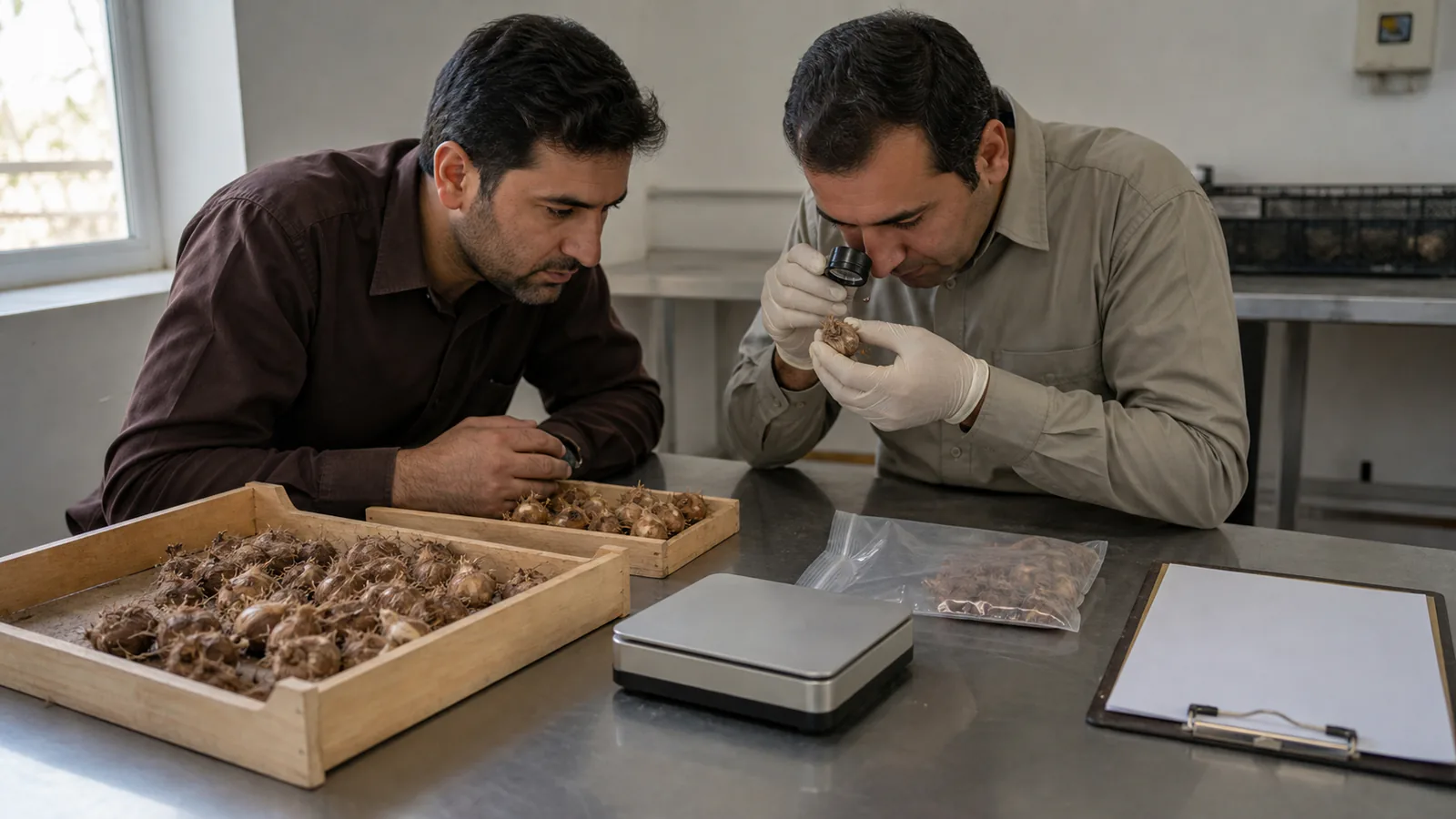
The “5 tons of saffron bulbs were smuggled” headline records a statement made by Iranian anti-smuggling official Abbas Nakhaei in late November 2015. He said that more than five tonnes of saffron planting material had been smuggled during the first half of the Iranian year, particularly towards Afghanistan. The surviving report does not identify a single five-tonne seizure, a case number or the consignments behind the total, so the figure remains an attributed period estimate rather than a fully documented incident.
The original page is difficult to follow because an automated translation mixed that saffron statement with every other subject in Nakhaei’s press briefing. Citrus, rice, medicinal plants, livestock and powdered milk all appear without clear transitions. Reconstructing the source makes the saffron claim easier to understand and prevents unrelated warnings from being mistaken for advice about saffron.
What Abbas Nakhaei reported
Nakhaei was introduced as director-general of the Target Goods Anti-Smuggling Office at Iran’s Central Headquarters for Combating the Smuggling of Goods and Foreign Currency. A Persian reproduction of the ISNA report, dated 8 Azar 1394, or 29 November 2015, quotes him as reporting the smuggling of more than five tonnes of saffron corms in the first half of that year, especially to Afghanistan.
“First half of the year” refers to the first six months of the Iranian year 1394, not January through June. The report does not break the total into dates, border points, vehicle loads or enforcement files. Nor does it say that five tonnes were found together. Those omissions matter. A period total assembled from several cases is different from one intercepted shipment, and neither should be described more precisely than the source allows.
The term “smuggled” is also an enforcement conclusion, not a botanical description. To assess it independently, a reader would need to know what export restriction or customs requirement applied to each movement, whether any permits were presented, and how origin and destination were recorded. The published briefing does not provide those details.
Saffron bulbs are corms, not the dried spice
Growers and older news reports commonly say saffron bulbs. The more accurate botanical term is corms. A corm is living planting material; dried saffron consists of the harvested stigmas of the flowers. The two commodities have different uses, risks and timelines.
This distinction is unusually important for Crocus sativus. The plant is a sterile triploid and reproduces vegetatively through corms. A 2024 study of corm development describes corm size as one of the variables related to saffron yield. Moving corms can therefore transfer production capacity, but it does not create a matching weight of dried spice. A five-tonne corm figure cannot be converted into hectares, flowers or future kilograms of saffron without corm size, planting density, survival, field conditions and time.
It also follows that a corm case should not be combined with a dried-saffron trafficking case. Our account of the South Khorasan corm seizures and the separate Kashmar dried-saffron theft shows why each event needs its own record.
Why unrecorded corm movement is a plant-health issue
Debate in the saffron trade often concentrates on future competition. There is another reason to document planting material: living corms and any soil or growing medium travelling with them can carry pests and pathogens. This is not a judgment about a country. It is a property of plants for planting.
The International Plant Protection Convention treats plants for planting as an important pest pathway. Its standards describe pest-risk analysis, inspection, sampling and phytosanitary certification as tools for managing international movement. An official certificate does not decide a customs-smuggling case, but it does establish plant-health information that an undocumented load may lack.
For saffron, useful records would identify the grower or nursery, source field, corm lot, net mass, health inspection, any treatment, carrier, consignee and border declaration. That paper trail protects farms on both sides of a border. It can also distinguish lawful trade from an allegation based only on where a vehicle was headed.
Afghan saffron cultivation was already established
The destination named by Nakhaei was Afghanistan. That does not mean every Afghan saffron corm came from the five-tonne movement, or even from Iran. Afghanistan had saffron cultivation before the briefing. FAO’s legal database records an Afghan regulation on purchasing and distributing saffron planting material and developing cultivation dated 6 August 2015. FAO also identifies Herat-Bastan saffron with established production districts in Herat Province.
Those records confirm that Afghanistan was building a saffron sector. They do not reveal the origin of the corms in Nakhaei’s estimate. Proving that link would require consignment or seizure records with traceable origin. It is safer to keep the two facts separate: Afghan cultivation was expanding, and an Iranian official reported more than five tonnes of corm smuggling, particularly towards Afghanistan.
Another 2015 Iranian warning, attributed to agricultural committee member Ali Hosseini, discussed years of alleged corm movement and the effect on Khorasan growers. It is preserved separately in our archive on significant saffron-corm smuggling to Afghanistan. That article is a different interview and should not be used to fill gaps in Nakhaei’s five-tonne figure.
What the wider press briefing said
The rest of the old page did not describe saffron. It reported Nakhaei’s broader review of agricultural and consumer-goods trafficking. Keeping that context explains the abrupt subject changes and preserves the original statistics without pretending they belong to the corm total.
Crop and medicinal-plant figures
Nakhaei said discoveries involving rice, several kinds of pulses, peanuts, garlic, sesame and medicinal plants totalled about 5.21 million kg during the first half of the year. Rice accounted for a reported 3,000,507 kg. A separate subheading gave 738,000 kg of medicinal plants and attributed the volume to weaknesses in production and export planning that required investigation.
These are enforcement statistics quoted in a news report, not a current crop-market dataset. The article does not provide a downloadable case list or explain whether the categories overlap. They should not be added together again or projected to a full year.
Citrus seizures and southern routes
For citrus, the briefing reported 320,000 kg of oranges, 147,000 kg of limes and 56,400 kg of mandarins or tangerines. Nakhaei said all of those discovered consignments were destroyed after the relevant authorities’ assessment. He referred to Article 12 of Iran’s Plant Protection Law, production-origin and transport requirements, and the risk of Mediterranean fruit fly. Those legal and technical reasons were his explanation for the action; the surviving article does not reproduce the inspection reports.
He also described goods loaded from Egypt, South Africa and Latin America, moved through Persian Gulf countries and then brought by sea across Iran’s southern border. The report says controls had been increased. This route description concerned the wider briefing and should not be attached to the saffron-corm movement unless a corm case file identifies the same route.
Livestock and the mistranslated milk warning
The source attributed further first-half discoveries to the agency: about 214,000 head of large livestock, 26,600 head of small livestock, and some birds of prey and poultry. It said recovered birds of prey were handed to the environmental authority. Camels were named as the priority for animal identification in a passage referring to coronavirus disease risk, written during the period of concern about MERS.
The instruction in the old English page to avoid buying “milk” from grocery shops was a translation error. Nakhaei was speaking about smuggled milk powder, alongside pesticides, canned foods, juices and compotes. He advised consumers in Iran at that time to buy the relevant milk-powder product from pharmacies and check its health-registration number. It was a separate public-health message, not a claim about saffron, corms or fresh milk.
What would verify the five-tonne claim?
A useful corm-smuggling record would let a reviewer follow the material rather than repeat a headline. At minimum, it would show:
- the enforcement case or cases included in the period total;
- discovery dates, locations and the direction of travel;
- the measured net mass and, where practical, corm count and size class;
- source-field, owner, carrier and intended consignee information;
- the customs classification, declaration, licence or restriction involved;
- phytosanitary inspection, sample and chain-of-custody records; and
- the final administrative or court outcome, rather than an allegation alone.
Those details would answer questions the 2015 article leaves open. They would also prevent later reports from combining five-tonne, four-tonne, 12.8-tonne or 23.31-tonne figures that came from different places and periods.
The careful conclusion
Abbas Nakhaei did report that more than five tonnes of saffron bulbs were smuggled in the first half of Iranian year 1394, especially towards Afghanistan. That is the basis of this post’s title. The accessible source preserves the speaker, period and direction, but not the underlying cases. It does not support treating the figure as one seizure or as a current annual rate.
The lasting lesson is practical. Saffron corms are living, economically important planting material, so their movement needs customs records, plant-health controls and lot-level traceability. Afghanistan’s legitimate saffron production should not be used as proof of an undocumented route. Clear records protect Iranian growers, receiving farms and the credibility of every enforcement statistic.
Sources and review note
- Tejarat News reproduction of the 29 November 2015 ISNA briefing (secondary archive used because the original ISNA page was not located)
- Plants: Understanding the Saffron Corm Development, 2024
- International Plant Protection Convention: adopted phytosanitary standards
- IPPC ISPM 12: phytosanitary certificates
- FAOLEX: Iran country profile and Plant Protection Law listing
- FAOLEX: Afghanistan cultivated-plant regulations
- FAO: Herat-Bastan saffron and Afghan production areas
Reviewed 29 August 2026. Historical quantities remain attributed to the 2015 briefing. No current trafficking rate, single five-tonne seizure or case outcome is inferred from them.

![Exporting Saffron to Turkey + Price Guide [Complete 0 to 100]](https://img.rowhanisaffron.com/20260827003933/saffron-export-turkey-quality-inspection.webp)



