


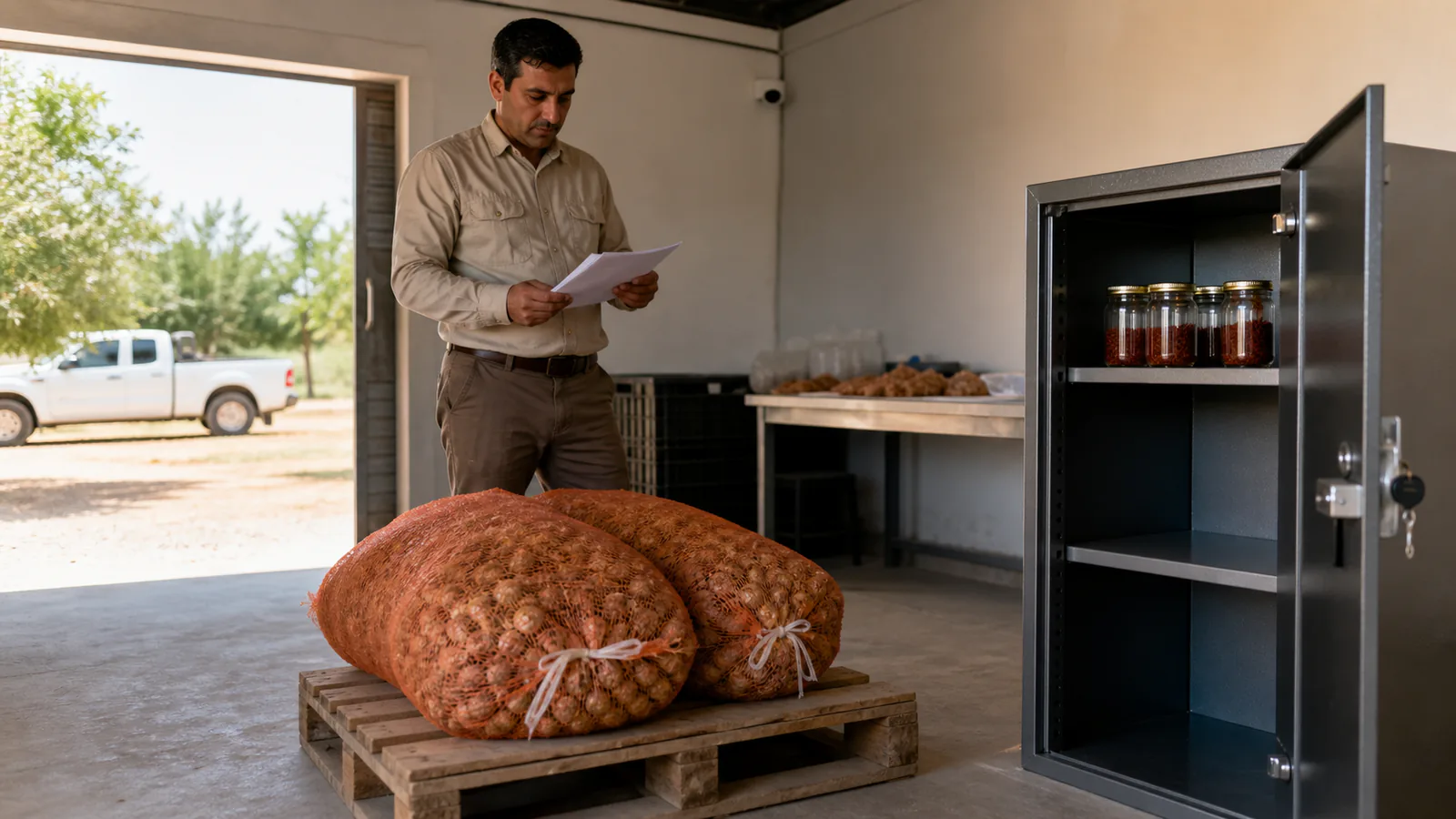
Three historical incidents illustrate two different saffron-security problems. In South Khorasan, one report described 12.8 tonnes of saffron corms seized across five vehicles, while another described a Nissan pickup carrying an unspecified quantity of corms without a cargo permit. In Kashmar, the stolen property was not planting material: it was three kilograms of finished saffron and 55 million rials in cash taken from a home.
Bringing these accounts together makes their differences easier to see. A transport case is about origin, destination and documentation for planting stock. A house theft is about protecting a compact, high-value product and maintaining an inventory that can be identified and recovered. Neither type of report should be stretched beyond the facts it actually supplies.
The reported 12.8-tonne South Khorasan seizure
The destination article attributed its main account to ISNA’s South Khorasan regional reporting and to Sarayan police commander Colonel Baradaran. It said officers discovered 12 tonnes and 800 kilograms of saffron corms during the planting season. Six people were reportedly arrested, five vehicles were seized, and the accused were referred to judicial authorities for legal proceedings.
The surviving English translation wrongly rendered the stated cargo value as 200 million dollars. The underlying sentence says 200 million rials, so the corrected unit is preserved here. That figure is an attributed historical case value, not a current quotation for saffron corms.
The report also said the discovery occurred in August, but its surviving copy does not identify the relevant year or calendar clearly. Its page timestamp predates August in the same Gregorian year, so treating that timestamp as the incident date would create a contradiction. The exact incident date remains unverified.
A separate Sarayan pickup case valued at 83 million rials
Another report from Sarayan described a different road-control incident. According to Colonel Baradaran, officers stopped a Nissan pickup carrying saffron corms without a cargo permit. Experts reportedly valued the load at 83 million rials, a case was filed and the person involved was referred to the judicial authorities.
This account did not state the cargo weight. It would be wrong to infer it from the value or from the 12.8-tonne case. The two reports may share a place, an official surname and a general subject, but they supply different quantities, vehicles and values. They should remain separate events unless an original case record proves otherwise.
The Kashmar theft involved dried saffron and cash
The Kashmar source concerned a reported theft from a home in the Hosseinabad district. Police chief Colonel Abolqasem Bagheri said three kilograms of saffron and 55 million rials in cash had been stolen. The account said investigators identified and arrested a 43-year-old suspect in less than 24 hours after judicial coordination, then recovered the saffron and money during a search of the suspect’s hiding place.
The report described the suspect as having an opiate dependency. That is a sensitive attributed detail, not an explanation for the alleged offence, and no causal claim should be drawn from it. The surviving article gives no case number, trial result or later judicial disposition, so arrest and recovery must not be rewritten as a final conviction.
Why the three incidents must not be blended
The two Sarayan accounts concern corms—the underground planting structures often called saffron bulbs. The Kashmar account concerns harvested spice and cash. A reader following a future redirect from any of the three old URLs should be able to find the promised facts without being led to believe they describe one operation.
- The largest report states 12.8 tonnes, 200 million rials, six accused and five vehicles.
- The second Sarayan report states one Nissan pickup, no cargo permit and an 83-million-rial valuation, but no weight.
- The Kashmar report states three kilograms of dried saffron, 55 million rials in cash and recovery in under 24 hours.
Adding those values or quantities would be meaningless. They relate to different goods, incidents and valuation bases.
What “saffron bulb smuggling” means in these reports
“Saffron bulb” is the common market phrase; botanically, Crocus sativus is planted from corms. The police reports used trafficking or smuggling language because the movements were said to lack required documentation or to fall within a local enforcement campaign. They did not reproduce the governing permit provision or final court ruling.
For that reason, this article reports what the named officials said rather than issuing its own legal judgment. Whether a particular movement is permitted depends on the applicable rules, cargo origin, destination and documents at the time. Anyone arranging a current shipment should obtain requirements from the competent local authority, not treat an old news translation as legal advice.
Why traceability matters for planting material
A corm consignment carries more than weight. Its field or nursery of origin, lot identity, size grade, condition and intended planting location affect its agricultural value and the ability to investigate a later problem. A waybill can document transport, but it does not by itself establish corm health or performance.
The International Plant Protection Convention’s ISPM 36 identifies origin, production conditions and type of planting material as relevant pest-risk factors. That is international plant-health guidance, not proof of the specific Iranian rule applied in the Sarayan cases. It supports the narrower practical point: planting material needs traceable origin and condition records.
A useful corm-shipment record
For growers, buyers and inspectors, a defensible record would identify:
- the supplier, buyer and field or nursery of origin;
- the botanical material and corm size or grade;
- lot number, sack count, net weight and weighing method;
- visible-condition findings and any required plant-health inspection;
- vehicle, route, intended destination and transport documents;
- the authority and case reference if a load is detained.
The historical stories provide only fragments of this chain. The 12.8-tonne story gives weight and vehicle count but not lot or weighbridge records. The 83-million-rial case gives a vehicle and valuation but no quantity. That is why neither report can serve as a current price or quality benchmark.
Why dried saffron needs a different security plan
Finished saffron is compact and can represent substantial value in a small space. The Kashmar report’s prevention advice was to use safes or anti-theft lockers and cameras, and to avoid leaving cash and valuables unprotected in homes or workplaces. Those measures address theft; they do not replace product inventory and access records.
Current Police.uk business-security guidance similarly recommends operational CCTV covering vulnerable areas, adequate lighting and moving high-value goods away from vulnerable displays. The exact design should fit the premises. A camera pointed at the wrong area or a safe whose access is widely shared offers weaker evidence and control than its presence might suggest.
Inventory records help before and after an incident
Physical controls work best with records that show what was present. For saffron stock, that means batch or lot identity, grade, sealed weight, storage location, receipt and release times, and the people authorised to handle it. Cash should be recorded separately rather than folded into product value.
If a loss is reported, an inventory can distinguish a measured shortage from an estimate. It can also help identify recovered goods without relying only on appearance. None of the three historical articles supplied batch numbers, packaging details or photographs tied to an evidence log, so this article does not claim that level of verification for them.
Reported values are not current market prices
The 200-million-rial and 83-million-rial figures were case valuations for corm loads. The 55-million-rial figure was cash reportedly stolen alongside dried saffron. They cannot be compared as if they were three saffron prices.
Even within the two corm cases, a price-per-kilogram calculation would be invalid for the 83-million-rial load because its weight is missing. For the larger load, the story does not state the corm grade, health, valuation method or date reliably. A current purchasing decision requires a current quotation tied to an identified lot and delivery terms.
Evidence the archived reports do not provide
Original dispatch links, incident dates, case numbers, the exact permit requirement, weighing records and final judicial outcomes would materially strengthen the two transport accounts. The Kashmar report would benefit from a police incident reference, an itemised recovery record and the final court disposition.
The absence of those records does not prove the reports false. It sets the boundary between an attributed news account and an independently verified case history. Words such as “reported,” “according to” and “the account said” preserve that boundary.
Practical lessons for saffron businesses
For corms, confirm the supplier, lot, quantity, condition, destination and required documents before loading a vehicle. Keep the commercial record distinct from any plant-health record, because they answer different questions. Our earlier review of two other reported saffron-corm seizures shows the same need to separate attributed incident facts from current legal or price advice.
For dried saffron, restrict access, maintain batch-level inventory, use suitable secure storage and make sure surveillance and lighting actually cover the vulnerable areas. If an incident occurs, preserve records and contact the competent authorities rather than conducting an informal accusation.
A careful reading of the historical record
The useful facts are specific: 12.8 tonnes and five vehicles in one South Khorasan account; a separate permitless pickup valued at 83 million rials; and three kilograms of dried saffron plus 55 million rials recovered after a Kashmar house theft report. The uncertainties are specific too: dates, legal provisions, evidence records and final outcomes.
Keeping both sides visible produces a more useful article than repeating the old headlines. It answers what each source promised, corrects the currency mistranslation and turns the incidents into practical lessons about traceable corm movement and secure saffron storage—without pretending the archived copies prove more than they do.

![Exporting Saffron to Turkey + Price Guide [Complete 0 to 100]](https://img.rowhanisaffron.com/20260827003933/saffron-export-turkey-quality-inspection.webp)



