


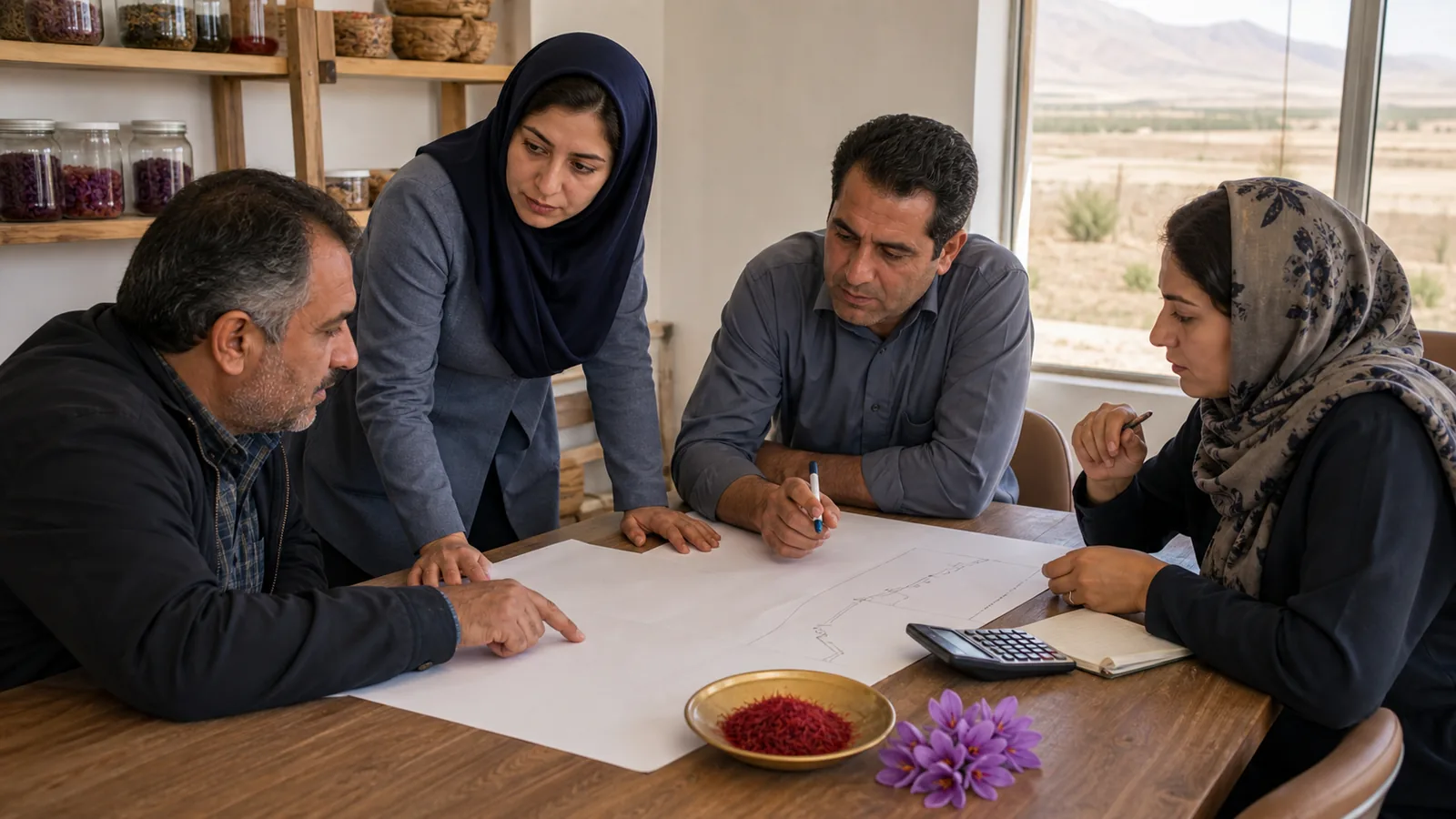
The statement that the saffron national plan was not passed in the state came from a Khorasan Razavi agricultural official in 2015. In the surviving report, the obstacle was a lack of budget, not a lack of “credibility” as the old English translation says. Later agricultural reporting described a national plan as Cabinet-approved, under revision and still awaiting defined funding. The apparent contradiction is a reminder that policy approval, budget approval and implementation are different milestones.
This article keeps the original announcement and all of its figures as a historical record. It also separates the saffron plan from the other provincial projects mentioned in the same speech, corrects damaged currency translations and explains what evidence would show that a national plan is actually operating.
What the 2015 Khorasan Razavi report said
The post attributed the remarks to the director-general of Agricultural Jihad in Khorasan Razavi. The official’s surname appears as Mazrouei in Persian transliteration and as “Mazrui” in the old English copy. He said that, despite extensive follow-up, the national saffron plan had not been approved by the government because sufficient funds were unavailable.
He connected the funding pressure to oil revenue, stating that every one-dollar decline in the oil price caused damage equivalent to one trillion tomans for the country. That is a quotation from the period, not an economic calculation established by this article. The report gives no oil benchmark, exchange-rate basis, fiscal model or date range with which to reproduce it.
Mazrouei also said there had been no shortage of agricultural inputs that year and that more than the required amount was stored in warehouses. The article does not identify the inputs, quantities, warehouse records or distribution dates, so “surplus” should remain an attributed statement rather than a verified inventory total.
The 133 projects were not the saffron plan
Another part of the speech concerned 133 provincial projects scheduled to begin operating during the Ten-Day Dawn period. Their stated credit was 383 billion rials, and they were expected to create work for 605 people. The old translation incorrectly changed 383 billion rials into 383 million US dollars.
The reported sector split was 60 percent for water and soil, 27 percent for livestock, and 8 percent for plant production and other sectors. Those shares add to 95 percent. The source does not allocate the remaining five percentage points, so rounding or a missing category is possible; inventing one would be wrong.
These projects appeared in the same interview, but the text did not say that their 383-billion-rial budget funded the national saffron plan. Treating all 133 projects as saffron projects would collapse two different announcements and create a budget that the source never claimed.
The water-line and crop-pattern figures also need their original units
Mazrouei said that in Iranian year 1393, roughly corresponding to 2014–15, more than 100 billion tomans had been allocated for laying 2,000 kilometres of water-transmission pipe. The same physical target was mentioned for 1394. Again, the damaged English copy labelled the money as US dollars; the underlying unit was tomans.
He then described a crop-pattern objective: reduce production of water-intensive crops such as melons and fodder by 10 percent, while increasing other products, including pistachio and saffron, by 26 percent. He called crop-pattern reform the most important factor in improving agricultural productivity.
Those percentages do not reveal the baseline tonnage, area, water use, geography or deadline. A 10-percent reduction in output is also not automatically a 10-percent water saving. Water accounting has to identify what is measured, what farmers plant instead, and whether saved water is actually left available or consumed by expanded area elsewhere.
Why later reports sound different
An Iranian Agricultural News Agency report published later in 2015 described the national saffron plan as a strategic document for the Sixth Development Plan. It said the intended scope ran from production to export and included the quantitative and qualitative development of saffron in South Khorasan and Khorasan Razavi.
In 2016, IANA reported that the plan was in final review. A ministry official said its drafting had ended in Iranian year 1391 and that it had Cabinet approval, while its information was being updated and funding needs were to be submitted to government after completion.
These reports may refer to different versions or administrative steps. They support a narrower conclusion than either headline alone: a policy framework could be approved while its updated programme and budget were not yet ready to operate. Without the final plan text, appropriation and implementation reports, it is unsafe to claim that the plan was wholly rejected, fully funded or currently active.
What a national saffron plan needs to specify
A plan becomes testable when it names the problem, responsible body, baseline, action, budget, deadline and public measure of success. “Support saffron” is not enough. Production, plant health, harvest labour, drying, testing, authenticity, packaging, finance and export access involve different actors and different evidence.
The UNIDO diagnostic study of Iran’s saffron value chain, prepared around the same period, mapped growers, dealers, processors, packers, exporters and market relationships. Its value is the chain view: a farm programme can raise output yet leave the grower no better off if quality loss, weak finance or poor access to final buyers absorbs the gain.
A credible national plan should therefore publish at least:
- the approved version, legal authority and start date;
- budget lines, funding source and actual annual expenditure;
- named delivery bodies and boundaries between national and provincial work;
- baseline data with definitions for area, yield, water, quality and exports;
- farmer outcomes, including net return and payment timing rather than output alone;
- plant-health, testing, traceability and authenticity measures;
- milestones, independent review and a method for correcting failed actions.
Numbers should be disaggregated enough to reveal trade-offs. A national increase can hide falling yields in an older province. A large pipeline target can hide low delivery or poor maintenance. A higher export value can reflect price changes rather than more product or more income reaching farmers.
Water policy cannot be reduced to “plant more saffron”
Saffron is often described as suitable for dry regions because much of its active growth falls outside the hottest months and it can create high value from limited land. FAO’s profile of the Qanat-based saffron system in Gonabad places that benefit within a particular water, livelihood and heritage system. It does not say that every field should switch to saffron or that the crop needs no water.
Crop-pattern reform must begin with a basin or aquifer constraint, not a national slogan. Planners need to compare water source, timing, salinity, return flow, local food and fodder needs, labour peaks, soil suitability and market capacity. If many growers expand the same high-value crop without buyers or harvest labour, the apparent water solution can become an income problem.
Our field guide to timely saffron irrigation explains why growth stage and local conditions matter. A national plan should fund the measurement and advice needed for those local decisions, not publish one schedule for every province.
Quality, authenticity and market value belong in the plan
Area and production are easy to announce, but buyers pay for an acceptable, consistent and traceable lot. Harvest timing, stigma separation, drying, storage, testing and honest labelling determine how much of a crop reaches that standard.
That remains a live policy issue. In November 2025, FAO and Iran held a national workshop in Mashhad on saffron quality integrity and value-chain development. The programme brought together farmers, processors, cooperatives, traders and national experts around production practice, post-harvest handling, safety, traceability, marketing and digital branding.
This later activity should not be described as proof that the 2015 national plan was finally funded. It is evidence that many of the same value-chain needs still require coordinated work. The distinction protects the historical record and prevents a newer project from being retrofitted into an older policy promise.
How to judge implementation rather than announcements
A reader should be able to follow a line from approval to money, from money to delivery, and from delivery to an outcome. For each year, the responsible body can publish what was budgeted, released, spent and completed. Project counts should show location, purpose and operational status, not merely inauguration.
For farmers, the outcome is practical: healthier corms, better advice, reliable water management, sufficient harvest capacity, less quality loss, credible testing and a market that pays for the resulting grade. For public investment, the result is not a press release but a measured change against a dated baseline.
The 2015 statement about a plan that was not passed remains part of the chronology. Later reports add necessary context: some form of approval appears to have existed, while revision and financing remained unresolved steps. The safest conclusion is not to choose the neatest headline. It is to ask which version was approved, what money was authorised, what actions followed and where the results were published.
The Mazrouei/Mazrui, oil-price, input-stock, 133-project, 383-billion-rial, 605-job, 60/27/8-percent, 2,000-kilometre, 100-billion-toman, 1393/1394 and 10/26-percent crop-pattern statements are retained as attributed claims from the site’s 2015 report. IANA, UNIDO and FAO sources were reviewed on 29 August 2026; no historical budget or plan status is represented as current.

![Exporting Saffron to Turkey + Price Guide [Complete 0 to 100]](https://img.rowhanisaffron.com/20260827003933/saffron-export-turkey-quality-inspection.webp)



