


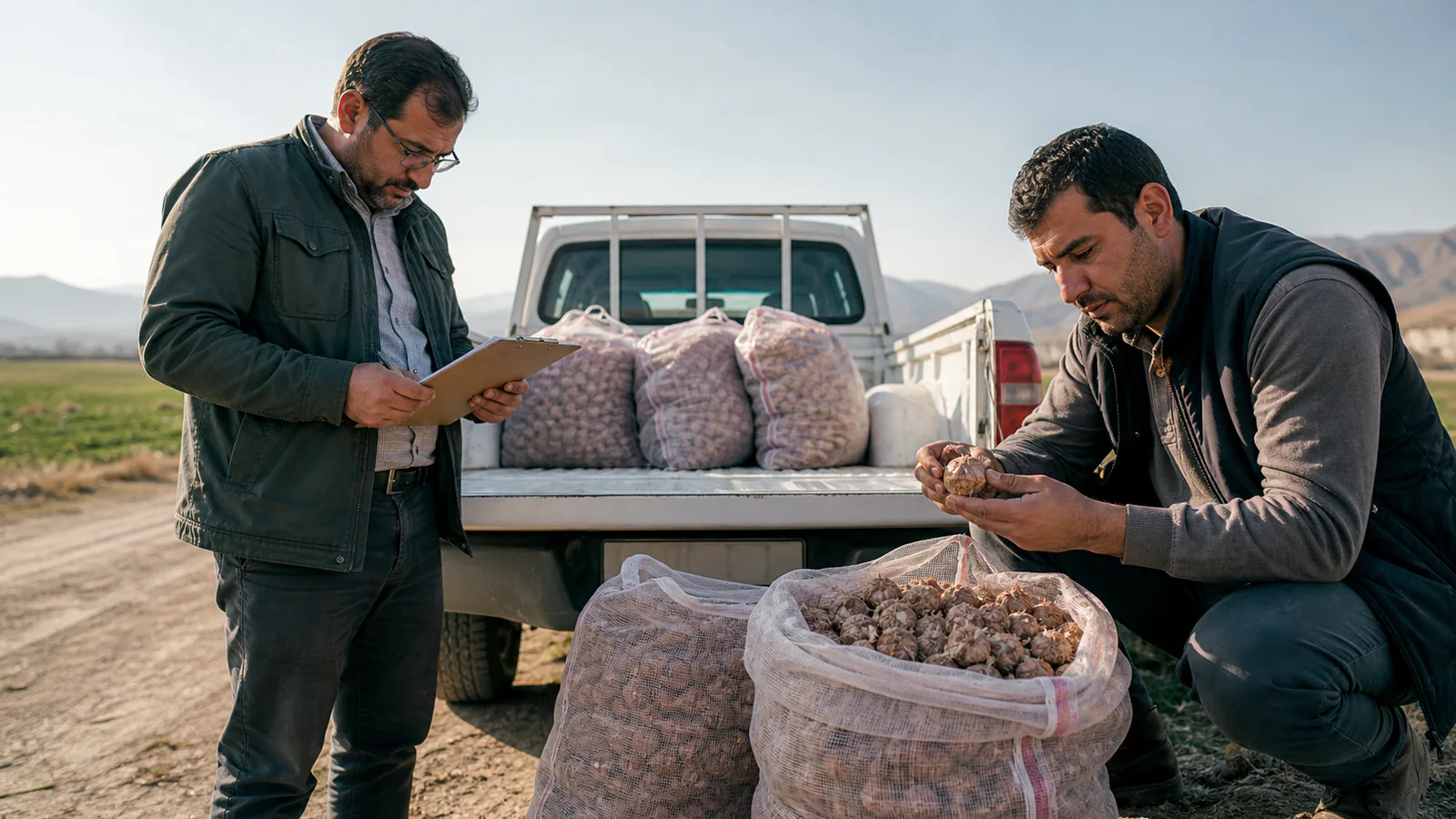
Two historical reports described saffron bulb trafficking in eastern Iran: a four-tonne load stopped near Sarayan and a much larger group of loads—reported as 40 tonnes across 20 pickup trucks—on the Bakhrz–Torbat-e Jam road. Both accounts concern planting material rather than the dried red spice sold for cooking. They also show why a headline about a seizure cannot, by itself, answer every question about legality, plant health or market impact.
Growers often call this planting material a saffron bulb. Botanically, it is a corm: the underground structure from which Crocus sativus grows. That distinction matters because moving corms can move an entire crop’s productive potential. It can also move poor-quality or unhealthy material if origin and condition are not checked.
The four-tonne Sarayan case
The first report placed the smaller incident on a road in Sarayan County, South Khorasan. It attributed the account to police commander Mohammad Esmail Baradaran and said officers from Ayask and the Masabi station became suspicious of a Nissan pickup during a road-control operation. According to the report, the driver changed direction after seeing the officers and was told to stop.
The account said the vehicle had no transport permit or waybill. A subsequent inspection reportedly found four tonnes of saffron corms. It added that the driver said the load had been bought in Sarayan and was intended for sale in Torbat-e Heydarieh. The vehicle was seized and the driver was referred to the judicial authorities, according to the same historical report.
Those details preserve what the original story promised: the amount, route, vehicle, stated destination and official response. They do not establish the final court outcome. The article supplied no case number, inventory sheet, weighing method, permit rule or judgment, so it would be inaccurate to infer a conviction from the roadside account.
The 40-tonne Bakhrz report
The second report concerned the Bakhrz–Torbat-e Jam corridor in Khorasan Razavi. It said officers identified 20 Nissan pickup trucks carrying a combined 40 tonnes of saffron corms. The stated value was about 1.2 billion rials.
District police chief Ali Mirjerdoudi was named as the source. The vehicles were reportedly seized, and the people involved were referred through a filed case to the district Agricultural Jihad office. The source article credited Jam-e Jam Online quoting IRNA, but the surviving copy did not include a publication date, dispatch link, case identifier or later disposition.
The figures therefore belong together as one attributed claim: 20 vehicles, 40 tonnes and a 1.2-billion-rial valuation. Dividing one number by another can illustrate the report—an average of two tonnes per vehicle—but it cannot prove that every pickup carried the same amount. Nor can the valuation be converted into a current corm price without the report date, corm grade, currency context and sale basis.
What the two incidents have in common
Both accounts describe road checks in saffron-growing provinces and use the language of unauthorised or trafficked planting material. Both name a public official and report vehicle seizure or referral. Most importantly, both are about traceability: who supplied the corms, what documentation accompanied them and where they were going.
They are not reports of the same event. The Sarayan account concerned one four-tonne load reportedly headed to Torbat-e Heydarieh. The Bakhrz account described 20 pickups and a total of 40 tonnes on a different road. Combining the stories should make that distinction clearer, not turn them into a single 44-tonne operation.
Why “bulb” and “corm” both appear
“Saffron bulb” is the familiar trade and search term, while “saffron corm” is the more precise horticultural term. Saffron is sterile and is propagated vegetatively, so planting stock is multiplied through replacement corms rather than ordinary seed. The quality of that stock affects what happens after planting.
A three-year study in Scientia Horticulturae found that mother-corm weight influenced flower, stigma and replacement-corm production. That result does not tell us the grade of either seized load; neither historical report recorded corm size, health or sampling. It explains why a tonne figure alone is an incomplete measure of agricultural value.
Documentation and plant health are separate checks
A waybill or transport authorisation can document a movement, but it does not by itself certify variety, disease status or planting performance. Conversely, healthy-looking corms are not proof that a shipment met every legal requirement. A credible record needs the questions kept separate.
For international movement, the International Plant Protection Convention’s standards treat plants for planting as an important pest-risk pathway. Exact requirements depend on the origin, destination and competent authorities. These global principles should not be misread as the specific Iranian rule applied in either domestic case; the original reports did not reproduce that rule.
What a useful consignment record would contain
A buyer, grower or inspector needs more than a dramatic quantity. A defensible record would normally identify:
- the supplier, buyer and actual field or nursery of origin;
- the number of sacks or containers, gross and net weight, and weighing method;
- corm size or grade, lot identity and visible condition;
- inspection, treatment or laboratory results where required;
- the transport document, vehicle identity and intended destination;
- the authority involved, case reference and final administrative or judicial outcome.
Neither archived story provides this complete chain. That absence does not disprove the reported seizures. It limits what can responsibly be concluded from them.
The reported domestic expansion programme
The Sarayan article also shifted from the seizure to a broader cultivation policy. It said 160 tonnes of saffron corms were to be distributed to farmers in 34 provinces to expand cultivation. The surviving text did not state the programme year, implementing agency document, recipient criteria or actual distribution achieved.
That statement should be read as a historical programme announcement, not a current supply figure. Planned distribution and unauthorised movement can exist at the same time because they answer different questions: one is an organised cultivation initiative; the other concerns the provenance and paperwork of a particular load. Our article on regional saffron cultivation explains the same need to separate a planting announcement from measured results.
The Afghanistan cultivation context
The older destination also included a long passage about expansion in Afghanistan. It reported studies identifying roughly 7,000 to 10,000 hectares of potentially suitable land and a possible 50–70 tonnes of production if cultivation succeeded. It further referred to training about 12,000 farmers, preparing cultivation instructions, obtaining 180 dryers and establishing three quality-control laboratories in Herat.
These are useful pieces of the article’s historical context, but the surviving copy did not name the studies, dates, training completion records or production series. Potentially suitable area is not planted area, and potential output is not harvested output. The account itself also listed constraints: access to suitable corms, storage and processing capacity, national standards, links between growers and exporters, and coherent public policy.
Why corm movement can affect growers
Corms embody several seasons of work. A poorly documented sale may leave a buyer unable to verify origin, grade or health, while an unrecorded movement makes it harder for authorities to trace a problem back to its source. For established growing regions, large outbound quantities can also prompt concern about local planting-stock availability. The two reports voiced that concern but did not provide stock balances or price series.
It would therefore be too strong to say that either reported load caused a shortage, raised prices or created cultivation abroad. Demonstrating those outcomes would require dates, lawful trade volumes, regional inventories, planting data and a counterfactual comparison. The reports document alleged movements; they do not measure the wider market effect.
How to read the quoted values
The 1.2-billion-rial figure in the Bakhrz story is a reported official estimate. Without a date and grade, it is not a useful present-day price guide. It is also unclear whether the figure represented a farm-gate estimate, wholesale value, assessed case value or another administrative basis.
The four-tonne report gave no cargo value. Supplying one by applying the other case’s average would create false precision: the incidents occurred in different places, may have involved different dates and may have contained different corm grades. Readers looking for a current purchasing decision need a current, documented quotation tied to size, health, quantity and delivery terms—not arithmetic built from an old news item.
What remains unverified
Several facts would materially strengthen this record: publication dates for both dispatches, the original police or Agricultural Jihad statements, weighbridge certificates, the legal provisions invoked, case numbers and final outcomes. For the cultivation passages, the underlying programme notice, Afghan land-suitability study and completion data would separate plans from results.
Until those records are available, the safest wording is “reported,” “according to the named official” and “the article said.” This is not empty caution. It preserves the substance of the two source reports without presenting an allegation, forecast or programme announcement as independently verified fact.
The practical lesson from both reports
The two cases are best understood as a traceability lesson. A saffron-corm shipment should have a clear origin, measurable quantity, documented destination and whatever transport or plant-health evidence the relevant authorities require. Growers also need quality information because equal weights of planting material can have very different agricultural value.
The historical record is specific where it can be: four tonnes near Sarayan; 40 tonnes in 20 pickups on the Bakhrz–Torbat-e Jam axis; a stated 1.2-billion-rial value in the latter case. It is equally important to be specific about what is missing. That balance gives a reader the promised facts without turning two brief reports into a claim they cannot support.

![Exporting Saffron to Turkey + Price Guide [Complete 0 to 100]](https://img.rowhanisaffron.com/20260827003933/saffron-export-turkey-quality-inspection.webp)



