


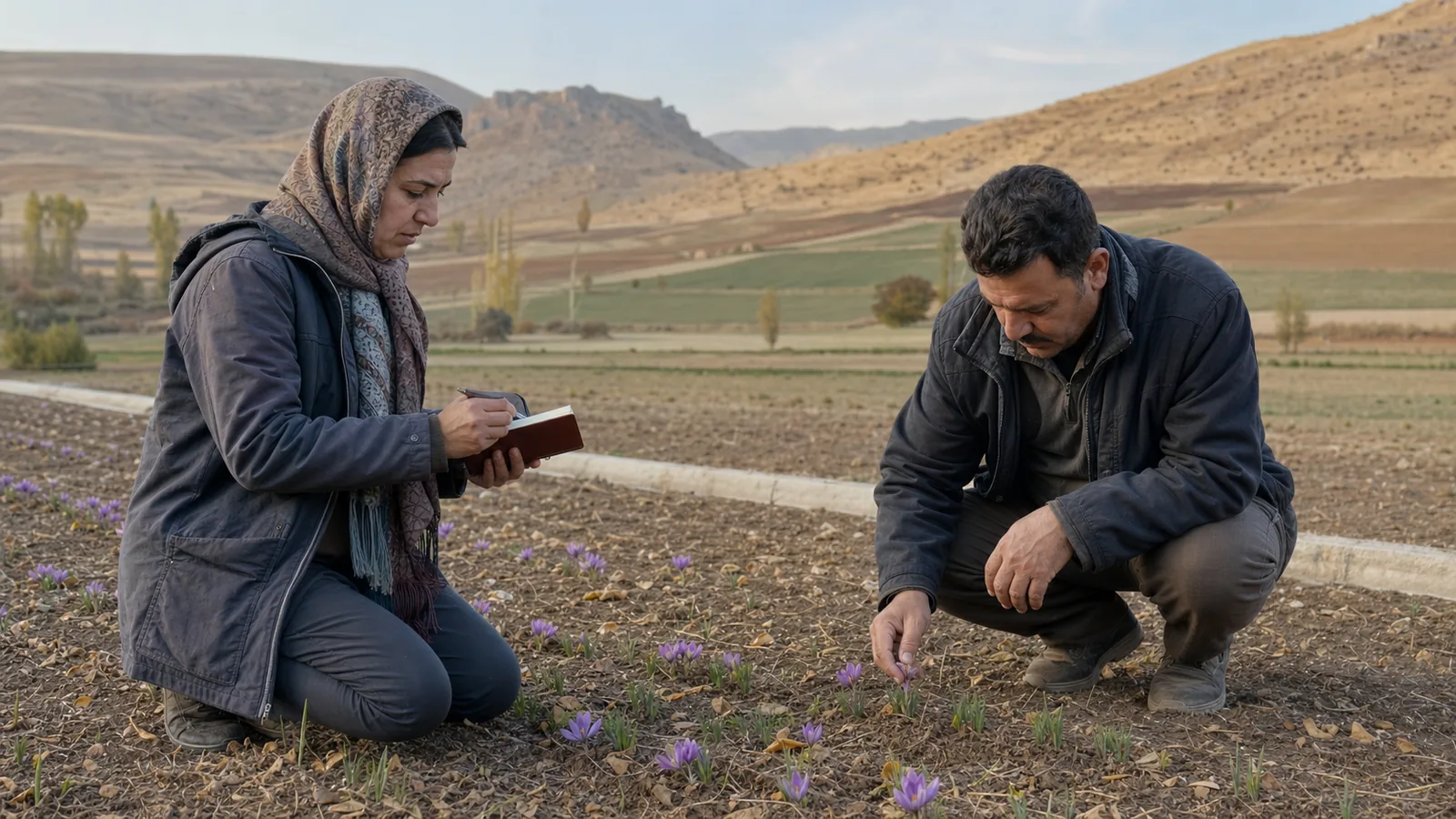
Famenin saffron cultivation increased from 1.5 hectares to more than seven hectares in the space of a reported year. Comparable historical accounts from Shahreza in Isfahan province and Khatam in Yazd province show the same pattern: small trials expanded as officials searched for crops that could fit declining water resources.
The figures are useful baselines, not current acreage or income data. Each source uses a different reporting period and provides different measures. This article keeps the regions separate, checks the calculations and distinguishes forecasts from harvested results.
Famenin grew from 1.5 to more than seven hectares
Jafar Kaviani-Javid, identified as head of Agricultural Jihad in Famenin County, said saffron area rose from 1.5 hectares in the previous year to more than seven hectares in the reporting year. Seven divided by 1.5 is about 4.67, so the area grew by at least 367%.
That is rapid expansion from a very small base. The source does not say how much of the new area reached bearing age, what dry yield was achieved or how many farms shared the hectares. Planted area should not be treated as the same thing as mature productive area.
The page was already indexed and receiving search visibility for Famenin and saffron cultivation in Iran. Its exact URL and Famenin-first purpose therefore remain unchanged even though the article now supplies the missing regional comparisons.
Why watermelon and sugar beet entered the discussion
Kaviani-Javid presented saffron as a possible alternative to relatively water-demanding crops such as watermelon and sugar beet. He linked the proposal to falling groundwater and reduced water resources and called for a better cultivation pattern and more productive use of available water.
The source’s phrase “low water content” is a mistranslation; the intended point is lower irrigation demand. Saffron is not water-free. Its autumn-to-spring growth and summer dormancy give it a different schedule, while actual need varies with soil, rainfall, temperature, planting density and field age.
A peer-reviewed study of irrigation and saffron corm intensity in a semi-arid region demonstrates why water and establishment choices need to be evaluated together. A sound replacement decision compares crop output, food role, labour, market risk and water use on the same farm rather than relying only on a “low-water” label.
The sugar-beet criticism was about planning
The translated Famenin account says “uncultivated cultivation” of sugar beet had caused improper water use. The more coherent reading is uncontrolled or insufficiently planned cultivation. The official said the following year’s sugar-beet area would need proper planning.
This is not evidence that sugar beet must disappear from Famenin. It records a local policy concern about matching crop area to constrained groundwater. Saffron can be one part of that discussion, but its economics also need to be proven under local yield and labour conditions.
Small plots, employment and village migration
Kaviani-Javid argued that saffron’s traditional, labour-intensive production model could suit small parcels. He expected it to create work, increase farmer income and reduce pressure for villagers to move to cities.
Those are development goals, not outcomes measured by the source. A small plot can use household labour and avoid the need for large machinery, but labour still has a cost. Flower picking and stigma separation occur in a short period and require enough people at the right time.
A later evaluation would need unique worker counts, person-days, gross revenue, full costs and household income before attributing changes in migration to saffron.
The historical policy context
The Famenin expansion was described within policies for national production and a “resistance economy.” That phrase identifies the context in which local officials promoted domestic strategic crops. It does not prove that each new hectare became profitable.
What matters agronomically is more concrete: healthy corms, a suitable site, measured irrigation, timely harvest, controlled drying and a buyer who values the resulting grade.
Shahreza expanded to 3.5 hectares
A separate report from Shahreza said about 1.5 hectares had been allocated to saffron in Iranian calendar years 1394–95, broadly spanning 2015–17, and another two hectares were planted in the reporting year. That brought the reported total to 3.5 hectares.
The source forecast 14 kilograms from the 3.5 hectares. If the whole area bore at that level, the implied yield would be four kilograms per hectare. It was an expectation at the start of harvest, not a final weighed total.
The official, identified in translation as Taky, hoped quality would improve as growers gained technical knowledge and experience. That is plausible as a programme goal, but the source supplies no laboratory or buyer data demonstrating the improvement.
The full source also contains unrelated material about apples, pomegranate pest control and safflower seed. Those subjects do not help a reader understand Famenin or saffron and are deliberately excluded. Our detailed article on Shahreza and Najaf Abad saffron trials provides the wider saffron-specific context without importing the agricultural roundup.
Khatam grew from about nine to 42 hectares
The Khatam report described saffron area rising from about nine hectares to 42 hectares. It called this a fivefold increase. The exact ratio is about 4.67 times, or a 367% increase, so “roughly fivefold” is a fair rounded description.
Crucially, only seven of the 42 hectares were described as bearing or productive; the remaining 35 hectares were young and not yet productive. That means 83% of the reported area had not reached the same production status. Applying a mature-field yield to all 42 hectares would overstate output.
The reported five-kilogram Khatam yield
Khatam’s Agricultural Jihad director reported an average yield of about five kilograms per hectare. The source does not explicitly say whether this average applied only to the seven bearing hectares, but that is the relevant denominator that a future dataset must identify.
If five kilograms applied to seven bearing hectares, the implied dry harvest would be about 35 kilograms. This is an illustrative calculation, not a sourced total. The 35 young hectares should not be assigned the same output until a later harvest proves it.
More than 60 million tomans per hectare
The Khatam source said one hectare generated more than 60 million tomans in income. It does not provide the reporting year, price per kilogram, grade mix or whether “income” means gross revenue or profit after costs.
The amount is therefore a historical attributed claim, not a current earnings estimate. At the reported five-kilogram yield, 60 million tomans would imply more than 12 million tomans per kilogram before resolving costs and scope. That arithmetic helps expose what the statement assumes; it does not validate the price.
About 1% of Khatam farmers grew saffron
The report counted roughly 10,000 people engaged in agriculture in Khatam and about 100 saffron growers. On those figures, saffron growers represented about 1% of the county’s agricultural participants.
The count shows that a fivefold area increase did not make saffron a universal crop. Expansion may have been concentrated among a relatively small group, and average hectares per grower cannot be calculated safely without knowing whether the 100 figure refers to farms, people or applications.
Khatam’s climate description needs correction
The translated source calls saffron a tropical plant, then describes hot summers, relatively mild winters and short-term tolerance of cold and snow. “Tropical” is not a useful label for cultivated saffron. The crop is grown in dry and temperate seasonal climates, and its response depends on the stage of its corm and leaf cycle.
Saffron is sterile and propagated through daughter corms, as explained in a peer-reviewed botanical review. A short cold event, summer heat and soil moisture affect different stages differently; a county climate description cannot replace field-level assessment.
What the three regional examples show
Famenin and Khatam both reported area increasing by at least 4.67 times, although their scales differed. Shahreza grew to 3.5 hectares and supplied a four-kilogram-per-hectare forecast. Khatam supplied a five-kilogram average but disclosed that most of its area was still young. Famenin supplied no yield.
That comparison illustrates why area alone is incomplete. A credible regional series should record:
- planted area and bearing area separately;
- dry-stigma harvest and yield for the same year;
- field age, corm source and irrigation basis;
- labour in person-days, not just broad employment claims;
- gross revenue, costs and price by grade; and
- tested quality for identified batches.
A preservation-minded conclusion
The indexed Famenin page remains a report about saffron cultivation in that Iranian city. Its strongest fact is the move from 1.5 to more than seven hectares as officials responded to groundwater pressure. Shahreza and Khatam add useful comparisons, but they do not replace Famenin’s purpose.
All three sources describe promising expansion. None proves current acreage or guaranteed income. Their value is as a dated record of how emerging regions tested saffron, which figures aligned, which ones require a denominator and what evidence a later follow-up should publish.

![Exporting Saffron to Turkey + Price Guide [Complete 0 to 100]](https://img.rowhanisaffron.com/20260827003933/saffron-export-turkey-quality-inspection.webp)



