


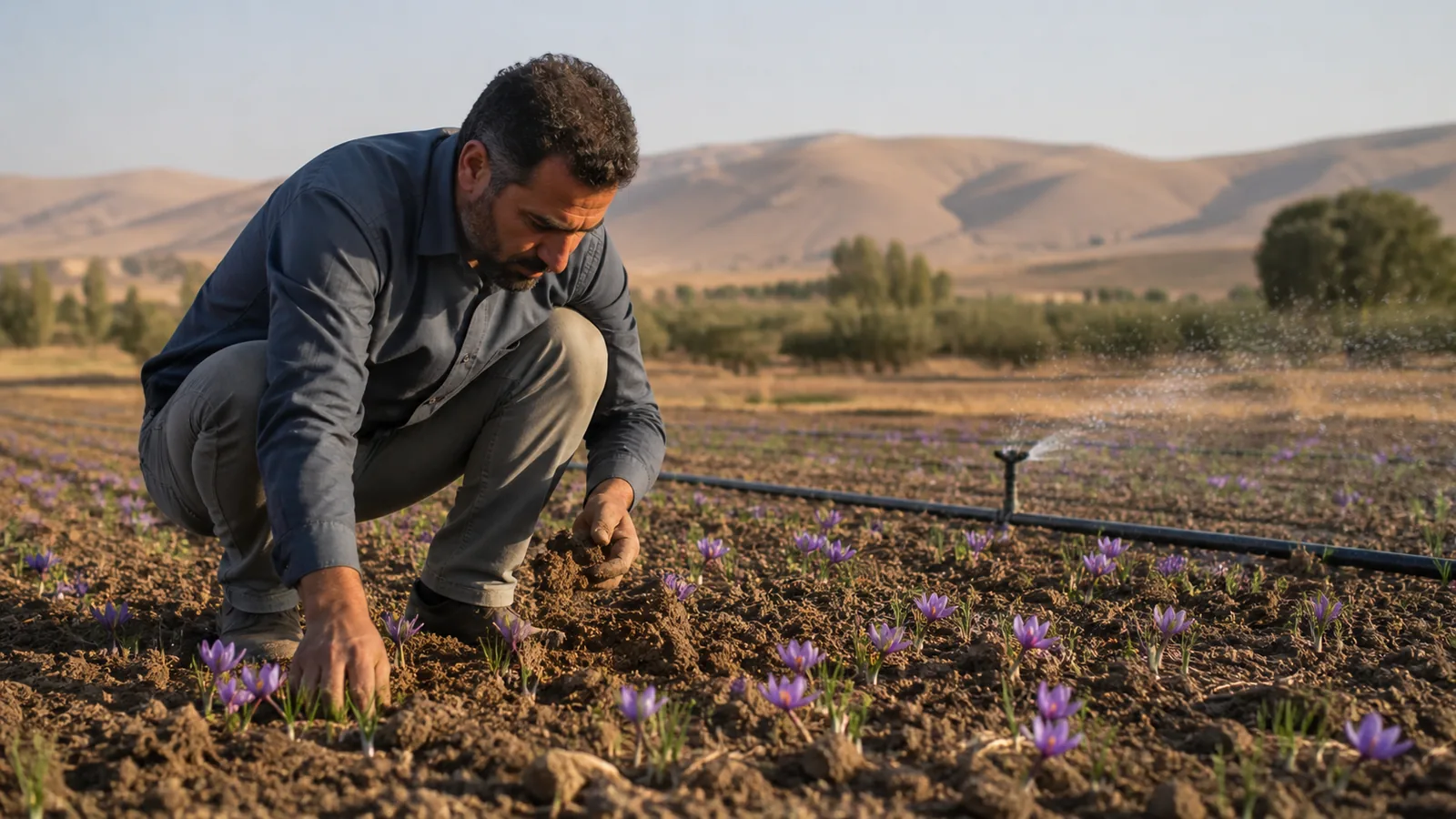
Shahreza saffron cultivation began with a reported three-hectare programme, while a separate trial in Najaf Abad covered 1.5 hectares under sprinkler irrigation. Both projects were presented as responses to drought and changing water availability in Isfahan province.
The reports describe plans and forecasts rather than completed commercial results. Shahreza’s account gives no harvested yield. Najaf Abad’s 4.5-kilogram-per-hectare figure was an expected average, not a measured outcome. Keeping that distinction clear makes the two local trials useful without overstating what they proved.
The three-hectare saffron programme in Shahreza
The director of Agricultural Jihad in Shahreza said saffron had been cultivated on three hectares of agricultural land for the first time. The archived report does not name the official or list individual farms. “First” is therefore best read as the first planting under the announced city programme, not proof that no resident had ever grown saffron before.
The stated aim was to test a crop with a different seasonal water pattern and, if it performed well, support gradual quantitative and qualitative growth. Productivity and employment were policy goals. No follow-up area, dry yield, quality result or number of jobs appears in the source.
Shahreza’s existing agricultural base
The report placed the trial within a much larger local farm economy. It attributed about 29,000 hectares of agricultural land to Shahreza and annual production averaging 35,000 tonnes of field crops, including wheat, barley and edible corn. Garden products were reported at 24,500 tonnes, with pomegranates, grapes, almonds and walnuts among the examples.
These are historical, attributed totals. The source provides no reporting year, survey method or district-level breakdown, so they should not be used as today’s production statistics. They do show why a three-hectare saffron planting was exploratory: it represented a very small part of the city’s agricultural land.
Drought was the reason for the crop-pattern discussion
Shahreza’s official linked the saffron trial to continuing drought and water shortages. The intention was to improve the structure of farming and horticulture while seeking better water productivity and employment.
Saffron’s summer dormancy and autumn-to-spring growth cycle can make its irrigation calendar useful in some dry areas. It still needs water at appropriate stages. Soil, rainfall, temperature, planting density and field age all affect the result; a peer-reviewed study of irrigation and saffron corm intensity in a semi-arid region shows why a single water slogan cannot replace field planning.
The source also contains an unrelated sentence claiming benefits for fatigue, strength and blood cholesterol. It supplies no study, dose or context, and the claim has nothing to do with the cultivation decision. It is not carried into this account.
What the source says about Shahreza’s location
The archived translation situates Shahreza in southern Isfahan province and refers to neighbouring Mobarakeh, Semirom, Fars province, Isfahan and Chaharmahal and Bakhtiari. It also gives a 2016 population of 159,797.
Its land-area figure appears as the corrupted string `7494/2983`, and its longitude sentence is incomplete. Choosing one number would manufacture precision, so neither value is presented as a verified area or coordinate. The defensible geographic point is that the programme was testing saffron in a dry part of the central Iranian plateau, not reproducing Khorasan conditions exactly.
Najaf Abad’s 1.5-hectare sprinkler-irrigated trial
The source assigned to this destination concerns Najaf Abad, another city in Isfahan province. It reports 1.5 hectares of saffron under sprinkler irrigation and attributes the information to an official whose translated name appears as Maryam Ameli.
The source title, “Planting saffron in rainy season,” is a mistranslation. The Persian phrase refers to sprinkler irrigation, not planting because rain had begun. This matters because the project was describing a water-delivery method rather than a seasonal planting recommendation.
No sprinkler specification, irrigation volume, schedule or field layout is supplied. The report therefore cannot establish that sprinklers are the best method for every saffron field. Equipment cost, wind, evaporation, soil infiltration and wetting of flowers or foliage all need local consideration.
The 4.5-kilogram yield was a forecast
Maryam Ameli forecast an average saffron yield of 4.5 kilograms per hectare. Applied to 1.5 hectares, that would imply about 6.75 kilograms of dried saffron if the whole planted area bore at the forecast rate.
That calculation clarifies the expectation; it does not turn it into a harvest result. The source gives no actual production, field age, sample basis or quality grade. A first-year planted area may not be comparable with a mature field, and forecast yield should not be used as guaranteed revenue.
Najaf Abad’s broader crop mix
The report described roughly 16,000 hectares of agricultural land in Najaf Abad. Its main field crops included wheat, barley, rice, corn and fodder. Orchard products included grapes, pomegranates, almonds, walnuts, apricots and apples.
It also identified medicinal plants, garlic and olives as areas of activity or opportunity under local weather conditions. Saffron was one option within that diverse system, not a recommendation to replace all established crops.
The mention of rice is especially important to the water discussion. A responsible crop-pattern analysis would compare the water, yield, labour, food role and income of each existing use instead of assuming that the crop with the highest sale price is automatically the best replacement.
The policy language behind the Najaf Abad project
Najaf Abad’s report said saffron had attracted attention under Iran’s “resistance economy” policy because officials viewed it as a relatively low-water crop with agricultural, economic and medicinal-product potential. That phrase identifies the historical policy context of the announcement.
It is not evidence that every planting was profitable or medically beneficial. Cultivation policy can create interest and support, but farm performance still depends on corms, site, water, labour, processing and a real buyer.
How the Shahreza and Najaf Abad trials compare
Shahreza reported twice the trial area: three hectares compared with 1.5 in Najaf Abad. Najaf Abad supplied a yield forecast and irrigation method; Shahreza supplied a larger city agricultural profile and a general management-plan ambition.
Their numbers should not be combined into a 4.5-hectare production result. They refer to different cities, programmes and probably reporting periods. The useful comparison is what each trial still needed to report:
- the exact planted and bearing area;
- corm source, size, density and field age;
- irrigation method, dates and water volume;
- actual dried-stigma yield and tested quality;
- labour hours, establishment and processing costs; and
- the selling channel and price received by growers.
Economic value has to be measured after harvest
Both reports describe saffron as economically suitable. The crop’s high unit value is only one side of the calculation. Harvest is labour-intensive, the saleable dried weight is small, and quality can be lost during separation, drying or storage.
A useful trial budget records household labour as a cost even if no wage changes hands. It also distinguishes farm-gate price from retail price and subtracts rejected product, packaging, finance and selling costs. Without those figures, “economic crop” remains a rationale for testing rather than a demonstrated margin.
The same evidence discipline is used in our reviews of emerging saffron areas in Qom and Nazarabad and Malayer. Area expansion, yield and profit are separate measures.
What these Isfahan-province reports establish
The archived evidence establishes two small saffron initiatives: a three-hectare planting in Shahreza and 1.5 hectares under sprinkler irrigation in Najaf Abad, where officials forecast 4.5 kilograms per hectare. It also records the crop mix and agricultural scale surrounding each trial and the water concerns that motivated them.
It does not establish current acreage, achieved yield or commercial success. A later report with common-year measurements could answer those questions. Until then, the value of these projects is that they began a controlled local test, not that they proved saffron could replace every water-demanding crop in the region.

![Exporting Saffron to Turkey + Price Guide [Complete 0 to 100]](https://img.rowhanisaffron.com/20260827003933/saffron-export-turkey-quality-inspection.webp)



