


Khorasan Razavi saffron cultivation covered an estimated 69,000 to 70,000 hectares in the historical provincial report, but officials warned that a larger planted area did not guarantee a larger crop. Water availability and autumn weather still constrained production. A smaller program in Malayer, Hamedan Province, makes the same point at a different scale: 23 hectares were expected to yield about 4 kilograms per hectare.
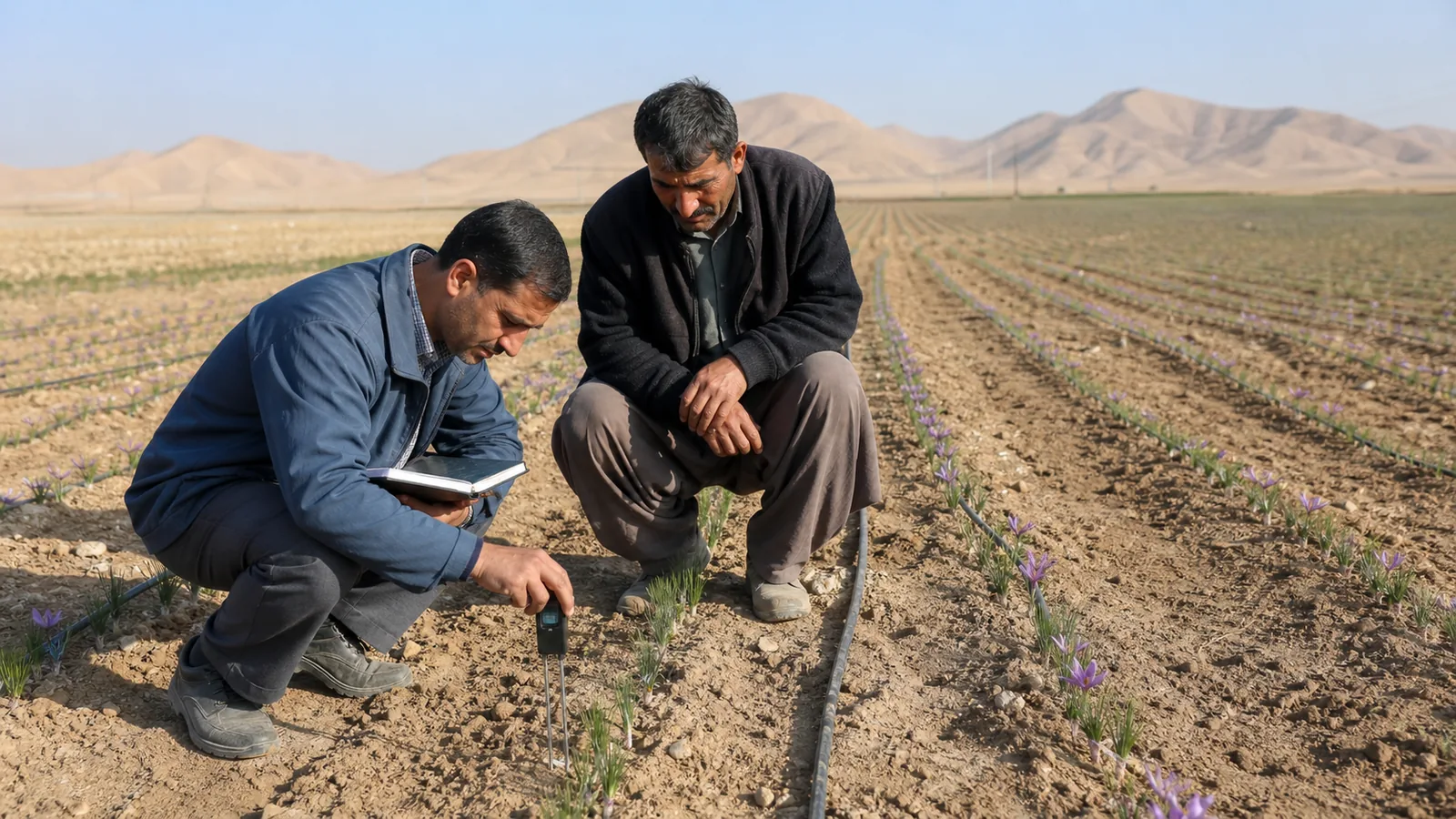
Both accounts are snapshots from their publication periods, not current acreage, price, finance, or permit notices. Their value lies in the relationship between land, water, and expected output.
Khorasan Razavi reported 69,000 to 70,000 hectares
Seyed Hashem Naghibi, identified as horticulture director of the Khorasan Razavi Agricultural Jihad Organization, said provincial saffron area had increased to between 69,000 and 70,000 hectares. The report rounds that range to 70,000 hectares in its headline.
Naghibi immediately qualified the expansion. In some areas, growers may have planted more land than their water resources could reliably support. Under those conditions, adding hectares could reduce output per hectare or leave part of the area under-served. The report does not give the previous acreage, so it is impossible to calculate the percentage increase.
It also does not distinguish mature productive fields from newly planted or temporarily inactive land. That means the area figure cannot be multiplied by a generic yield to create a credible provincial harvest total.
Why no harvest total was announced
Naghibi said it was too early to publish a production estimate because the crop still depended on autumn rainfall. The statement should be read as a forecast limitation for that season, not a claim that rainfall alone determines saffron output.
The official reported no shortage of saffron corms, but he described water as a restricted input in dry Khorasan Razavi. Farmers were asked to match the land they planted to the water actually available to them.
This distinction is central to the article: cultivated area, irrigable area, productive area, and final dried output are different measurements. A larger first number can coexist with a weaker harvest if the other conditions deteriorate.
The historical cooperative price mechanism
The report did not announce a final saffron price. Naghibi said that once harvest entered the market, farmers could take produce to the relevant cooperative if prices fell below a designated minimum and sell under an agreed-price arrangement. He presented this as a way to reduce dependence on intermediaries and limit losses.
No minimum price, eligibility rule, cooperative name, purchase volume, payment date, or later outcome appears in the article. The mechanism must therefore remain historical and attributed. It is not evidence that the same purchasing program or terms are available now.
Malayer’s 23-hectare cultivation program
In Malayer, a separate local report placed saffron cultivation at 23 hectares. Gholamhossein Taghavi, then head of the city’s agricultural office, forecast about 4 kilograms per hectare. If all 23 hectares produced at that rate, the implied total would be approximately 92 kilograms.
The official described the expected crop as excellent quality, but the report supplies no grade, laboratory analysis, sampling method, or final harvest result. The quality statement remains his forecast rather than an independently verified classification.
Hamedan Province was encouraging saffron, medicinal plants, and greenhouse production as alternatives in areas facing water limits. The report says growers could approach the Malayer agricultural office about facilities and permits. Because the notice is historical and gives no program name or terms, readers should verify any current support directly instead of treating the article as an active offer.
For additional Hamedan figures from Malayer and Bahar, see the site’s Hamedan saffron cultivation report. The reporting periods differ, so its totals should not be added to the 23 hectares without checking the underlying crop year and geographic coverage.
Large and small regions share the same constraint
Khorasan Razavi’s 69,000–70,000 hectares and Malayer’s 23 hectares are not competing totals. They describe separate provinces, programs, and scales. What connects them is the policy rationale: officials viewed saffron as a potentially lower-water alternative to some crops, yet the Khorasan report openly warns that saffron still has to be planted within real water limits.
“Low-water” should not be confused with “no-water,” and “profitable” should not be treated as a guarantee. Neither report provides irrigation volumes, establishment costs, labor costs, grade distribution, sale prices, or net returns.
What should be verified in a current update
A current regional comparison would need crop-year dates, mature productive hectares, actual water allocation, final dried output, average yield, grade, and realized farm-gate prices. For Malayer, it would also need the final result of the 4 kg/ha forecast and the status of the referenced facilities and permits. For Khorasan Razavi, it would need the final harvest and documented terms of any cooperative purchase.
Until those data are available, the strongest conclusion is the one the original Khorasan official made: expanding saffron acreage without matching it to water resources is not the same as increasing saffron production.

![Exporting Saffron to Turkey + Price Guide [Complete 0 to 100]](https://img.rowhanisaffron.com/20260827003933/saffron-export-turkey-quality-inspection.webp)



