


The Ben saffron harvest in Chaharmahal and Bakhtiari was forecast at 40 kg from about 20 hectares in the historical report preserved here. The old English version repeatedly called the place “Bonn,” but the Iranian county is Ben (Persian: بن), near Shahrekord. Two educational farms in Ravansar and Roodehen add useful context on how students were learning saffron cultivation and testing planting density.
The three accounts do not share a crop year or research protocol. Ben describes a county harvest; Ravansar describes a vocational conservatory; Roodehen describes a university teaching plot. Keeping those roles separate allows their numbers and observations to inform one article without pretending they form a single field trial.
Ben’s 20-hectare saffron harvest
Kamal Akbarian, identified in the report as the local governor, said saffron picking had begun in Ben County. Approximately 20 hectares were planted, and the season’s crop was forecast at 40 kg.
If the forecast and acreage use the same land, the implied average is 2 kg of dried saffron per planted hectare. That is a simple scale check, not a measured yield. The article does not state how many hectares were mature and bearing, when the crop was weighed or whether 40 kg was later achieved.
The source’s undated population figure and garbled tourism description do not help interpret the harvest and are not presented as current geography. The supported location is Ben County in Chaharmahal and Bakhtiari, with its administrative centre about 25 km from Shahrekord.
Quality, water and profitability claims
Akbarian attributed the crop’s aroma, colour and taste to suitable local climate and described saffron as a way to reduce agricultural water use. He also considered it more profitable than other crops grown in the county.
Those are an official’s assessments. The report supplies no laboratory results, representative sampling, irrigation measurements, alternative-crop comparison, production costs or selling prices. It cannot prove that every Ben saffron lot has the same quality, uses less water in every management system or earns more for every farmer.
The historical programme still illustrates why smaller counties were interested in saffron: a high-value dried product can be produced from relatively limited land. Whether that becomes durable farm income depends on bearing yield, labour, corm and input costs, water availability, drying quality and access to buyers.
Educational saffron farming in Ravansar
In Kermanshah Province, harvest began at the Zarrin Clusters Agricultural Conservatory on the Ravansar–Kamyaran road. Rahim Karami said saffron was grown to educate students, support productive activity at the school and encourage local cultivation.
The conservatory reportedly controlled 118 hectares and had two deep wells. That is the institution’s total land area, not a stated 118 hectares of saffron. The report does not disclose the size or output of its saffron plot.
It placed the site at approximately kilometre five on the road and said 120 male students received training in oilseed and saffron cultivation, the preparation and repair of planting machinery, and pressurised irrigation systems. Participation by two people associated with Razi University is also mentioned, but the English wording is unclear about whether they were graduates or graduate students.
What the Ravansar report says about timing
Farshid Gheibi described Ravansar’s soil and climate as suitable and considered saffron economically promising. He said meaningful income begins from the third year of cultivation and that flowering lasts about 20 days in late November and December.
Those statements are local teaching guidance, not universal guarantees. A young saffron field can change as daughter corms multiply, but the year of peak return depends on planting material, density, establishment, weather, management, labour costs and price. The report provides no annual yield or cash-flow series.
Likewise, a 20-day flowering period describes the reported local window. It does not mean every flower remains open for 20 days or every future Ravansar field will flower on identical dates.
Roodehen Azad University’s planting-density exercise
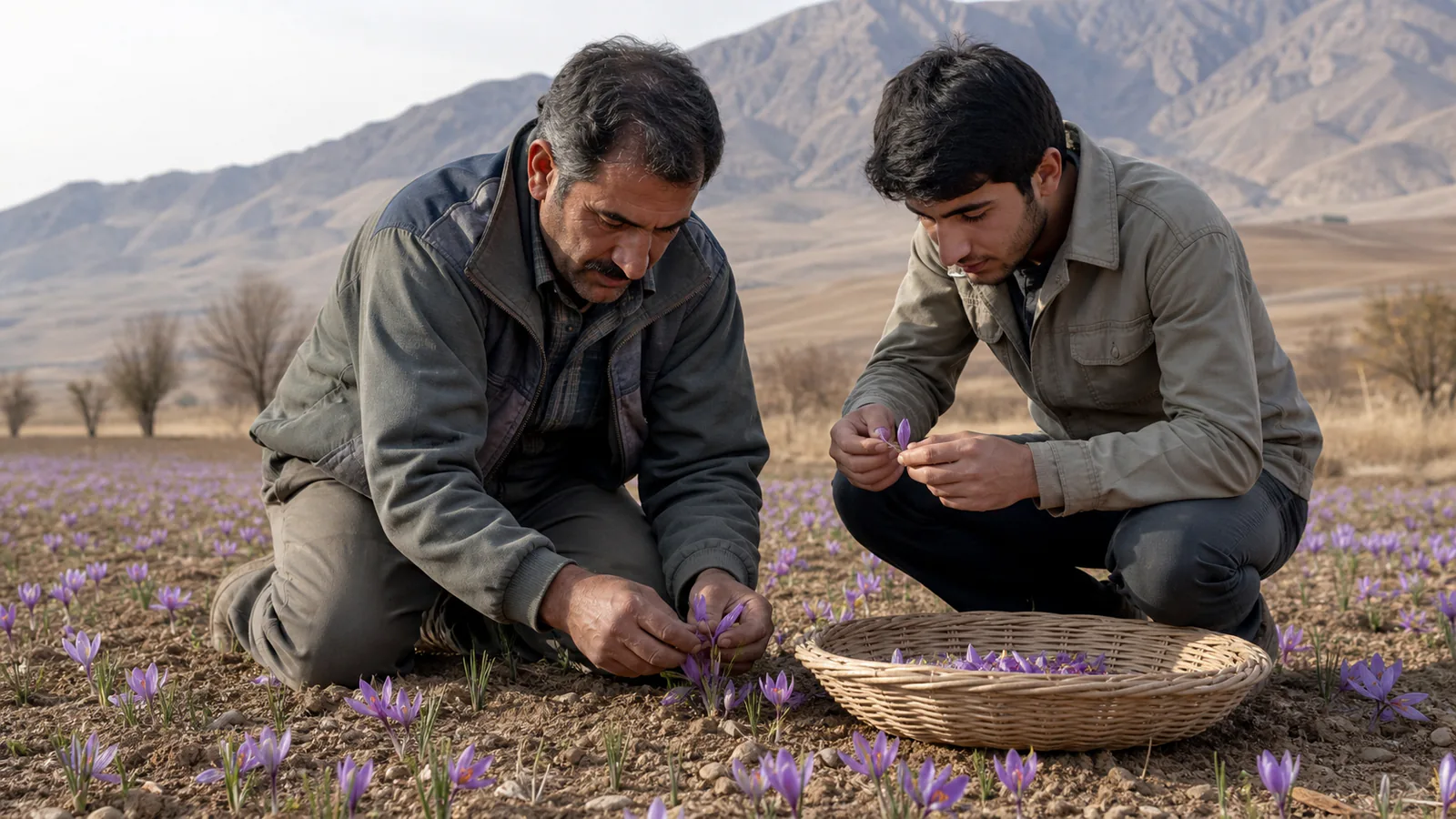
At Islamic Azad University of Roodehen, agriculture students began harvesting during the first half of November as part of their practical training. Dr Baghi, identified as head of the Faculty of Agriculture, described three groups testing different planting densities.
The groups placed five, three or two saffron corms in each planting hole. The same animal manure treatment was used across the three methods, and the three-corm treatment reportedly produced the most flowers.
This result belongs to an educational plot. The source gives no plot size, number of replicated holes, corm weight or diameter, spacing between holes, irrigation schedule, flower counts, dried-stigma yield or statistical analysis. Holding manure constant controls one variable, but it does not make three corms per hole an optimum for every soil or farm.
The old translation calls the planting material “onions.” Cultivated saffron is planted with corms. Corm size and health can affect establishment and flowering, so a density comparison without those details cannot be transferred directly to a commercial field.
What part of the flower becomes saffron?
The Roodehen account tries to explain separation but mistranslates the flower structure. Each saffron flower normally has a three-branched red stigma connected to a paler style. During processing, the stigma is separated from the rest of the flower and dried; the amount of attached style can differ by product category and grading practice.
It is not a “three-leafed horn-shaped leaf,” and the pale section is not cream in the dairy sense. Accurate botanical language matters because petals, yellow stamens, style length and foreign matter affect what a buyer receives. The Codex standard for dried saffron defines product requirements and sampling more precisely than the old translated paragraph.
Correcting the ounce conversion
The source says one ounce equals 6.4 g and 216 ounces equal 1 kg. Those two statements are not internally consistent and neither describes the international avoirdupois ounce.
According to the US National Institute of Standards and Technology, 1 avoirdupois ounce equals 28.349523125 g, and 1 kg is approximately 35.274 avoirdupois ounces. The old numbers may have been a mistranslation of another traditional unit, but the post does not name that unit, so guessing would create a new error. Saffron quantities here use grams and kilograms.
What the three reports establish
- Ben: about 20 hectares planted and a 40 kg forecast, implying 2 kg/ha only if the same area forms the denominator.
- Ravansar: an educational saffron plot within a 118-hectare conservatory training 120 male students; the saffron area was not stated.
- Roodehen: a teaching comparison of two, three and five corms per hole, with the three-corm treatment producing the most flowers in that plot.
- Ravansar’s third-year income and 20-day flowering statements are local observations, not universal promises.
- The old ounce conversion is incorrect and is replaced with the NIST value.
For another group of small local harvest programmes, see the Damghan, Soomehsara, Namin and Sarein comparison. The Natanz harvest and vocational-training report shows how education and local processing were linked to expansion at a larger scale.
Sources and reporting limits
- Historical reports attributing the Ben figures to Kamal Akbarian, the Ravansar programme to Rahim Karami and Farshid Gheibi, and the Roodehen exercise to Dr Baghi.
- FAO/WHO Codex CXS 351-2022: Standard for Dried Floral Parts—Saffron.
- NIST SP 1020: ounce, gram and kilogram conversion factors.
All farm figures are historical and lack a common crop year. Forecasts, local assessments and educational observations remain labelled, while mistranslated place names, botanical terms and units are corrected without changing the destination URL.

![Exporting Saffron to Turkey + Price Guide [Complete 0 to 100]](https://img.rowhanisaffron.com/20260827003933/saffron-export-turkey-quality-inspection.webp)



