


The Damghan saffron harvest covered 17 hectares in the historical season reported here, with 14 hectares described as bearing and an average yield of 4 kg/ha. Fifty growers were involved, and more than 60% of the crop area lay in southern Damghan. Smaller reports from Soomehsara, Namin and Sarein show how saffron was also being tested or expanded well beyond Iran’s largest production centres.
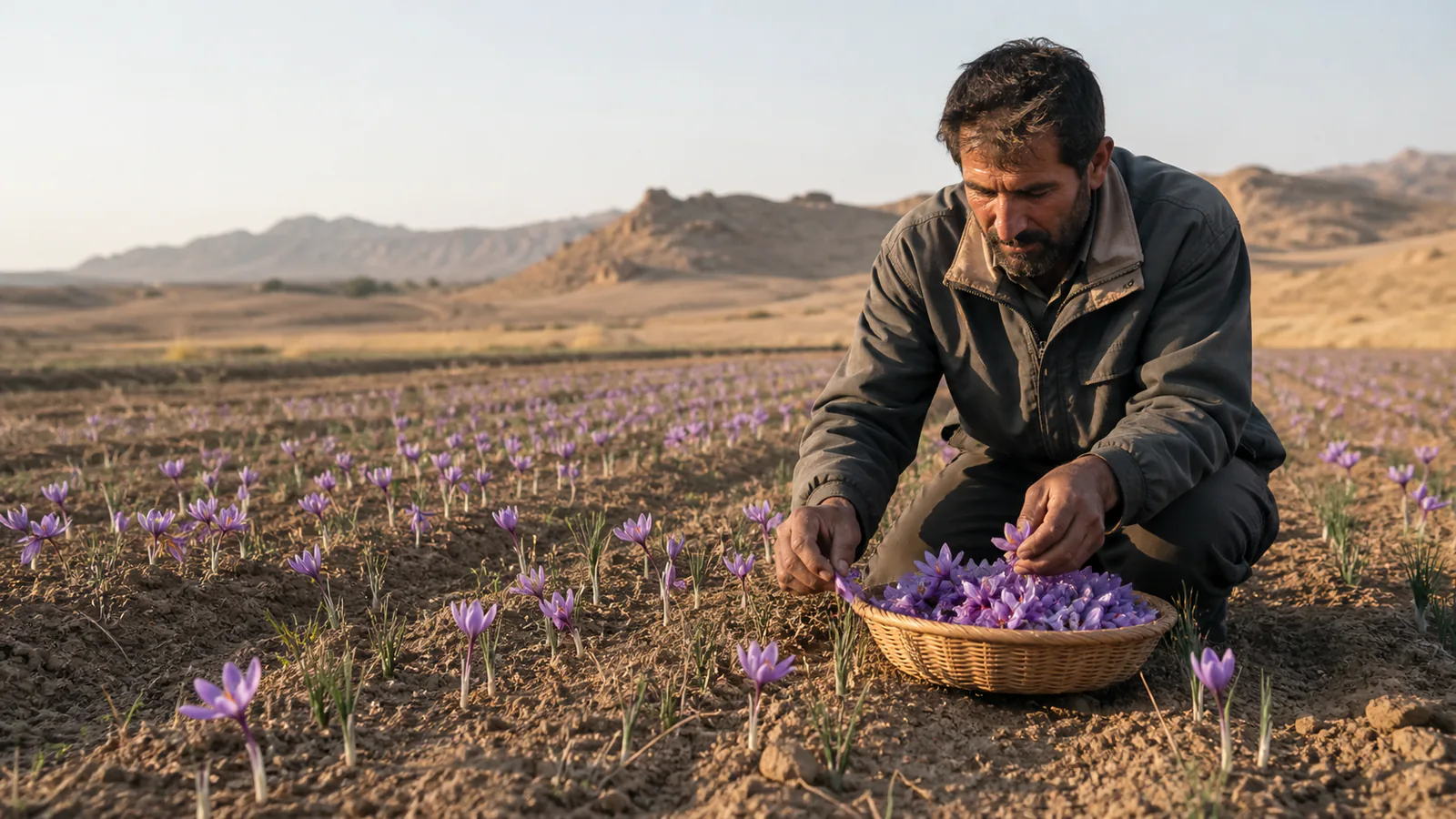
These local accounts are useful because they give acreage, timing, grower numbers and cultivation details. They are not a controlled comparison. Their dates, definitions and reporting methods differ, so the figures stay attached to their original locations rather than being combined into a national average.
Damghan’s 17-hectare saffron harvest
Seyed Mohsen Tabatabayan, then identified as director of Damghan Agricultural Jihad, said the harvest had begun and would continue through the end of December. Of the city’s 17 hectares under saffron, 14 hectares were described as fertile or bearing.
He reported an average harvest of 4 kg/ha, higher than in previous years. The source does not say whether that average uses all 17 hectares or only the 14 bearing hectares. Applying it to the bearing area would imply about 56 kg, while applying it to the whole planted area would imply 68 kg. Neither total was stated, so neither should be presented as a measured crop.
The report counted 50 growers and placed more than 60% of the cultivated area in southern Damghan. “More than 60%” means over 10.2 hectares if it refers to all 17 hectares, but no village-level allocation was provided.
Where Damghan saffron was sold
According to Tabatabayan, Damghan saffron was sold in local markets and sent to eastern provinces. The report did not identify buyers, shipment volumes, grades or prices. It therefore documents a domestic sales direction rather than a complete supply chain.
He praised the crop’s taste and colour and described its quality as consistent across the city. Those are an official’s observations, not results from a disclosed sensory panel or laboratory test. Modern quality comparisons need representative samples and defined measures; origin alone cannot prove that every lot has the same colour strength, aroma, moisture or purity.
The account associated better production with field nutrition, weather and rainfall, older saffron stands, denser planting and improving farmer knowledge. Because it supplies no field records or comparison plots, these remain proposed contributors rather than measured effects. A final sentence about bank support and low-interest assistance is cut off in the stored source, so no financing programme is claimed here.
Small-scale saffron in Soomehsara, Gilan
In Soomehsara, Ahmad Padiab of the local Agricultural Jihad office reported harvest from 12,000 square metres, equal to 1.2 hectares. He identified Nafoot village as Gilan’s saffron-production centre and credited the Safarzadeh family with helping expand its cultivated area over several years.
The report said Soomehsara’s saffron area had increased by 10% from the previous year. It forecast that 25 farmers would collect 3.6 kg in total. If both the area and production forecast use the same fields, that is an implied 3 kg/ha. It remains a forecast, not a final weighed result.
The old English wording appears to describe corm planting in September and harvesting in November. Padiab said saffron was grown alongside other crops and even between poplar trees. That intercropping detail is distinctive, but the report does not give row spacing, shade levels, yields from a saffron-only control or effects on the companion crop. It shows a local practice, not proof that poplar intercropping will work in every field.
Padiab also attributed larger corms, more flowers and export-competitive quality to local soil and climate. No corm measurements, flower counts, ISO test results or export records accompany the statement. The supported conclusion is that local officials considered Nafoot a promising small production hub.
Namin’s six growing sites in Ardabil
Seyed Mikael Hosseini reported saffron at six locations across 1.5 hectares in Namin during the programme’s sixth consecutive year. Corm planting was said to start from 1 June, with harvest beginning in the first week of November.
Hosseini cited a prior yield of 4 kg/ha and expected a similar performance in the reported season. If all 1.5 hectares were bearing at that rate, the implied crop would be about 6 kg. The article did not report a final harvest total, so 6 kg is only a conditional calculation.
The local office distributed planting material and offered technical training to applicants. The translation calls that material both “seed” and “onion.” Cultivated saffron is a sterile triploid and is propagated vegetatively by underground corms, so corm is the accurate term. The report gives no recipient count, quantity distributed or measured outcome from the training.
Claims that Namin’s climate, soil and “engineered cultivation” produced high quality remain attributed to Hosseini. Without a defined comparator and test data, they cannot establish superiority over another province.
Sarein harvested more than 12 kg
Another Ardabil Province report covered Sarein. Mohammad Ebrahim Mohammadi, then director of the city’s Agricultural Jihad office, said harvesting began in mid-October and ended with more than 12 kg of dried saffron from more than 5 hectares.
An exact yield cannot be calculated from two open-ended figures. Dividing 12 kg by 5 hectares gives 2.4 kg/ha, but the real numerator and denominator were both larger and may not have increased in the same proportion. The report supports only “more than 12 kg from more than 5 hectares.”
Mohammadi expected cultivation to grow because farmers were interested, he considered the climate suitable and the crop potentially profitable. The account provides no production-cost ledger, selling price or later acreage result, so that outlook is retained as a forecast. His praise for Sarein saffron’s aroma, taste and colour is likewise an attributed assessment rather than a comparative test.
How the four local harvests compare
- Damghan: 17 hectares planted, 14 bearing, 50 growers, a reported 4 kg/ha average and sales in local and eastern markets.
- Soomehsara: 1.2 hectares, 25 farmers, a 3.6 kg forecast, 10% year-on-year area growth and cultivation among other crops and poplar trees.
- Namin: six sites across 1.5 hectares, a prior 4 kg/ha yield, June corm planting, early-November harvest and a training-and-corm distribution programme.
- Sarein: more than 5 hectares and more than 12 kg of dried saffron, with harvesting beginning in mid-October.
The harvest windows stretch from mid-October in Sarein to an announced end-of-December date in Damghan, but the reports do not share a crop year. Elevation, local weather, irrigation and reporting conventions may all matter. The dates should guide interpretation of these historical accounts, not serve as one calendar for every future season.
Damghan was the largest of the four local programmes by reported area, yet all were small beside the established saffron regions of eastern Iran. For another province-level expansion sequence, see the Markazi saffron harvest and acreage reports. Our overview of Iran’s harvest and post-harvest chain gives the broader production context.
Sources and reporting limits
- Historical local statements attributed to Seyed Mohsen Tabatabayan, Ahmad Padiab, Seyed Mikael Hosseini and Mohammad Ebrahim Mohammadi in the four reports consolidated here.
- Peer-reviewed research on saffron’s sterility and propagation through corms.
- FAO Iran: authenticity testing and quality integrity in the saffron value chain.
All local acreage, output, timing and programme figures are historical and remain tied to the report in which they appeared. No source supplied a full methodology, crop-year label or comparable laboratory results. The article therefore distinguishes stated totals, forecasts, implied arithmetic and unsupported quality superlatives.

![Exporting Saffron to Turkey + Price Guide [Complete 0 to 100]](https://img.rowhanisaffron.com/20260827003933/saffron-export-turkey-quality-inspection.webp)



