


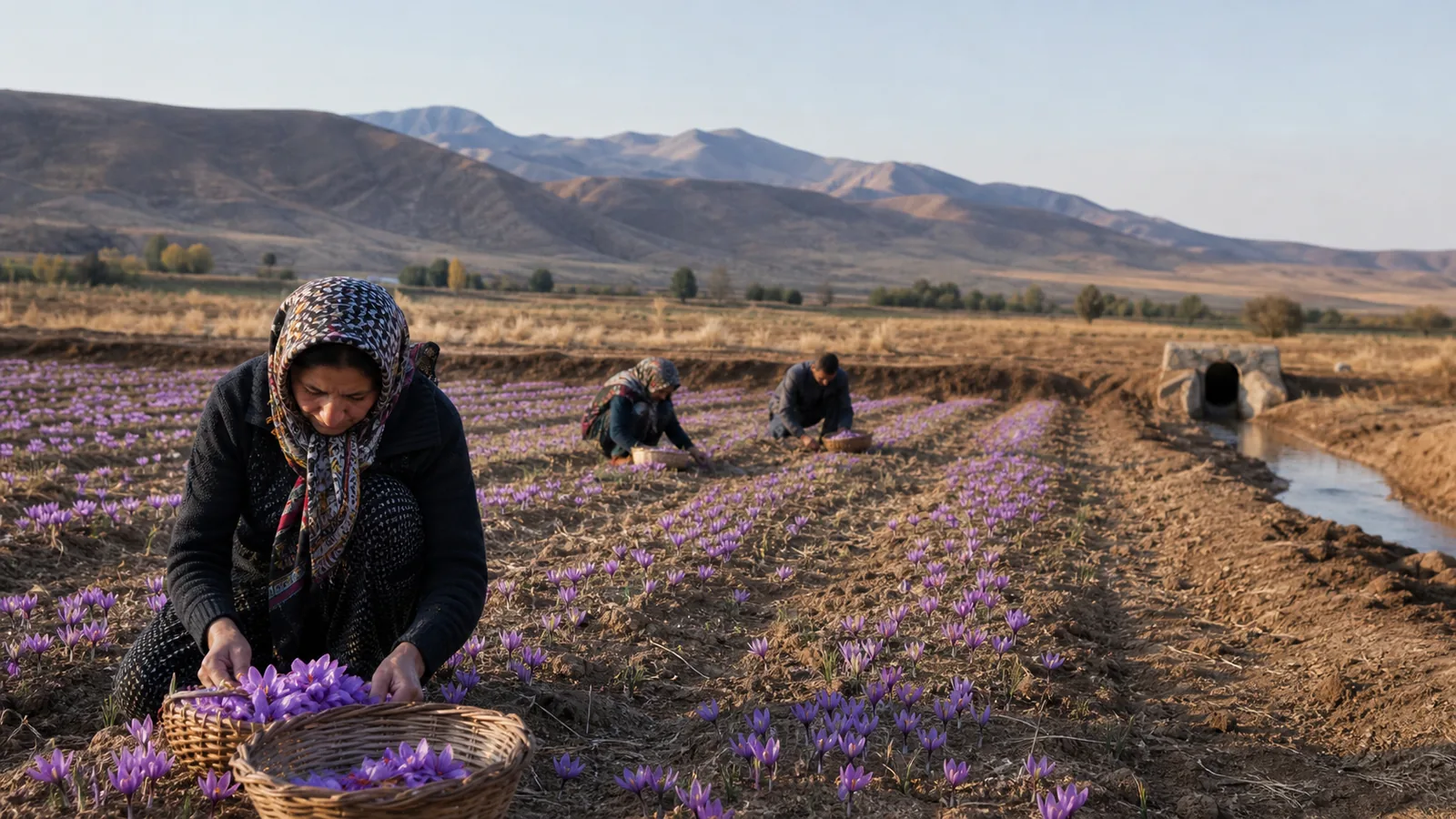
3 tons of saffron were produced in Khoshab city of Khorasan Razavi in the historical crop year covered by this report. Ebrahim Rudsarabi, then head of Khoshab Agricultural Jihad, placed the dried crop at 3,000 kilograms from 850 hectares.
The reported yield was 3.5 kilograms per hectare
Rudsarabi gave Khoshab’s average as 3.5 kilograms of dried saffron per hectare. Multiplying that figure by 850 hectares produces 2,975 kilograms, which is close to the reported 3,000-kilogram total. The 25-kilogram difference is consistent with rounded city-level figures.
The previous year’s average was reported as 3 kilograms per hectare. If the same 850 hectares had been productive in both years, that earlier yield would imply 2,550 kilograms. The article did not confirm that the bearing area was identical, so this remains a comparison of averages rather than a reconstructed final crop.
Production was said to have risen by about 500 kilograms
The agricultural official attributed an increase of roughly 500 kilograms to suitable rainfall and favourable weather. The difference between 3.0 and 3.5 kilograms per hectare across 850 hectares is 425 kilograms, not exactly 500.
Both values were presented as rounded figures, and the acreage used for the two seasons may have differed. The safest reading is that output rose by approximately half a tonne, while the average yield increased by about half a kilogram per hectare.
Government support centres were opened for that harvest
The report said the government had established saffron support-purchase outlets at rural cooperative centres. Their stated purpose was to help growers and limit a fall in the product’s price during the harvest.
No outlet list, purchase quantity, grade, guaranteed price or payment result was included. This was a programme described for that season, not evidence that the same purchasing arrangement is available today.
Khoshab’s agriculture relied on several water sources
The wider local farming picture covered 36,000 hectares of fields and orchards. The report listed 225 deep and semi-deep wells, 265 qanats and two perennial rivers serving the area.
“Water passages” in the old English translation refers to qanats, the underground channels traditionally used to move groundwater. Listing those sources explains the county’s agricultural base, but it does not establish how much water was available to saffron fields or whether supplies were stable.
Sultanabad is the administrative centre
The account identified Sultanabad as the centre of Khoshab County, about 175 kilometres west of Mashhad. It placed the area’s population at 38,000.
The wording did not clearly distinguish the population of Sultanabad city from that of the wider county. For that reason, 38,000 is best retained as the report’s area-level population figure rather than assigned more precisely.
What the Khoshab figures show
This was a substantial local saffron harvest: about 3 tonnes from 850 hectares, with an average near 3.5 kilograms per hectare. Officials reported an improvement over the prior year’s 3-kilogram average and connected it with rainfall and weather conditions.
The figures are historical and rounded. They do not establish Khoshab’s current acreage, present yield, today’s purchasing policy or the outcome of the support centres. Read in their proper setting, they document one productive season and the infrastructure surrounding agriculture in western Razavi Khorasan.

![Exporting Saffron to Turkey + Price Guide [Complete 0 to 100]](https://img.rowhanisaffron.com/20260827003933/saffron-export-turkey-quality-inspection.webp)



