


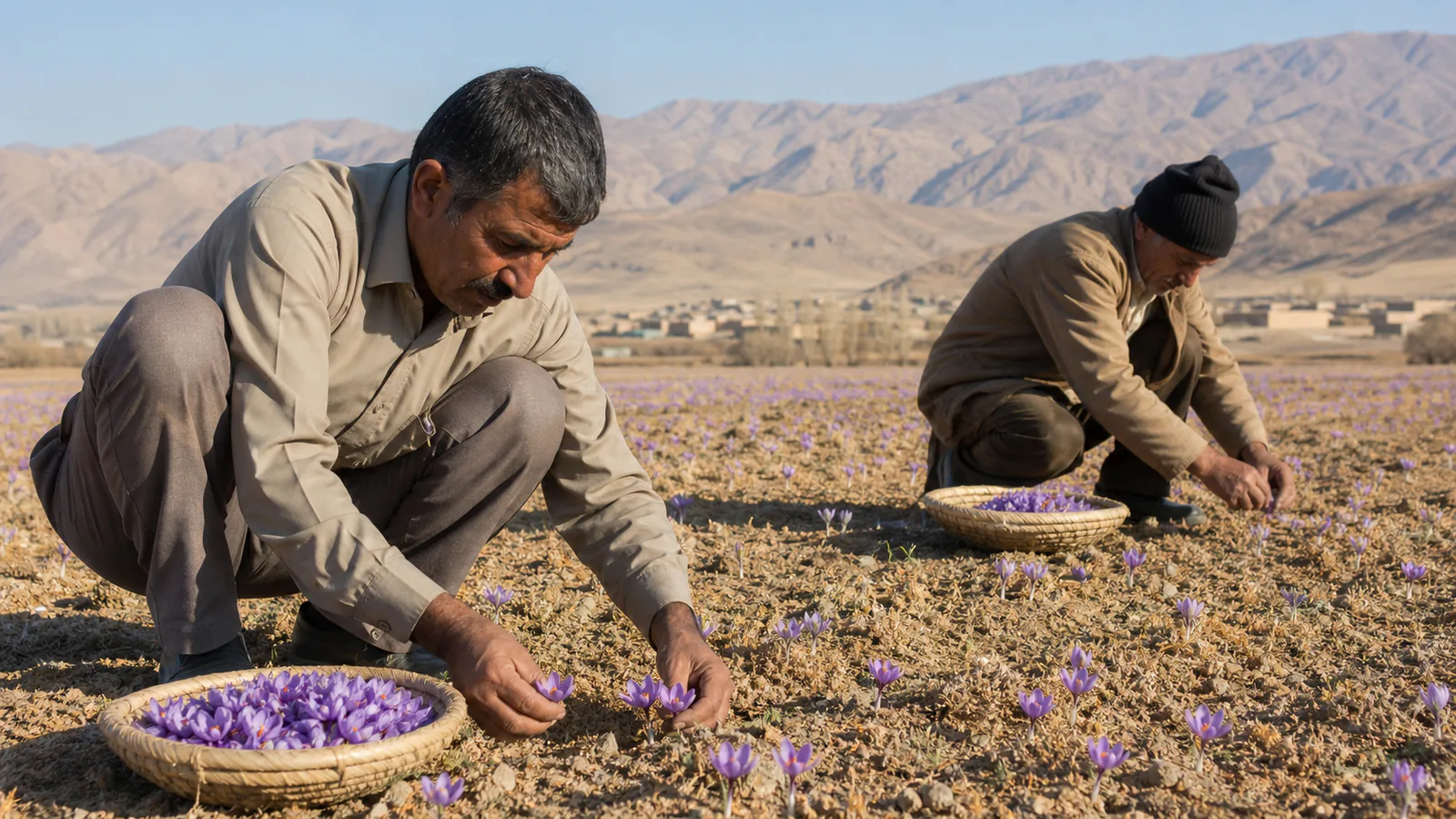
The Natanz saffron harvest began across 170 hectares in the historical season covered by this report, with picking expected to continue through the end of November. The local agriculture office forecast about 8 kg of dried saffron per hectare and more than 1,350 kg in total, while identifying Torqorud and its surrounding villages as the city’s main production area.
A related account from the same official gives the longer story behind that harvest. It describes more than fourfold growth in saffron area over ten years, a wider medicinal-plants programme, small processing businesses and local training. These details explain how acreage expanded, but they are historical statements rather than current production statistics.
Natanz’s 170-hectare harvest forecast
Abdolreza Mehdi Badi, identified as director of Natanz Agricultural Jihad, said saffron picking started during the second month of autumn. The harvest was expected to run until the end of November across 170 hectares of the county’s farms.
He forecast 8 kg of dried saffron per hectare. Multiplying that rate by 170 hectares gives 1,360 kg, which is consistent with his rounded expectation of more than 1,350 kg. This is a useful arithmetic check, not confirmation of the final crop. The report does not supply the harvested weight, number of bearing hectares, sampling method or losses during drying.
The projected yield is also an average. It cannot show how individual fields performed or whether newer plots produced less than mature ones. Field age, corm density, soil, irrigation, weather, harvest timing and drying practice can all differ, but the source provides no farm-level data for separating their effects.
Torqorud led production within the county
Mehdi Badi placed the largest share of Natanz saffron production in Torqorud and nearby villages. No village-by-village acreage, output or grower count accompanies that statement, so Torqorud can be identified as the reported centre without assigning it an invented tonnage.
He also described Natanz as first in Isfahan Province by saffron cultivation area at that time. The claim concerns area, not necessarily final output, yield, grade or sales. It is tied to the historical reporting period and should not be read as a current provincial ranking without a newer official dataset.
The article mentions drought and declining water resources but its sentence about agricultural support is incomplete. No support amount, recipient count, irrigation programme or measured water saving is preserved in the text. Those details are therefore not reconstructed.
More than fourfold growth over ten years
In the related medicinal-plants briefing, Mehdi Badi said Natanz’s saffron cultivation area had grown by more than four times during the preceding ten years. The source does not provide the starting and ending hectare values or specify whether “more than fourfold” means the final area exceeded four times the original area or grew by more than 400%.
Because those expressions are not identical, the article keeps the official’s wording rather than deriving an opening acreage. The later 170-hectare harvest report may represent a subsequent snapshot, but neither document provides enough dating detail to connect it mathematically to the ten-year comparison.
Farmers’ interest was attributed to saffron’s economic value and relatively modest water demand. That explains the programme’s rationale, not guaranteed profitability. Neither report includes corm, labour, irrigation, drying, finance or marketing costs, and neither records the price growers actually received.
Natanz’s wider medicinal-plants programme
The earlier briefing presented saffron as one part of a broader programme that also mentioned Damask rose, cumin, mint, qodumeh and other locally relevant plants. Mehdi Badi described a two-stage approach: research and possible commercialisation for plants not yet developed as crops, followed by expanding cultivation where the first stage supported it.
This is a programme description rather than evidence that every named plant reached commercial scale. The source does not provide trial designs, hectares for most crops, buyers or results from the research stage.
The old translation also turns an aspiration for healthy or organic medicinal-plant production into a sweeping claim that pesticides and chemical fertilisers destroy a plant’s medicinal value. That assertion is too broad and is not supported by residue tests, agronomic trials or a cited standard. No Natanz crop is labelled certified organic here because the report provides no certifier, standard, certificate or traceable lots.
Damask rose and local processing
Mehdi Badi reported approximately 90 hectares of Damask rose, also known locally as Golmohammadi. He connected growth in rose and other aromatic or medicinal crops with seven traditional distillate workshops operating in the county.
The briefing also said licences had been issued for one semi-industrial processing unit and one industrial agricultural-products packing unit, both expected to begin work in the reported year. A licence and expected start are not proof that a facility opened, remained active or processed saffron. Later verification would need commissioning dates, capacities and operating records.
The processing details matter to the saffron account because harvest value depends on what happens after flowers leave the field. Clean separation, controlled drying, testing, storage and suitable packing help preserve quality, but the Natanz source does not describe the equipment or controls used by any particular workshop.
Facilities, workshops and vocational training
The official said concessional facilities were prioritised for medicinal-plant cultivation. In a locally coordinated “resistance economy” programme, more than 90% of the relevant granted facilities reportedly went to applicants producing plants such as saffron and Damask rose. The denominator is that programme’s facilities, not all agricultural funding in Natanz.
No monetary total, loan count, interest rate, repayment record or beneficiary list appears in the report. It can support the direction of funding, but not an estimate of investment per farm or the programme’s financial success.
Training was delivered directly by the Agricultural Jihad office and through workshops with other local institutions. The briefing also said a medicinal-herbs field had been established in vocational schools after coordination with the local education department. About 30 people had graduated and were said to be engaged in medicinal-plant cultivation.
The source does not define whether all 30 were farming full-time, operating businesses or participating alongside other work. Even so, the training detail adds an important human layer to the acreage story: expansion was being supported not only with planting and finance, but with an attempt to build local knowledge.
What the Natanz reports establish
- Harvest began across a reported 170 hectares and was expected to continue through November.
- An 8 kg/ha forecast implies 1,360 kg, consistent with the rounded forecast of more than 1,350 kg.
- Torqorud and nearby villages held the largest reported share of production.
- Saffron area had grown more than fourfold over the preceding ten years, although the starting acreage was not supplied.
- The wider programme included about 90 hectares of Damask rose, seven traditional distillate workshops, two newly licensed processing or packing units and vocational training.
- All rankings, acreage and programme figures are historical; none should be treated as current without fresh official data.
For comparison, the Markazi saffron harvest reports also show how an emerging province connected acreage expansion with training, processing and market plans. Our article on Iran’s saffron harvest and post-harvest chain explains why projected field output and finished saleable saffron are not interchangeable.
Sources and reporting limits
- Two historical Natanz reports consolidated here, both attributing their figures to Abdolreza Mehdi Badi of Natanz Agricultural Jihad; the medicinal-plants briefing names Mehr News as its original publisher.
- FAO Iran: saffron harvesting, processing and quality practices.
The reports do not provide final harvest weights, crop-year labels, quality test results or programme outcome data. Forecasts, official assessments and completed results remain clearly separated throughout this article.

![Exporting Saffron to Turkey + Price Guide [Complete 0 to 100]](https://img.rowhanisaffron.com/20260827003933/saffron-export-turkey-quality-inspection.webp)



