


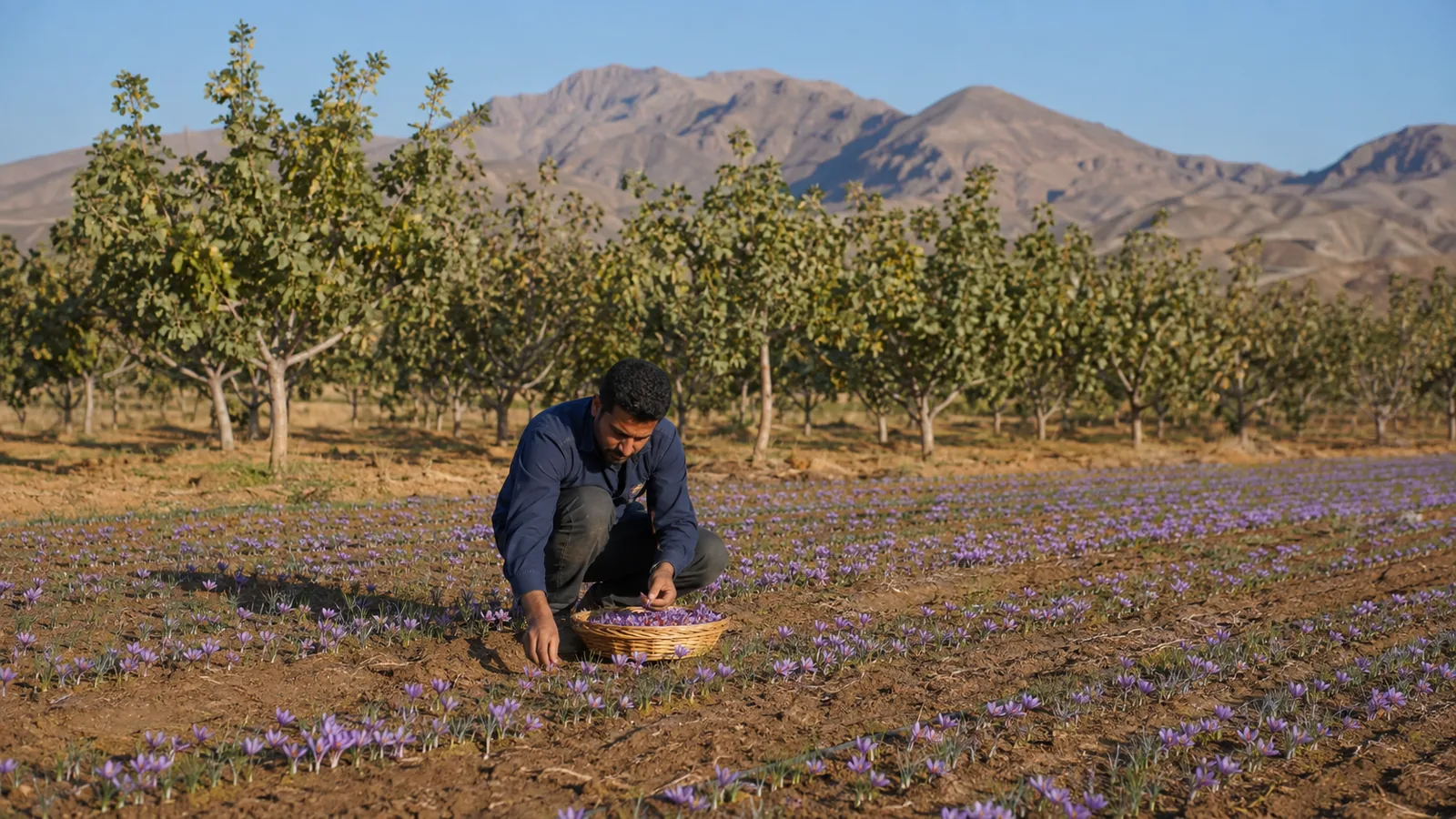
Harvesting saffron from the pistachio-rich land of Rafsanjan city shows a quieter side of an agricultural area known worldwide for pistachios. A historical report recorded about 10 hectares of saffron, centred on the cooler Raviz region, and an average yield of roughly 5 kilograms per hectare.
Rafsanjan saffron production in context
Rafsanjan is strongly associated with pistachio orchards, but its agricultural landscape is not uniform. Mountainous and cooler districts create different conditions from the plains, allowing growers to cultivate saffron and other crops on a smaller scale.
Reza Bemani, identified in the historical article as the director of Rafsanjan’s Agricultural Jihad office, discussed the crop while visiting Raviz. He placed the city’s saffron area at about 10 hectares and said cultivation had been under way for almost 15 years.
Why Raviz matters
Raviz lies in a colder, higher part of the wider Rafsanjan area. That setting helps explain why it became an early centre for the local crop. The old report focuses on Raviz rather than suggesting that saffron was spread evenly across pistachio-growing land.
Later official information reinforced the district’s position. In 2017, Iran’s Agricultural News Agency reported that Raviz held 60 percent of Rafsanjan’s saffron area. It also named Khanaman and Sarcheshmeh as producing areas and Davaran as suitable for cultivation.
The 10-hectare figure
The article states twice that roughly 10 hectares were planted. That repetition makes the scale central to this dated account. It should not be mistaken for the city’s present cultivated area, because later reports used larger numbers.
An earlier public report preserved by the Iran Pistachio Association also recorded more than 10 hectares in Raviz and a forecast of 2 to 3 kilograms per hectare. Its date and figures differ from the 5-kilogram average in the article here, illustrating how a bed’s age and the season being measured can change the result.
Average yield of about 5 kilograms per hectare
Bemani gave an average Rafsanjan saffron yield of about 5 kilograms per hectare. At that rate, 10 fully bearing hectares would produce around 50 kilograms, although the article does not state that every planted hectare was mature or harvested in the same year.
A later official report quoted a much higher Raviz average of 12 kilograms per hectare. The two figures should not be blended into one claim: they refer to different reporting dates and may use different fields or measurement bases. Neither is a promise of what a new farm will produce.
The previous 30-kilogram harvest
The historical article says 30 kilograms of saffron were harvested in Rafsanjan in the preceding year. If all 10 hectares were bearing, that would equal 3 kilograms per hectare. The source does not provide enough detail to know whether the whole area produced that season.
This difference between a 30-kilogram total and a 5-kilogram average is worth retaining rather than smoothing away. One may describe the prior season while the other reflects established fields or an expected norm.
Two irrigations before harvest
Bemani highlighted saffron’s relatively modest water schedule and said the crop needed only two irrigations before harvest in the system he was describing. He also noted that the timing did not coincide with peak demand from some other crops.
That does not mean saffron requires only two irrigations everywhere or can grow without water. Soil, rainfall, corm-bed age and local practice matter. Any irrigation plan needs to respond to the actual field rather than copy one sentence from a regional news report.
Cold weather and the harvest
The report attributes lower production that year to falling temperatures and early autumn cold. Weather can alter the timing and concentration of flowering, while a short harvest window leaves little room to recover if field access or labour is disrupted.
Prepared picking teams and processing space are important even on a 10-hectare area. Flowers should move promptly into clean, shallow containers, followed by careful stigma separation and controlled drying.
Training and finance for expansion
A damaged translation says the local administration improved the cultivated area through “banking training.” The likely meaning is support involving training and bank facilities, but the source does not separate the two clearly enough to state that as fact.
Both types of support can matter. Training helps growers make decisions about corm health, planting depth, irrigation and drying; suitable finance can help cover establishment costs before a new bed reaches productive maturity. Expansion is safer when these decisions are based on realistic yield and labour assumptions.
Saffron alongside pistachios
The article’s phrase “pistachio-rich land” is more than a decorative contrast. Rafsanjan’s identity and infrastructure grew around pistachios, yet reliance on one crop also makes alternatives interesting where soil, elevation and water timing allow them.
Saffron does not need to replace the region’s principal crop to have value. On suitable small areas, it can broaden the harvest calendar and create a high-value product, provided growers have labour, clean processing and a credible route to market.
What makes a Rafsanjan lot valuable
Origin alone does not establish grade. A buyer needs clean saffron with consistent moisture, aroma, colour and traceability. The flowers’ appearance in the field cannot reveal how well the stigmas will be separated, dried or stored.
Clear lot records can preserve the identity of saffron from Raviz or another district instead of allowing it to disappear into anonymous bulk trade. They also make it easier to compare one season with the next without relying on broad regional averages.
How to read the historical Rafsanjan figures
The safest summary is that the report described around 10 hectares after almost 15 years of local saffron cultivation, an average yield near 5 kilograms per hectare and a previous harvest of 30 kilograms. It linked production mainly with Raviz and recorded early autumn cold as a cause of reduced output.
Later official figures show that Rafsanjan saffron production expanded and that the mountainous districts remained important. Keeping each number with its date and geography gives readers a clearer answer than treating every historical estimate as current.

![Exporting Saffron to Turkey + Price Guide [Complete 0 to 100]](https://img.rowhanisaffron.com/20260827003933/saffron-export-turkey-quality-inspection.webp)



