


A historical forecast for farms in Bam city expected 20 kilograms of dried saffron from 5 hectares. That works out to 4 kilograms per hectare, not 20 kilograms per hectare, and the distinction is essential when using the report to understand local saffron yield.
The 20-kilogram harvest forecast
Reza Ghahri reported that 5 hectares of agricultural land in Bam were under saffron cultivation and predicted a total harvest of 20 kilograms. He gave the same production relationship directly: an average yield of 4 kilograms per hectare.
This was a forecast for a particular season, not a current count or a guaranteed result for every Bam farm. Bed age, healthy corms, soil, irrigation and weather can change the number of flowers and the amount of dried saffron obtained from them.
Is the saffron yield 20 kg per hectare?
No. The historical report does not describe a saffron yield of 20 kg per hectare. Twenty kilograms was the predicted total across 5 hectares; the reported per-hectare average was 4 kilograms.
Confusing total production with yield multiplies the apparent performance by five. Anyone comparing farms should check whether a figure refers to whole flowers or dried stigmas, whether it covers one hectare or the entire project, and whether every planted hectare was old enough to bear.
Why Bam’s mountainous areas were selected
Ghahri said climatic conditions in the mountainous parts of Bam were suitable for saffron cultivation. This is more specific than saying every field in the city has the same potential. Elevation, winter cold, soil drainage and reliable irrigation still need to be assessed at farm level.
The historical account therefore belongs to upland agricultural land within the wider Bam area. A grower cannot transfer its 4-kilogram average to a warmer or poorly drained site without testing local conditions.
The reported water requirement
The article places saffron’s water requirement in Bam at 3,000 cubic metres per hectare over a growing period. Across 5 hectares, that would amount to 15,000 cubic metres if every field followed the same schedule and the estimate applied in full.
That figure is plausible as a regional planning estimate, but it is not a universal irrigation prescription. An official agricultural report from another Iranian production region likewise cited about 3,000 cubic metres per hectare annually, while explaining that much of saffron’s irrigation falls outside the peak demand of summer crops.
Planting from mid-September to mid-October
The Bam report gives a planting window from mid-September to mid-October. That is the schedule described for this local programme; actual timing should follow temperature, dormancy, irrigation availability and guidance for the selected field.
Planting material matters as much as the date. The old English text calls it saffron “onions,” but the correct botanical term is corms. Ghahri advised farmers to obtain them through the local Agricultural Jihad office so their health could be checked.
Choosing healthy saffron corms
Healthy corms should be firm and free from obvious rot, deep wounds or pest damage. A documented source reduces the risk of bringing a problem into soil where the planting may remain for several seasons.
Size alone does not prove that planting material is safe. Growers need to inspect the lot, handle it without bruising and use field hygiene suited to local disease and pest risks. Any treatment should follow qualified agricultural advice rather than an improvised recipe.
Why weed control was emphasised
Ghahri singled out weed control as very important. Weeds compete for water, nutrients and light, and they make hand picking harder during the brief flowering period. Letting them set seed can also enlarge the problem in later years.
Control needs to be planned around the saffron growth cycle. Field observation, timely shallow cultivation where appropriate and locally approved methods are safer than applying an unspecified herbicide. The right choice depends on the weed species and stage as well as the crop.
The mid-November to mid-December harvest
The report says harvesting on Bam farms began in mid-November and continued until mid-December. This month-long local window describes the season as a whole; each field may flower for a shorter and more concentrated period.
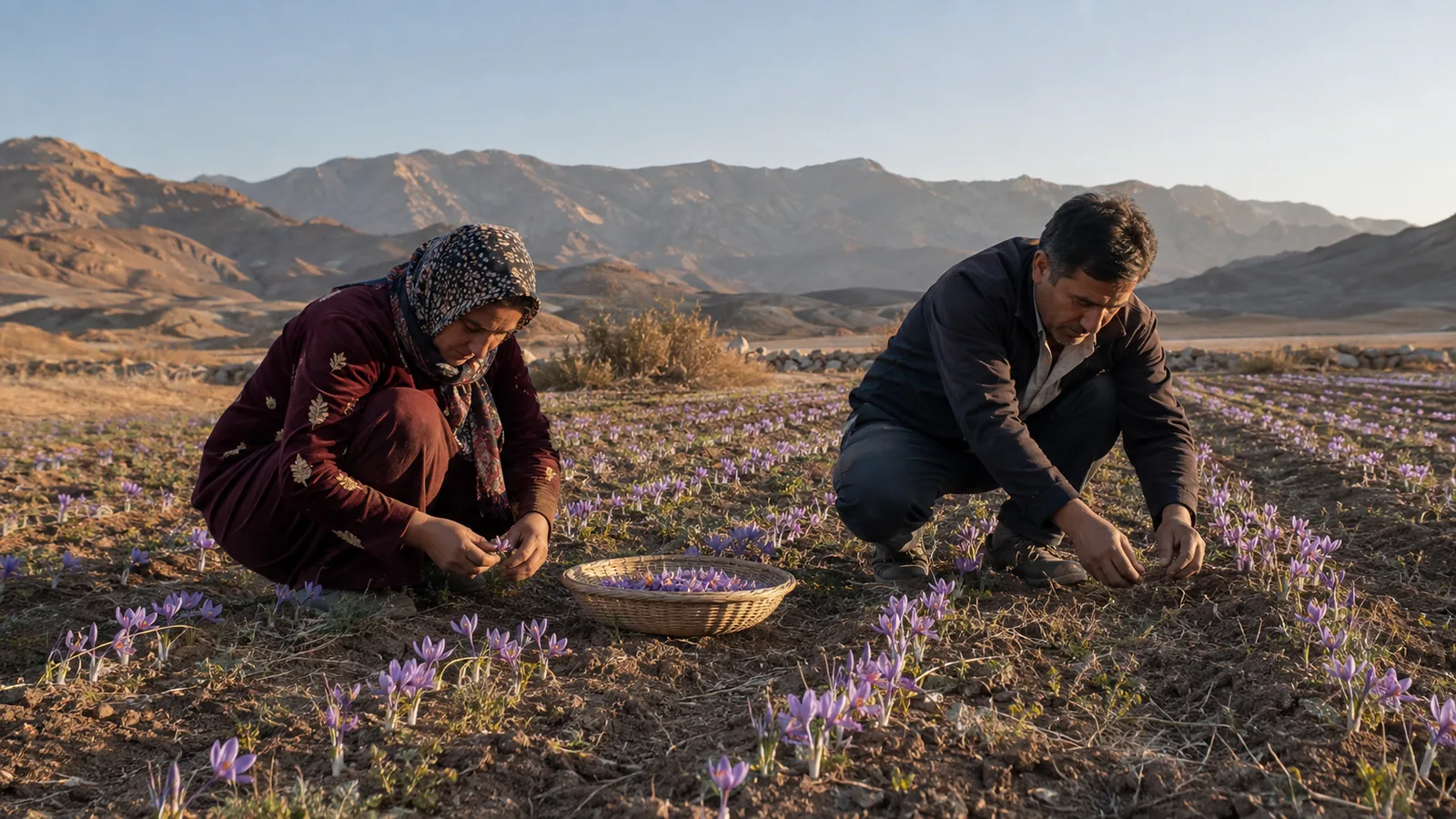
Picking teams need to be ready before the first flush. Fresh flowers should move in shallow, clean containers and be separated promptly, since a 20-kilogram dried-saffron target represents a much larger volume of delicate flowers.
Interpreting the 4-kilogram average
Four kilograms per hectare sits near reported averages in several Iranian growing areas, but comparison still requires the same definitions. A later official report for East Azerbaijan, for example, gave an average dried yield of 4.6 kilograms per hectare.
The comparison offers scale, not a performance benchmark for Bam. A mature well-managed bed and a young planting may produce very different results even within the same village.
Geographic and population context
The original page describes Bam in Kerman Province in southeastern Iran and gives a 2016 population of 318,241. It also lists the centre near 58°21′ east and 29°6′ north at about 1,050 metres above sea level.
Two different area figures appear: 5,175 and 17,755 square kilometres. They likely refer to different administrative boundaries or came from mixed source passages, but the surviving text does not identify them clearly. Neither is used here to calculate saffron density or grower numbers.
How to use this Bam forecast
The page’s useful core is a dated local record: 5 hectares, a 20-kilogram total forecast, an average of 4 kilograms per hectare, an estimated 3,000 cubic metres of water per hectare, and defined planting and harvest windows.
It also preserves practical priorities—healthy corms and weed control—without turning an old report into a universal farming prescription. Most importantly, it answers the misleading yield interpretation directly: the forecast was 20 kilograms in total, not 20 kilograms from each hectare.

![Exporting Saffron to Turkey + Price Guide [Complete 0 to 100]](https://img.rowhanisaffron.com/20260827003933/saffron-export-turkey-quality-inspection.webp)



