


The Markazi saffron harvest expanded rapidly across several historical reporting periods, but the surviving figures need careful reading. Provincial reports described about 150 hectares and a 400 kg forecast in one season, 170 hectares and 500 kg in another, and later 336 hectares alongside a headline forecast of 1.2 tonnes. These are successive snapshots, not numbers from one harvest.
Read together, the reports show where cultivation was concentrated, how many growers were involved and why provincial officials wanted a direct-export cooperative. They also contain inconsistent percentages, an ambiguous yield translation and a later article whose body ends before explaining the production forecast in its headline. This account preserves the useful facts without smoothing over those gaps.
When the Markazi saffron harvest begins
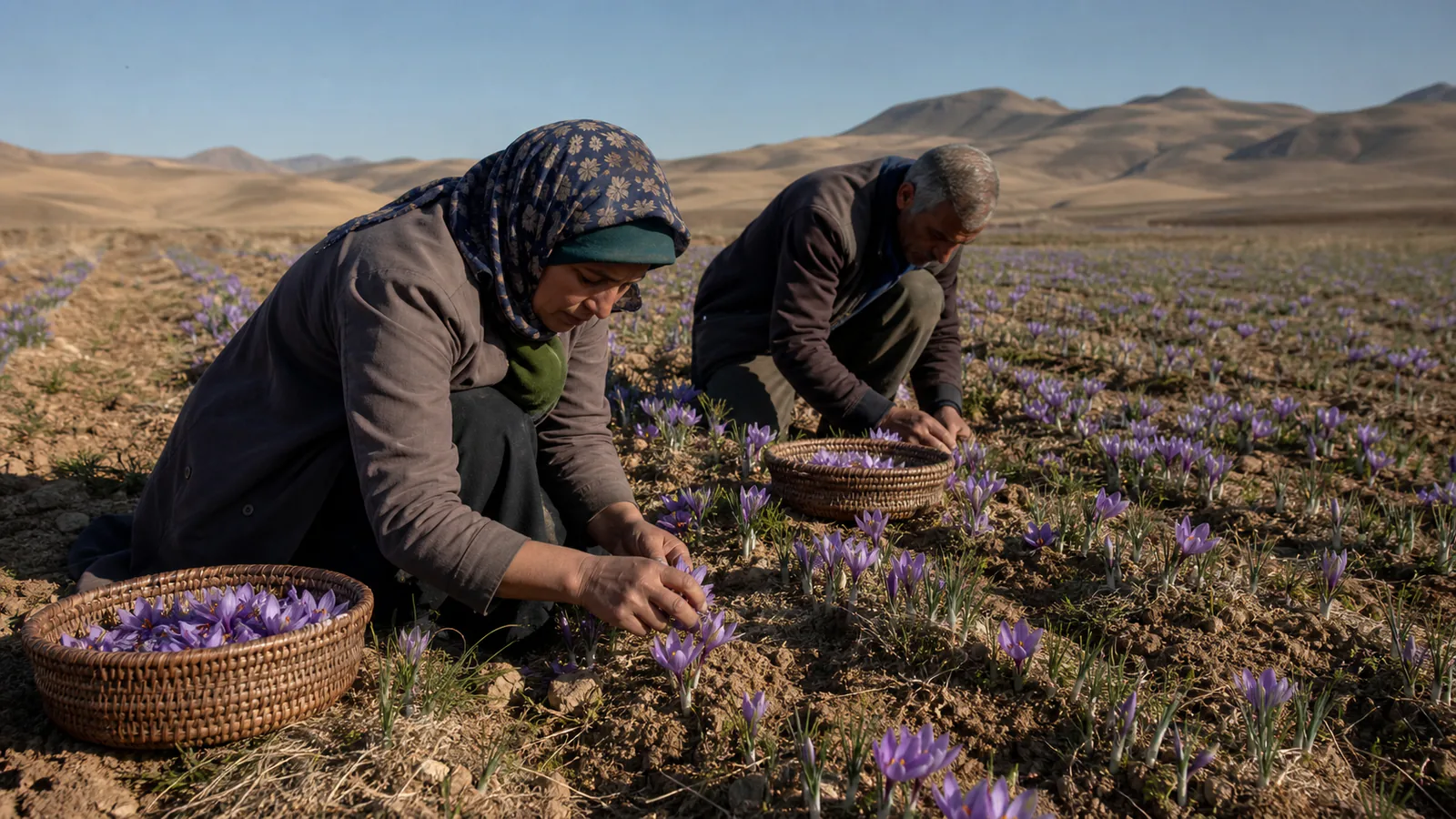
In the 150-hectare report, Ahmad Asadi of Markazi Province’s Agricultural Jihad Organization said picking began on 6 November and would continue through the first ten days of December. That gives a reported harvest window of roughly one month, not a permanent province-wide calendar.
Flowering can vary between fields, and the report did not identify the crop year, daily temperatures or irrigation dates. The dates should therefore be understood as the schedule announced for that particular season. They do not guarantee that every farm in Khomein, Kamijan or another county will flower on the same day in a later year.
Asadi forecast approximately 400 kg of dried saffron from around 150 hectares. Dividing those totals gives an implied province-wide average of about 2.67 kg/ha. The old English text also says “3.2 tenths of a kilogram per hectare,” which is not compatible with the totals and appears to be a damaged translation. It is not repeated as a reliable yield.
From 147 hectares and 350 kg to 170 hectares and 500 kg
A separate provincial update compared two consecutive seasons. It reported 350 kg from 147 hectares in the earlier season and 500 kg from 170 hectares in the next. The same update counted about 450 people directly farming saffron in Markazi.
The exact figures imply that production increased by approximately 42.9%, while planted area increased by approximately 15.6%. The source headline called the production gain 30%. Because 30% cannot be reproduced from the stated 350 kg and 500 kg totals, the safer account retains the underlying numbers and identifies the mismatch instead of presenting both as though they agree.
The implied output per planted hectare moved from about 2.38 kg/ha to 2.94 kg/ha. These are arithmetic checks, not measured yields from a defined sample. The reports do not say how many hectares were mature and bearing, how the crop was weighed, or whether every grower and field was included.
A later report put saffron acreage at 336 hectares
The later update placed the province’s saffron area at 336 hectares and said farmers’ interest in using water more efficiently was supporting further development. Its English wording also mentions a 100-hectare increase “this year,” but it does not make clear whether that increase was already included in the 336-hectare total or was still to be added. Adding the figures together would therefore create a total the source does not establish.
The article’s headline forecast a 1.2-tonne harvest. Its surviving body, however, ends mid-sentence and does not contain the supporting production quote, method or harvest result. If 1,200 kg were spread across all 336 hectares, the implied average would be about 3.57 kg/ha, but that calculation assumes every reported hectare was bearing. The 1.2-tonne number remains a historical forecast from the headline, not a confirmed final crop.
This later acreage is best treated as evidence of expansion rather than combined with the earlier 150- and 170-hectare snapshots. No common crop year, measurement date or definition is supplied across all three reports.
Where saffron was grown in Markazi
The 150-hectare report identified Khomein as the county with the largest saffron area at that time, about 40 hectares, and Khondab as the smallest at roughly 2 hectares. The 170-hectare update named Khomein, Mahallat, Delijan and Kamijan as the province’s main production centres, with Khomein and Kamijan leading in area and output.
Those statements are complementary rather than contradictory: one gives the high and low counties for a particular season, while the other names a broader group of production centres. Neither report provides a complete county-by-county inventory, so the unnamed remainder of the province should not be assigned to particular places.
Officials linked the expansion to extension work, expected sales opportunities and a policy preference for crops considered economically useful under water constraints. That explains the policy direction reported at the time; it does not prove that every new field was profitable or received less water than every alternative crop.
Growers, local sales and the cooperative plan
The earlier harvest account counted 400 saffron farmers. The 170-hectare update reported 450 direct growers. Because the figures belong to different snapshots, they suggest participation increased but should not be used to calculate a precise retention or growth rate.
At the time of the 150-hectare report, Asadi said Markazi growers had not made significant direct-export progress. Production first served demand within the province, with additional saffron sent to Tehran. The next update described a planned saffron growers’ cooperative intended to support production and direct exports from Markazi.
A plan is not a completed export channel. The source gives no registration date, membership total, export licence, buyer contracts or shipped volume. The cooperative should therefore be recorded as a stated priority, not evidence that direct exports subsequently began.
How Damask rose production fits the provincial picture
The later saffron update also discussed Rosa damascena, commonly called Damask rose or Mohammadi flower in Iran. It reported 2,770 tonnes of flowers harvested from 990 hectares and described Markazi as fifth in Iran by rose-growing area at that time.
That material does not turn this into a rose-production article, but it explains the wider horticultural strategy. The report said flower growers, particularly sellers of cut flowers, had been hurt during the coronavirus disruption. It described support through the Agricultural Sector Development Fund and purchases by a medicinal-plant essential-oil company as part of the response.
The translated text does not state the amount purchased, the price paid, the number of growers helped or an independently measured income effect. It also gives a separate 670-hectare figure for flowers, plants, vegetables and summer crops that cannot be reconciled with the 990 hectares of Damask rose in the same text. That conflicting 670-hectare figure is not used as a province-wide total here.
What the three reports establish
- One Markazi saffron harvest was reported to run from 6 November into early December.
- Historical snapshots put planted area at about 150 hectares, then 170 hectares and later 336 hectares.
- The reports respectively described a 400 kg forecast, a 500 kg stated output and a later headline forecast of 1.2 tonnes.
- Khomein, Mahallat, Delijan and Kamijan were named as important production centres; Khomein and Kamijan led in the broader update.
- Grower counts rose from 400 in one report to 450 in another, without enough information for a formal trend calculation.
- A direct-export cooperative was proposed, but the source does not document its completion or results.
For a wider view of how a labour-intensive harvest fits into Iran’s production chain, read our account of Iran’s saffron harvest and post-harvest handling. A comparison with South Khorasan’s saffron harvest reports also shows why acreage, forecasts and worker counts should remain tied to their own place and season.
Sources and reporting limits
- Three historical Markazi provincial reports consolidated on this page, each attributing its figures to Ahmad Asadi of the provincial Agricultural Jihad Organization.
- FAO Iran: saffron harvesting, processing and quality practices.
All acreage, production, employment and programme figures above are historical statements from those reports. They are not presented as current Markazi statistics. Where the old English text is incomplete or internally inconsistent, the limitation remains visible instead of being replaced with an unsupported estimate.

![Exporting Saffron to Turkey + Price Guide [Complete 0 to 100]](https://img.rowhanisaffron.com/20260827003933/saffron-export-turkey-quality-inspection.webp)



