


Kermanshah saffron production was reported at about 200 kg from 80 hectares in an earlier account and 300 kg after the cultivated area reached roughly 90 hectares. The reports describe a small but expanding industry in western Iran, supported by corm assistance, cooperatives and local packing. Their separate yield and water-use claims need careful qualification.
This unified article follows the reported development from six hectares to 80, then about 90–92 hectares, and explains what the 200 kg and 300 kg totals mean. It does not treat proposed expansion as completed acreage or present an old nominal market value as a current price.
How saffron cultivation expanded in Kermanshah
Reza Zarei, identified as horticulture director at the Kermanshah Agricultural Jihad Organization, said the provincial saffron program had been on the agenda since 2009. He reported 80 hectares under cultivation by 2015 and said another 10 hectares brought the total to 90 in the period covered by the destination article.
An earlier statement attributed to Khosrow Shahbazi, then head of the provincial organization, described growth from an initial six hectares to 80 hectares and production of 200 kg. The translation around one intervening year is garbled, but the six-to-80-hectare direction is clear.
A related version gave the current area as 92 hectares and placed more than 29 hectares in Kermanshah city. The difference between 90 and 92 may reflect rounding, reporting dates or two datasets. The articles do not provide a common survey date, so neither number should be silently substituted for the other.
From 200 kg to a reported 300 kg a year
Shahbazi’s report put production at 200 kg when 80 hectares were under saffron. Zarei later stated that the province was producing 300 kg annually. He also cited an average provincial yield of 4.5 kg per hectare.
The yield arithmetic does not fully reconcile
Dividing 200 kg by 80 total hectares gives 2.5 kg per hectare. Dividing 300 kg by 90 hectares gives about 3.3 kg per hectare; using 92 hectares gives about 3.26 kg. None equals the separate 4.5 kg/ha statement.
A 300 kg harvest at 4.5 kg/ha would imply roughly 66.7 bearing hectares. That could be possible if the rest were newly planted or non-bearing, but the source never gives that breakdown. Shahbazi also quoted a national average of 4 kg/ha; the reported 200 kg divided by 80 total hectares remains below it.
The safe reading is that 200 kg, 300 kg, 4 kg/ha and 4.5 kg/ha were official figures from related reports, but they did not all use an identified common denominator. For a fuller explanation of bearing area, field age and dry-weight definitions, see our guide to saffron yield per hectare.
Why officials considered saffron economical in Kermanshah
The officials focused on the crop’s seasonal fit with water-limited agriculture. The “Economical Saffron” source described sites with sun, mild winters, hot dry summers and protection from cold winds as suitable. This is broad guidance rather than a map of suitable land: Kermanshah varies in elevation, cold exposure, rainfall, soil and drainage.
The same report said saffron’s water demand falls mainly between mid-September and mid-May, when rainfall supplies part of the requirement and competing irrigation demand may be lower. This seasonal timing can be useful, but it does not remove the need to assess establishment, pre-flowering moisture and the conditions of a particular field.
The source mentioned a maximum water requirement of “about 6,000 cubic metres” without stating per hectare, per field or per season. A quantity without its area and time denominator cannot be used as an irrigation plan.
The one-to-three irrigation claim needs context
Shahbazi was also quoted as saying saffron generally needed two or three irrigations a year and that satisfactory production could occur with one. That is an attributed local claim, not a universal schedule. Rainfall, soil storage, planting date, field age and weather around flowering determine whether one event is adequate.
A technical review of saffron water requirements describes high water productivity and lower irrigation demand than conventional crops, while noting that satisfactory yields in dry Iranian regions still depend on appropriate water supply and timing. The FAO profile of Gonabad’s qanat-based system makes the same basic distinction: saffron does not require large quantities, but it uses a reliable water source.
Neither reference turns the Kermanshah quotes into a fixed prescription. A grower needs local soil and weather data and advice from the relevant agricultural and water authorities.
Reported economic value and support
The earlier 80-hectare/200 kg report assigned the crop an economic value of approximately 1.5 billion tomans. If the value and harvest refer to the same period, that works out to about 7.5 million tomans per kilogram. The source does not state whether this was a farm-gate value, retail value, average grade, gross sales estimate or completed transaction total.
It is also a nominal historical figure. Inflation, currency conditions, grade and the reporting year make it unsuitable as a current price. Anyone assessing profitability now would need present costs and actual buyer terms.
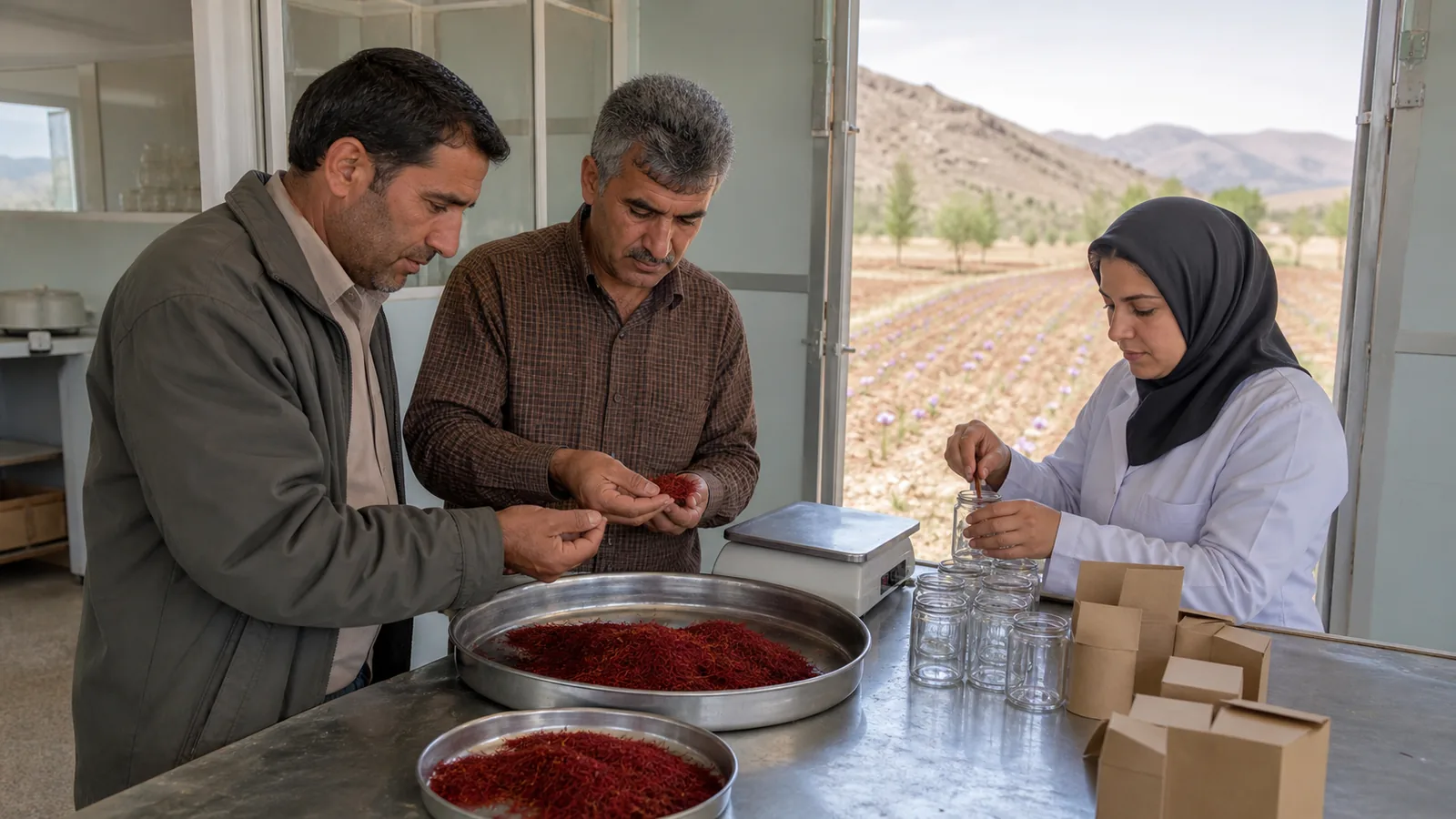
Shahbazi said the provincial organization supported cultivation with subsidized assistance, including planting corms. He also referred to two saffron cooperatives and two packing units in Kermanshah, associated in the translation with Shahini and the village of Koozaran. The reports do not name the cooperatives, capacity, operating status or brands, so this article does not claim those facilities are active today.
Zarei’s later account likewise mentioned two active packing workshops handling locally produced saffron under a Kermanshah identity. Local packing can retain more value and improve traceability only when grading, hygiene, moisture control, packaging and buyer requirements are consistently managed.
Expansion plans were targets, not completed results
Zarei announced a one-year proposal for another 100 hectares and a five-year goal of reaching 500 hectares with farmer participation. The article does not report that either target was achieved. Adding planned hectares to the 90-hectare baseline would misstate the historical record.
He said most cities in the province could potentially cultivate saffron, except Qasr-e Shirin and Sarpol-e Zahab in that assessment. The other source located Kermanshah along the Zagros and listed its area as 25,009 square kilometres, about 1.5% of Iran. It named Islamabad-e Gharb, Songhor, Harsin, Kangavar, Javanrud, Sahneh, Paveh, Gilan-e Gharb, Ravansar, Dalahu, Salas-e Babajani and the two excluded western counties. Administrative boundaries and cultivation suitability can change, so the list remains geographic context rather than a current zoning decision.
Expansion should proceed from proven local fields. The important questions are how many hectares are bearing, whether corms and labour are available, what measured yields established fields achieve, and whether buyers and packing capacity can absorb the extra crop.
Planting and harvest calendar in the reports
Zarei gave August and September as the preferred planting period, with a broader window from mid-summer to early autumn. He placed harvest from late October to mid-November and said it continued until rainfall.
These dates describe the Kermanshah program, not every saffron region. Corm dormancy, soil temperature, moisture and the local onset of autumn weather should guide a site-specific date. Harvest timing follows the flowers and can shift from year to year.
The wording “until rainfall” also deserves care. Rain can change access, flower condition and drying risk; it is not a reliable calendar endpoint by itself. A farm needs labour ready for the actual bloom.
What the quality claims do and do not show
Shahbazi described Kermanshah saffron as being among Iran’s high-quality products. Zarei referred to laboratory work and to strong “gene pool” potential. The translated destination incorrectly used the phrase “saffron collagen.” Collagen is an animal structural protein and is not a saffron quality measure; this was evidently a translation failure.
No laboratory name, sample count, ISO test result, crocin/picrocrocin/safranal value, moisture result or comparison set was published in these articles. The quality statement can be preserved as the officials’ assessment, but it cannot be upgraded into a verified ranking.
Zarei also expected local corm multiplication eventually to reduce the need to source planting material from other provinces. That is a forward-looking capacity claim. It depends on corm health, multiplication, sorting and the actual expansion rate.
Is Kermanshah saffron cultivation profitable?
The reports show why provincial officials saw an opportunity: a high-value crop, seasonal water timing, an expanding local corm base, cooperative support and packing facilities. They do not provide a profit-and-loss account.
A current decision would need at least:
- site-specific soil, cold, wind, rainfall and supplemental-water assessment;
- healthy corm cost, planting density and expected years to full bearing;
- land preparation, weeding, harvest and separation labour;
- drying, testing, grading, packaging and transport costs;
- measured yield scenarios rather than a single 4–4.5 kg assumption; and
- documented buyer prices for the grade the farm can consistently deliver.
Kermanshah saffron production clearly grew between the reports, and the later 300 kg figure is worth preserving. The best conclusion is not that the crop is automatically economical, but that the province built the beginnings of a local production and packing chain. Its long-term value depends on reconciled field data, disciplined water management and real market returns.

![Exporting Saffron to Turkey + Price Guide [Complete 0 to 100]](https://img.rowhanisaffron.com/20260827003933/saffron-export-turkey-quality-inspection.webp)



