


The South Khorasan saffron harvest starts in scattered fields before building toward a mid-November peak and can continue into December. Two historical provincial reports describe different seasons: one forecast 41 tonnes from about 13,000 hectares, while an earlier report forecast 56 tonnes and identified Qain as the province’s largest saffron-growing county.
The two sets of acreage, output, value and worker figures belong to separate crop years. Keeping them separate shows real variation instead of inventing one average season. It also reveals where the original translations lost digits, confused rials with tomans, or turned a low-pesticide claim into an unsupported “organic” label.
When South Khorasan’s saffron harvest begins
Gholamreza Hadarbadi, identified in one report as head of the South Khorasan Agricultural Jihad Organization, said harvest had begun in some parts of the province. He expected the peak around mid-November, with work continuing until late November or early December.
The earlier report said harvesting would continue until the end of the Iranian month of Azar, around late December. That later endpoint can coexist with a mid-November peak. Saffron does not flower on one province-wide date: elevation, field temperature, irrigation timing and local weather shift the window from one district to another.
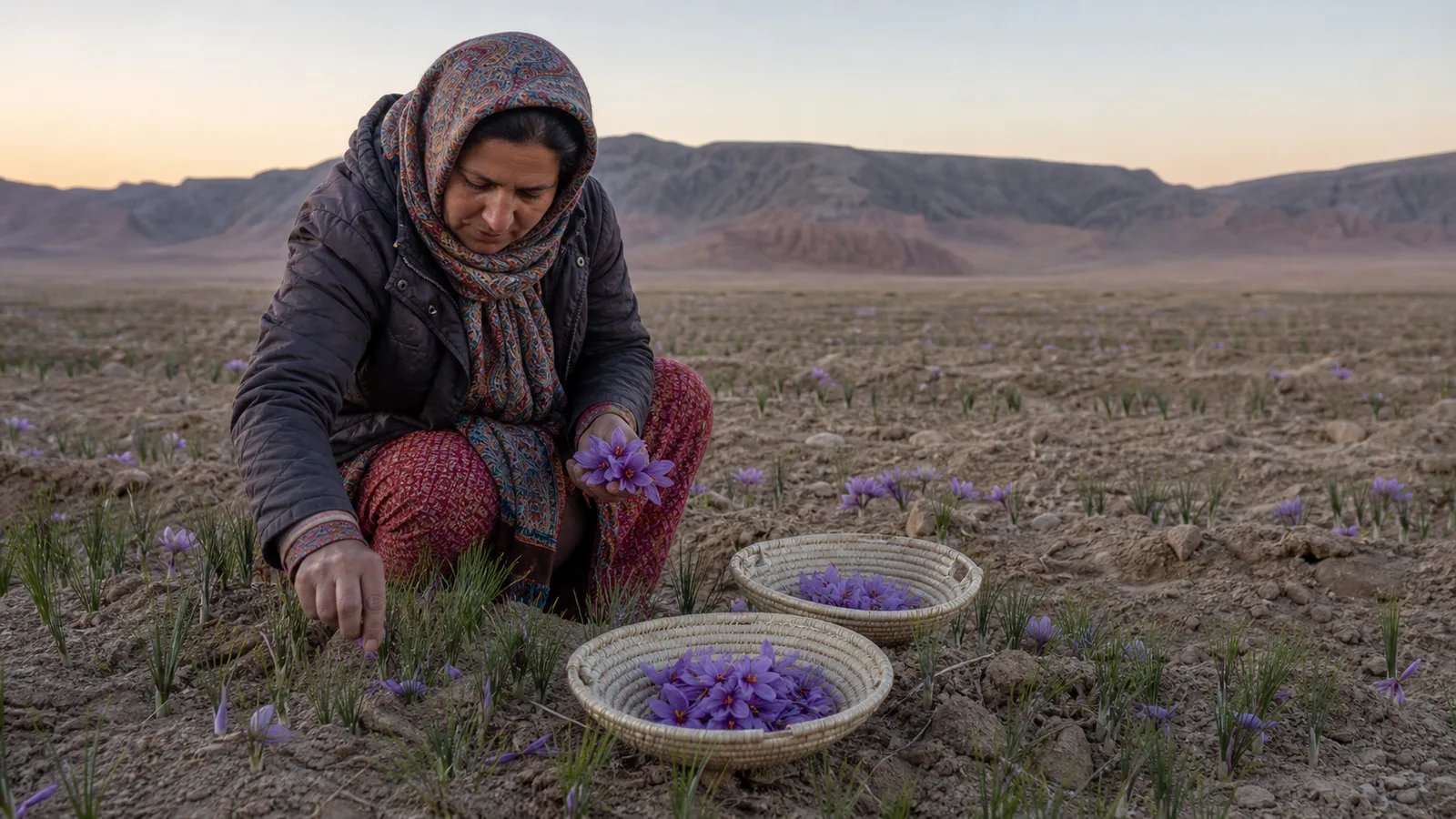
Flowering is brief once it starts. Pickers collect low-growing crocus flowers, then separate and dry the red stigmas. The high labour demand is concentrated into this narrow period, which helps explain why the two reports counted tens of thousands of people in the sector.
The 13,000-hectare and 41-tonne season
Hadarbadi described approximately 13,000 hectares under saffron and forecast a 41-tonne crop worth 600 billion rials. At that time, he called South Khorasan Iran’s second-largest saffron-producing province and said Qain had the greatest cultivated area within the province.
If the full 41,000 kg were divided by all 13,000 hectares, the implied average would be about 3.15 kg/ha. That is useful as an arithmetic check, not a verified yield. The report did not distinguish mature bearing fields from new or non-bearing hectares, and 41 tonnes was a forecast rather than a final weighed result.
The stated total value works out to about 14.6 million rials per kilogram, or 1.46 million tomans per kilogram, only if the same 41 tonnes and 600 billion rials share one exact denominator. Grade, purchase point and valuation method were not supplied. It is a historical implied figure, not a current market price.
An earlier 56-tonne forecast
In the earlier season, Hashem Vali Pourmotlagh, then head of the provincial Agricultural Jihad Organization, forecast 56 tonnes with an estimated value of 263 billion tomans. The source did not state the province-wide planted area used for that forecast, so it cannot support a yield-per-hectare calculation.
It did report that the previous year produced 54 tonnes from 15,014 hectares. The old English translation collapsed this to “15,14,” while the Persian source attribute preserves “15 thousand and 14.” Dividing those figures gives about 3.60 kg/ha, subject to the same bearing-area limitation.
The difference between 600 billion rials and 263 billion tomans is not evidence that one report is wrong. They use different currency units and crop years; one toman equals ten rials, and nominal values also change with price and inflation. Without matching dates, grades and valuation methods, comparing the totals would mislead.
Qain’s reported 4,492 hectares
The earlier report assigned Qain County 4,492 hectares, the largest share in South Khorasan. A previous English rendering and the redirect planning note transposed the last two digits as 4,449, but the Persian text embedded in the source says “4 thousand and 492 hectares.” The final article uses the number supported by that text.
Pourmotlagh praised Qain saffron for aroma and colouring power and said buyers included Germany, Spain and Gulf countries. The export destinations remain part of his historical market account. The claim that it was categorically the “best saffron in the world” is not repeated as fact because the report supplied no comparative ISO 3632 results, sampling method or independent test across origins.
Origin reputation can help a producer, but traceability and measured quality are stronger evidence than a superlative. Colouring strength, moisture, aroma-related chemistry, foreign matter and authenticity need appropriate sampling and testing.
24,500 workers in one report, 36,500 in another
Hadarbadi put employment in the provincial saffron sector at 24,500 people. The earlier report said 36,500 saffron workers would take part through the end of the season.
Neither source defined whether these were unique people, growers, household members, seasonal pickers, processing workers, full-time equivalents or all participants expected during harvest. The difference should therefore be preserved rather than “corrected” by choosing one number. It may reflect changing acreage, a different counting method or different parts of the value chain.
The work itself extends beyond collecting flowers. Stigma separation, drying, grading, storage, testing, packing and transport all determine whether the crop reaches buyers in good condition. For context on why the national harvest remained heavily labour-dependent, see our article on manual picking and Iran’s saffron market chain.
Drought and mobile water delivery
The 41-tonne-season report said 330 million tomans had been spent in the preceding year on mobile water supply to saffron fields, with help from the provincial crisis-management authority. Water delivery was continuing in the reported year.
This documents a drought response, not its effectiveness. The source gave no tanker capacity, trip count, hectares served, water quality, delivery timing or comparison with crop requirement. It is therefore impossible to calculate irrigation per hectare or attribute the forecast crop to tanker delivery.
Saffron uses less water than many conventional crops, but flowering and corm growth still depend on water arriving at useful stages. Emergency supply may keep a field alive without providing the timing or volume needed for its normal yield.
Low pesticide use is not the same as certified organic
Hadarbadi associated the province’s quality with climate and minimal use of the main pesticides used in saffron production. The old translation then called the crop “organic.” Reduced pesticide use alone does not establish organic certification.
An organic claim would require a defined standard, documented production practices, inspection and certification applicable to the product and market. The supported conclusion is narrower: the official described low pesticide use and considered the crop high quality. Individual lots still need their own records and tests.
Purchase support and a ten-year development plan
The report said an agreed-purchase programme was planned to improve producer prices. It did not provide the purchasing body, grades, quantities, opening date, funding or final prices, so the article does not imply that every farmer received a guaranteed amount.
Hadarbadi also referred to a comprehensive quantity-and-quality improvement plan approved by a parliamentary infrastructure commission. He said implementation would span two five-year periods after cabinet approval and funding, with goals including productivity, trade competitiveness and Iran’s global position.
That is a proposal with dependencies, not proof of completed ten-year results. A later assessment would need funded projects, dates, participating farms and measured changes in yield, quality or producer income.
What the reports do—and do not—show
- The harvest spreads from early fields into a mid-November peak and can continue into December.
- One season forecast 41 tonnes from about 13,000 hectares; another forecast 56 tonnes, following a reported 54 tonnes from 15,014 hectares.
- Qain led the earlier reported county area with 4,492 hectares, not 4,449.
- Employment estimates of 24,500 and 36,500 lack a shared definition and cannot be directly compared.
- Low pesticide use does not by itself prove certified-organic status.
- All output, value and worker figures are historical and should not be treated as current provincial statistics.
The destination’s old closing health claims—covering depression, Alzheimer’s disease, pain, blood formation and circulation—were not supported by evidence in either agricultural report. They are not harvest facts and are not retained as treatment advice. This page stays with what its sources can support: South Khorasan’s flowers, workers, acreage, water pressure, markets and plans.
Sources and context
- Historical provincial statements attributed to Gholamreza Hadarbadi and Hashem Vali Pourmotlagh in the two reports consolidated here.
- FAO Iran: traditional harvesting, modern processing and post-harvest quality.
- FAO Iran: authenticity testing and saffron quality integrity.

![Exporting Saffron to Turkey + Price Guide [Complete 0 to 100]](https://img.rowhanisaffron.com/20260827003933/saffron-export-turkey-quality-inspection.webp)



