


A warning from Ilam concerned safflower flowers being packaged and sold as saffron. The problem was not safflower itself, which is a legitimate plant and food ingredient. It was the substitution of one product for another without telling the buyer.
The archived report named agricultural expert Ali Farzinejad and Ilam standards official Massoud Javadi. Their comments described suspected deceptive trade, the role of mandatory saffron standards and the need for laboratory testing when a product’s identity was disputed.
What the Ilam report said
Farzinejad said safflower material was being offered in the province’s food market in place of saffron flowers. He attributed the practice to similarities in the dried products’ red-orange appearance and their use as food colourants. He also raised the possibility of unregulated production or repacking in underground workshops, whether inside Iran or abroad.
Those were concerns reported at the time, not findings that every safflower seller or every package from a particular place was fraudulent. The useful distinction is narrower: safflower must be labelled and sold as safflower. Calling it saffron, or mixing it into saffron without disclosure, misrepresents what the customer is buying.
Javadi said saffron production and packaging were subject to mandatory standards and warned about packages that lacked the required standard mark. He added that some identity testing was then carried out by centres in other provinces, with non-compliant results referred for enforcement. This article preserves that historic account; buyers should check the current rules and responsible authority where they live rather than treating an old local statement as present-day legal advice.
Safflower and saffron are different plants
True saffron is the dried stigma of Crocus sativus, a purple-flowering member of the iris family. Safflower is Carthamus tinctorius, a thistle-like annual in the daisy family. Its orange or red florets have their own culinary and colouring uses, but they are not saffron stigmas.
This botanical difference matters because the two ingredients do not have the same chemical profile, aroma, flavour or commercial value. Safflower can colour a dish and is sometimes sold openly as an inexpensive ingredient. It only becomes a saffron-authenticity problem when the name, package or composition conceals what is actually present.
Why the substitution can fool a buyer
Dried safflower florets can resemble loose red-orange strands at a quick glance, especially through a sealed package. Grinding removes much of the structure a buyer might otherwise inspect. Added colour can make visual judgement harder still.
The risk is not theoretical. A European Commission control study of herbs and spices lists safflower among the materials considered when checking saffron authenticity. That does not mean all safflower is fraudulent; it shows why an undeclared mixture needs reliable testing rather than a guess based on colour.
What a customer can check before buying
A buyer cannot reproduce a laboratory at home, but a few checks reduce avoidable risk:
- Read the ingredient name. It should identify saffron as Crocus sativus, not use a vague phrase such as “saffron flower” for an unspecified plant.
- Look for a traceable producer or packer, batch information, net weight and the certification details required in the market where the product is sold.
- Prefer intact threads when provenance is uncertain. Powder is convenient, but it gives the buyer fewer visible features to examine.
- Treat a price far below the normal market range as a reason to ask questions, not as proof by itself.
- Keep the package and receipt if the product may need to be tested or reported.
Colour-release demonstrations, taste tests and internet “tricks” may flag something unusual, but they cannot establish purity or species on their own. Genuine saffron varies with grade, storage, moisture and preparation. A sophisticated mixture may also be designed to pass a simple visual test.
How laboratories distinguish safflower from saffron
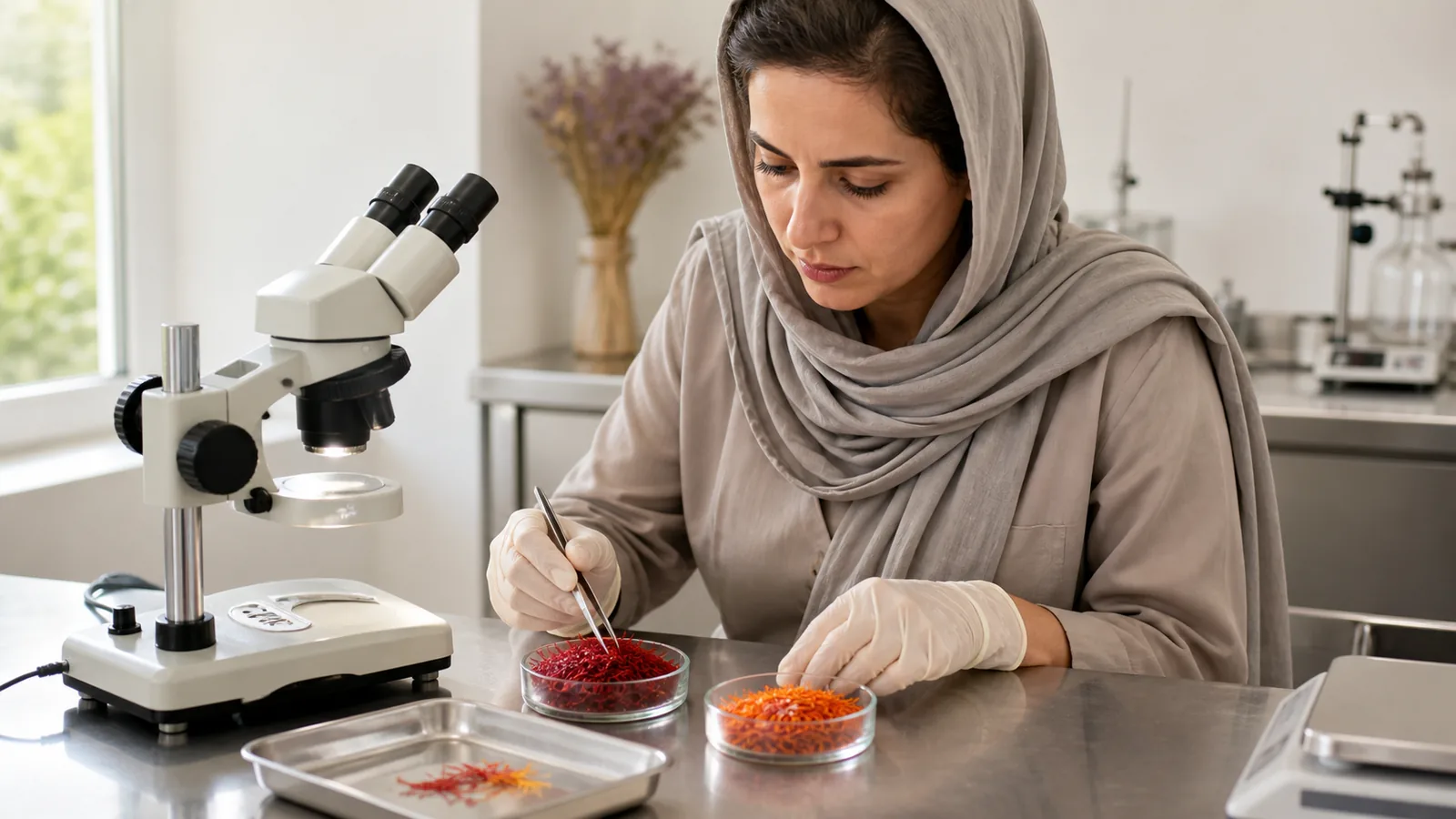
Professional authentication can combine several approaches. Microscopy examines the shape of plant tissue. Chromatographic and spectroscopic methods compare chemical fingerprints. DNA methods look for species-specific genetic material, which is particularly useful when the sample has been ground and its visible structure has disappeared.
Researchers have developed a real-time PCR method designed to detect and quantify safflower in saffron. In that study, the assay could detect safflower at 0.1% in prepared saffron mixtures. The researchers also cautioned that very small signals in commercial samples could represent cross-contamination rather than deliberate adulteration. That is a useful reminder that a test result needs interpretation.
A separate study examined 104 market samples using morphology, chromatography and DNA barcoding. The methods did not identify exactly the same samples, which is one reason strong authenticity work may use more than one line of evidence. A laboratory can assess whether a package contains saffron, another plant, added material or a mixture; a photograph of the package cannot do all of that reliably.
What saffron standards contribute
ISO 3632 is the international reference for saffron specifications and test methods; Part 1 was updated in 2025. Such standards help define product requirements and analytical procedures. They are more meaningful when certification is genuine, the batch is traceable and the sampled material is the same product that reached the customer.
A printed mark is therefore useful but should not be treated as magic. Labels can be copied, packages can be refilled, and a legitimate producer’s name can be misused. Conversely, the absence of one particular mark may have different legal meaning in different countries. The safest interpretation combines compliant labelling with a responsible seller, intact packaging and batch-level records.
Safflower should be sold on its own merits
Safflower does not need to imitate saffron to have value. Its florets have a history as a colourant, and its seeds are grown for oil. A clearly labelled safflower product lets the customer choose it for the use, flavour and price they expect.
Substitution damages both markets. The saffron buyer pays for a spice that is not present in the promised amount, while an honest safflower producer has a real crop reduced to the role of a concealed filler. Accurate naming protects the customer without implying that safflower itself is undesirable.
The lasting lesson from the Ilam warning
The original Ilam story was about buying and selling safflower flowers instead of saffron. Farzinejad focused on suspected deceptive packing and trade; Javadi focused on standards, marks and enforcement. The modern practical lesson is to separate three questions: what plant is in the package, whether its amount matches the label, and whether the claim can be traced to a responsible batch.
Appearance can start an inspection, but it should not finish one. When identity matters, transparent sourcing and appropriate laboratory methods provide stronger evidence than colour, price or packaging alone.

![Exporting Saffron to Turkey + Price Guide [Complete 0 to 100]](https://img.rowhanisaffron.com/20260827003933/saffron-export-turkey-quality-inspection.webp)



