


Saffron cultivation in Zarandieh was promoted as a way to earn more from land with limited water. An archived local report said farmers had planted more than seven hectares in Kharqan and the central district, creating seasonal work and an estimated 1.25 billion rials in annual farm income at the time.
The original English headline—“Dehydration and saffron trout in Zarandieh city”—is a broken translation. The article is about water scarcity and saffron growing; it says nothing about dehydration or trout. Its figures are also undated historical statements, not current statistics for Zarandieh.
Why saffron cultivation in Zarandieh attracted interest
Ahmad Gharabegloo, identified in the report as Director of Zarandieh Agricultural Jihad, said saffron was adapting to the district’s climate. Cultivation had started in parts of Kharqan and the central district, and the crop’s relatively limited irrigation demand was encouraging more farmers to consider it.
That argument needs a careful comparison. Saffron is dormant through much of the hot summer and its active cycle falls in cooler months, which can help it fit dry regions. The UN Food and Agriculture Organization’s account of Gonabad’s qanat-based saffron system says the crop does not require large quantities of water and has long supported livelihoods under severe water scarcity.
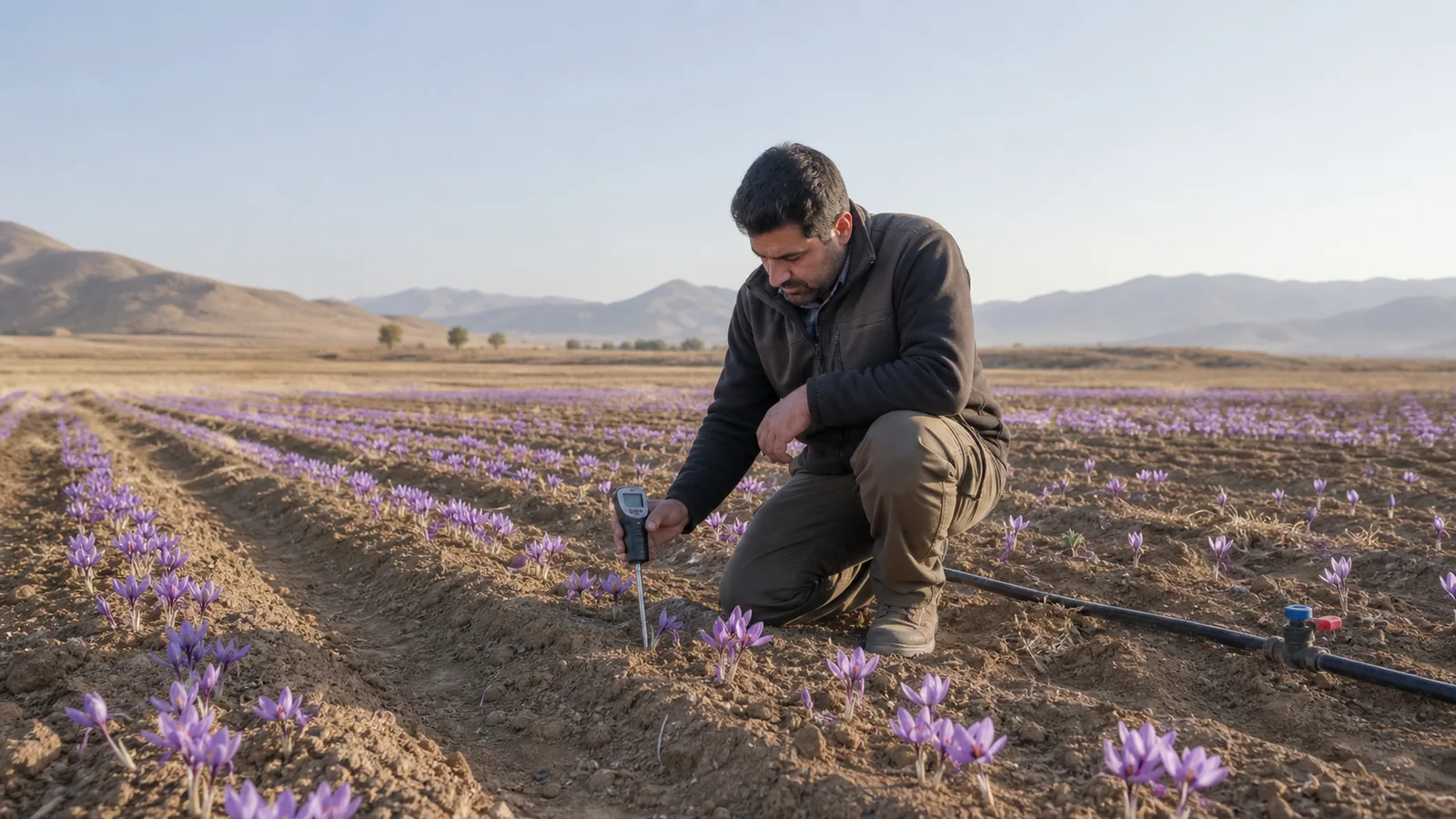
“Low water” does not mean “no water.” Establishment, pre-flowering irrigation, winter growth, rainfall, soil drainage, salinity and the timing of each application affect flower and corm yield. A Zarandieh grower still needs a field-specific irrigation plan rather than a general promise that saffron will solve water shortages.
What the seven-hectare figure tells us
The report placed Zarandieh’s saffron area at more than seven hectares. It did not say when the figure was measured, how much of the land was mature enough to flower, or how many kilograms were harvested. Those missing details prevent a reliable calculation of yield per hectare.
Seven hectares is better understood as evidence of an early local cluster than as proof of a large industry. A small cluster can share corm sourcing, agronomic advice, flower processing and marketing, but only if growers record field age, harvest weight and quality consistently.
Seasonal work and the income claim
Gharabegloo was quoted as saying saffron generated an average of about 210 person-days of seasonal work in the city. That unit means one person working for one day; it should not be reported as 210 permanent jobs. Saffron’s short flower-picking window and the need to separate stigmas soon after harvest make labour demand concentrated rather than year-round.
The same report estimated that Zarandieh farmers earned an average of 1.25 billion rials per year from their saffron harvest. No year, farm-gate price, harvested weight or cost base is supplied, so the number cannot be converted into a current income forecast. Currency value and saffron prices have changed substantially since the statement was made.
For a useful modern calculation, growers would need saleable dried-saffron yield, actual grade, selling price, labour, corms, irrigation, fertiliser, testing and packaging costs. Revenue is not the same as profit.
Does organic saffron automatically earn 40% more?
The archived article says organic saffron in Zarandieh attracted a 40% price increase over “normal cultivars.” It gives no buyer, market date, certification standard, sample size or comparison grade. The statement should be treated as a historical local estimate, not a guaranteed premium.
Organic describes a verified production system; it is not a saffron cultivar. A credible organic claim normally requires documented practices, separation from conventional product and certification accepted by the target market. Quality still matters. Poorly dried or weak saffron does not become premium merely because its field practices are organic.
Why autumn-to-spring water was proposed
Gharabegloo said using available surface water from autumn to early spring could support saffron and help change the local cropping pattern. The timing matches the crop’s active season more closely than summer irrigation would, but the source and quality of that water still matter.
Before expanding a field, farmers should check soil drainage and salinity, test irrigation water, confirm reliable autumn supply and plan where excess water can leave the corm zone. Saffron tolerates dry conditions better than waterlogging; too much poorly drained water can be as damaging as too little at a critical stage.
What public support was expected to provide
The report said the government planned to make facilities available, supply saffron corms and support the crop’s development. It framed saffron as part of wider agricultural plans for smallholders, women and rural households, with the goal of strengthening the local economy.
Corm distribution alone is not enough. Growers also need clean, appropriately sized planting material; practical advice on density, irrigation and field life; hygienic flower handling and drying; and a realistic route to buyers. Without those pieces, expansion can increase planted area without producing a consistent saleable crop.
A safer way to decide whether to expand
For Zarandieh, the strongest case for saffron is not that it is universally drought-proof or automatically high-profit. It is that the crop may align its water demand with cooler months while creating concentrated harvest work and high value from a small physical quantity.
A farmer can test that case with a modest plot, then record irrigation, labour, flower weight, dried stigma yield, quality and actual selling price for several seasons. Expansion makes sense only when those local records show that saffron performs better than the realistic alternatives for the same land and water.

![Exporting Saffron to Turkey + Price Guide [Complete 0 to 100]](https://img.rowhanisaffron.com/20260827003933/saffron-export-turkey-quality-inspection.webp)



