


Hamedan saffron cultivation covered 50 hectares in one provincial report, with a 164-kilogram harvest forecast. Later local accounts show how unevenly the crop developed: Malayer reached a reported 103 hectares, Bahar reached 16, and another province-wide season forecast 170 kilograms from 45 hectares.
These are historical snapshots from different reporting periods, not one continuous official dataset. Their areas and forecasts should not be added together. Read in sequence, however, they show where cultivation was concentrated, how output changed, and which practical constraints growers and agricultural officials identified.
The 50-hectare Hamedan snapshot
Rahim Bayat, a horticulture official at the provincial Agricultural Jihad organization, reported 50 hectares of saffron across Hamedan province—also commonly written Hamadan. That was two hectares more than the previous crop year. Expected dried production was 164 kilograms, equivalent to about 3.3 kilograms per hectare if all 50 hectares were productive.
The locality breakdown in that account was:
- Malayer: 25 hectares;
- Hamedan: 7.5 hectares;
- Nahavand: 6 hectares;
- Tuyserkan: 1.5 hectares;
- Kaboudrahang: 3 hectares;
- Razan: 3.3 hectares;
- Bahar: 3.3 hectares; and
- a second entry translated as Bahar: 3 hectares.
Those entries total 49.6 hectares, close to the rounded 50-hectare headline. The duplicated Bahar name probably reflects a transcription or translation problem, but the available article does not identify the intended eighth locality. It is therefore disclosed rather than silently replaced with another county.
Bayat said no written expansion plan existed at that point. He nevertheless described saffron as fitting a different seasonal water cycle from many field crops, with flowering beginning in November.
A different season: 170 kilograms forecast from 45 hectares
Another provincial report from Bayat recorded a different crop year. It forecast 170 kilograms from 45 hectares, following an actual harvest of 154 kilograms from 42 hectares in the previous year.
The rounded figures imply a rise from about 3.7 to 3.8 kilograms per hectare. Because one number is a forecast and the other is a completed harvest, that small difference should not be treated as a measured yield gain until the forecast is replaced by a final result.
The reported harvest window ran from the beginning to the end of November. Bayat again identified Malayer as the province’s largest saffron-growing locality. He promoted the crop as a possible alternative to water-intensive alfalfa and watermelon during drought, while also acknowledging barriers: planting corms required permits and were not easy to buy, growers needed current technical knowledge, and cultivation demanded substantial labor.
He also described Hamedan as a historical cradle of Iranian saffron. That is an attributed heritage claim from the provincial official; the source does not provide the historical documents needed to establish priority over other ancient growing regions.
Malayer became the provincial center
A later Malayer account illustrates why the earlier 25-hectare figure should not be mistaken for a permanent total. Mohsen Maleki, then a technical official in the city’s agricultural department, said cultivation had begun about ten years earlier and had expanded to 103 hectares across five areas in villages around Malayer.
The city had 132 saffron producers. Maleki described a typical yield of 3–4 kilograms per hectare, an actual prior-year harvest of about 164 kilograms, and a forecast near 200 kilograms for the new season. The harvest generally began in late October and continued into mid-November.
There is an important data gap. Applying the stated 3–4 kilogram yield to all 103 hectares would produce 309–412 kilograms, well above both the 164-kilogram result and 200-kilogram forecast. The most likely explanations are a mix of young and mature fields, rounded figures, or yield measured only on productive land, but the article does not say which. The numbers are retained without manufacturing a reconciliation.
The same historical report put the local price at 10 million tomans per kilogram in the previous year and 14 million in the current year. Those figures describe that period, not today’s market. Maleki also mentioned 28 million tomans in low-fee facilities for growers, but did not make clear whether that was a total program amount or support per recipient.
He said Malayer saffron reached buyers in Persian Gulf countries, Iraq, Russia, and Europe, although no shipment weights or customs records were included. Much of the crop was also sold locally. A private dried-fruit packer was seeking the licenses needed to package saffron in the city; the report describes that process as underway, not completed.
Bahar reached 16 hectares
Abdolhossein Akbari Babian, then head of Bahar’s agricultural office, reported 16 hectares in the city during another crop year—a 27.2% year-on-year increase. Of that area, 12.5 hectares were productive and 3.5 hectares were not yet bearing a normal crop.
The previous harvest was 41 kilograms. Dividing that amount by the 12.5 productive hectares gives about 3.3 kilograms per hectare, consistent with the official’s stated 3–3.5 kilogram range. He expected output to rise, but the source does not supply a completed figure for the new season.
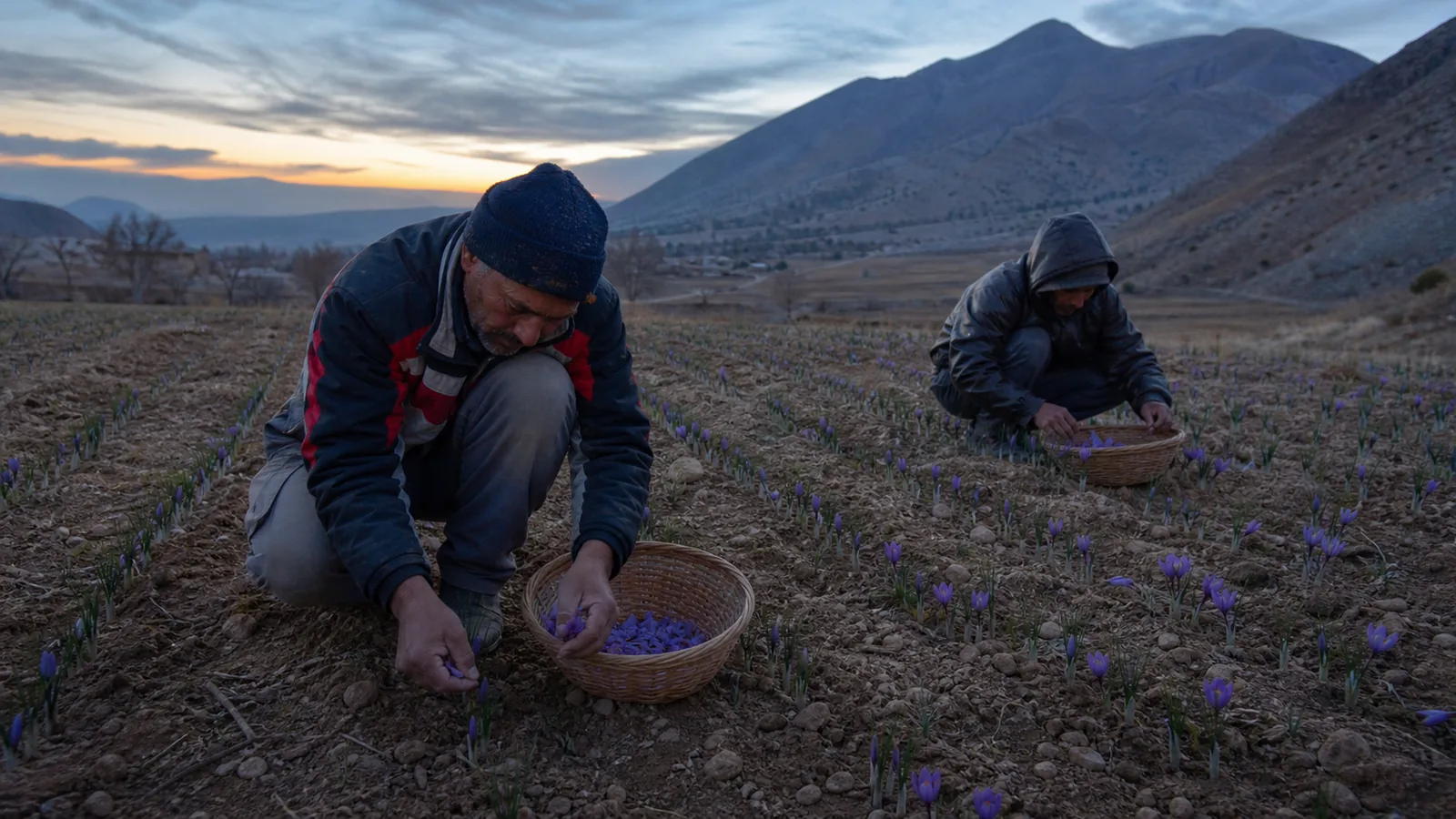
Bahar’s flowering and harvest period lasted about 20–25 days. Farmers collected flowers before sunrise, when cool conditions help protect the delicate stigmas and the day’s hand-separation work can begin promptly. The account again linked local interest to saffron’s seasonal water pattern.
What regional support could and could not do
The combined Hamedan reports describe several forms of support: credit with reduced fees, access to planting material, technical guidance, and promotion of saffron as part of crop-pattern change. These can help a farmer establish a field. They do not guarantee mature yield, a profitable sale, or an export customer.
Saffron’s autumn growth cycle may reduce direct competition with the summer irrigation schedule of crops such as alfalfa and watermelon. It is not a water-free crop. Local soil, drainage, rainfall, irrigation quality, corm health, labor availability, drying practice, and buyer access still determine whether replacing another crop makes sense.
A separate Sonqor and Kolyai comparison
One assigned source was machine-translated as “Sangroukliai.” The place appears to be Sonqor and Kolyai, which official Iranian tourism material places in Kermanshah province, not Hamedan. Its figures are included here only as a neighboring Zagros-region comparison; they are not added to the Hamedan totals.
Governor Mohammad Nasser Masoumizadeh said about 15 hectares were already planted with saffron. The development plan described two 25-hectare phases, one in the current year and another in Iranian year 1400. The source title calls this a 50-hectare program, but its wording does not clarify whether the existing 15 hectares sat inside or outside that target. Claiming a definite 65-hectare final area would therefore go beyond the evidence.
The wider agricultural plan included two processing units in the first year and three in the next, along with infrastructure for 50 hectares of greenhouses. Those projects were not described as saffron-only facilities, so they are context for the county’s agricultural investment rather than proof of dedicated saffron-processing capacity. An unrelated fish-farming item from the same source is omitted.
What the combined record establishes
Hamedan’s reports show cultivation moving from a roughly 50-hectare provincial base into stronger local concentrations. Malayer became the largest reported center, while Bahar’s productive-area figures aligned with a yield near 3.3 kilograms per hectare. The second provincial snapshot recorded a modest increase in both cultivated area and output, although one figure remained a forecast.
The durable lesson is not that every Hamedan field will perform alike. Expansion in Iranian saffron production depends on mature-area records, healthy corms, site-specific water planning, skilled harvest labor, verified quality, and a market that pays enough to cover establishment and handling costs.

![Exporting Saffron to Turkey + Price Guide [Complete 0 to 100]](https://img.rowhanisaffron.com/20260827003933/saffron-export-turkey-quality-inspection.webp)



