


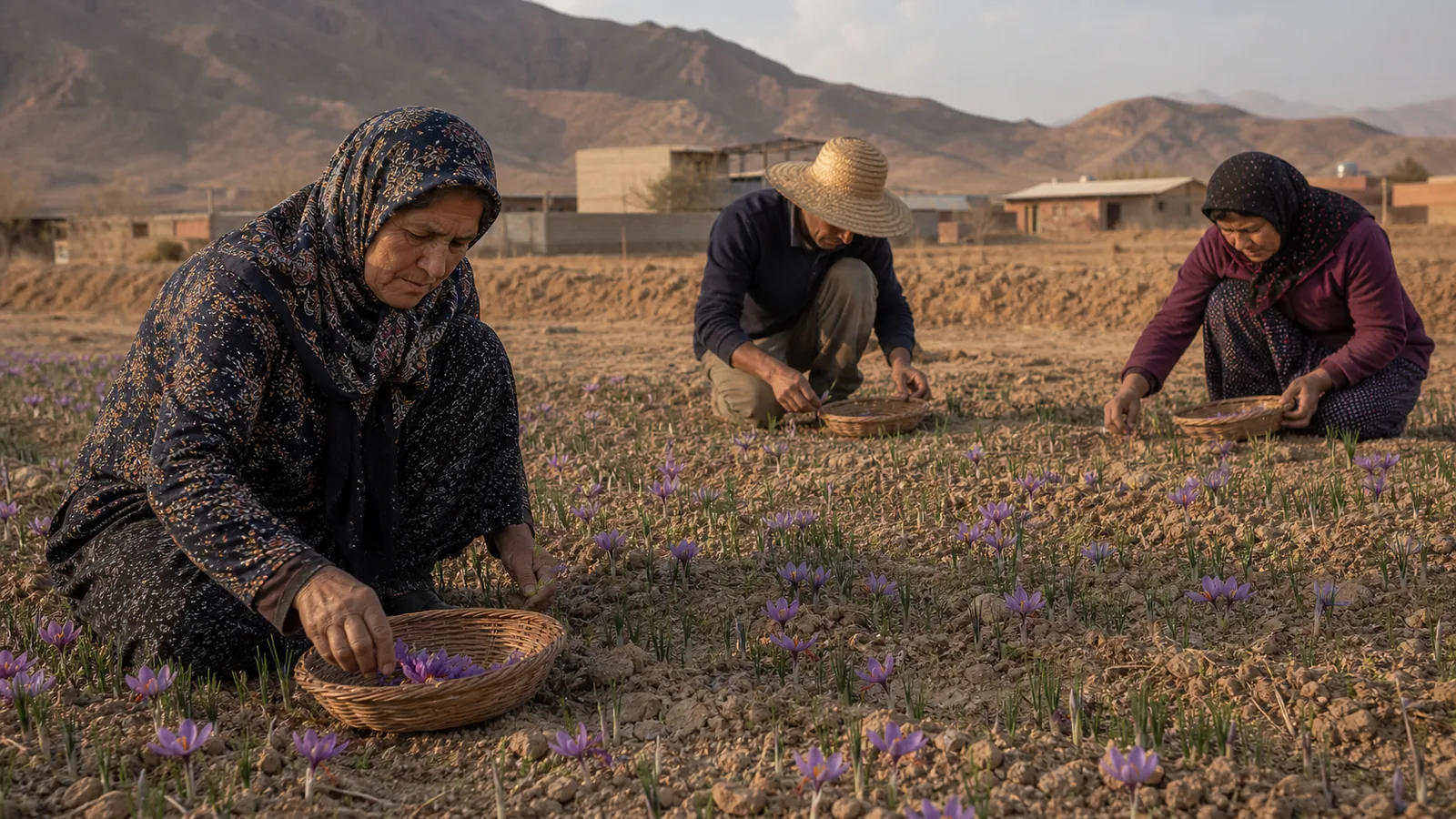
Qom saffron cultivation was reported at about 10 hectares during an early trial stage and at 15 hectares in a later provincial account. Mohammad Reza Talaei, then head of the provincial Agricultural Jihad organisation, presented the crop as one option for water-constrained farms and small plots where large machinery was impractical.
The reports also contain figures that do not fit neatly together. An average yield of two kilograms per hectare across 10 hectares would imply roughly 20 kilograms, yet the same source says the provincial harvest rose from under three kilograms to eight. Rather than hiding that conflict, this article preserves the figures with their limits and explains what would be needed to compare them reliably.
From 10 to 15 hectares of saffron in Qom
The earlier announcement placed the cultivated area at about 10 hectares and called production experimental. A separate account later described 15 hectares. If both figures refer to the same land definition and consecutive reporting stages, that would represent a 50% increase in area.
Neither archived post supplies a dated provincial table, a list of districts or a distinction between newly planted and bearing land. The safest reading is therefore that officials reported expansion from roughly 10 to 15 hectares, not that every one of those hectares produced a full commercial harvest in the same year.
At that scale, Qom remained a small emerging area rather than a rival to the established production base in Khorasan. The purpose of the trial was to learn whether local fields could produce a dependable crop and economic return.
The reported two-kilogram yield needs a denominator
Talaei said average saffron yield in Qom was two kilograms per hectare. That is a useful benchmark only if it refers to dry stigmas, a defined harvest year and comparable bearing fields. A newly planted hectare, a mature field and a demonstration plot can give very different results.
The report also says total harvest increased more than 2.5-fold, from less than three kilograms in the previous year to eight kilograms. Eight divided by any value below three is indeed more than 2.67, so the growth description is arithmetically plausible.
It does not reconcile with 10 hectares at an average two kilograms per hectare. The eight kilograms may cover a smaller bearing area, a subset of farms or a different period, but the source does not say. No missing denominator should be invented. A future update needs planted area, bearing area, total dry harvest and per-hectare yield for the same season.
Why Qom considered changing its crop pattern
Both reports connect saffron to limited water resources. Saffron has an autumn-to-spring growth cycle and a summer dormant period, which can make its irrigation calendar attractive compared with some crops. It is not water-free, and one schedule cannot be copied across Qom without considering rainfall, soil and field age.
A peer-reviewed study of irrigation and saffron corm-planting intensity in a semi-arid region shows that water and establishment decisions interact. The appropriate comparison for a Qom farmer is a field-level one: expected output per unit of water, labour and capital versus the crop being replaced.
This is the same distinction that matters in other emerging regions, including the expansion reports from Nazarabad and Malayer. A low-water label can justify a trial; measured results determine whether expansion makes sense.
Was 30% of Qom’s land suitable?
Talaei stated that 30% of the province’s land was capable of saffron cultivation. The source provides no land-capability map, hectare total, slope limit, soil definition or water-access condition behind that percentage. It also does not distinguish all provincial land from agricultural land.
The claim should be treated as an official planning estimate, not a recommendation to plant 30% of Qom. Suitability screening would need to exclude urban land, protected areas, unsuitable slopes and soils, locations without workable water access, and fields where another use has greater value.
Technical suitability is only the first filter. A crop can grow and still fail economically if harvest labour, drying, quality control or buyers are missing.
Qom’s historical relationship with saffron
In the 15-hectare report, Talaei described saffron as native to the Iranian plateau and said the historical cultivation and use of saffron extended into central Iran. He referred to the History of Qom as evidence that saffron was known in many villages around the city in the early Islamic period.
The archived article does not provide an edition, page, quotation or translation of that historical source. The reference is worth preserving because it explains why the programme was presented as a revival rather than a wholly foreign crop, but it is not enough to reconstruct the precise scale or methods of early cultivation.
Climate claims need field-level interpretation
The translated destination calls saffron a plant of arid and semi-arid “tropical” regions, then says it performs better with temperate conditions, dry summers and mild winters. “Tropical” is misleading here. Saffron is cultivated across dry and temperate environments, and its corm needs a seasonal cycle that supports dormancy, root growth and autumn flowering.
The plant is sterile and propagated through daughter corms, as described in a peer-reviewed review of Crocus sativus. That means the health, size and handling of planting material are central to establishment. A provincial climate label cannot compensate for poor corms or a badly drained field.
Small plots and the family-labour model
Talaei saw a role for saffron on small parcels where machinery could not be used efficiently. He also proposed involving household members in planting, field care and harvest to reduce cash labour costs and keep more income with the farm family.
Family participation can make a small plot workable, especially during the short flower-picking period. It does not make labour free. A realistic budget should record everyone’s hours, ensure work is safe and voluntary, and compare the value of that time with other household or paid work.
The model also depends on enough hands being available at the right moment. Flowers should be collected and processed promptly; delaying stigma separation or drying can reduce consistency. Expansion beyond household capacity requires a labour plan before the crop flowers.
What “modern methods” should mean
The Qom official criticised existing production and processing as outdated and said output did not cover costs. That is a broad judgement, not evidence that every traditional practice is ineffective. Modernisation is useful when it solves a measured problem.
For a trial programme, that can include:
- recording corm source, health, size and planting density;
- matching irrigation to soil and weather rather than a fixed slogan;
- tracking bearing area and dry yield separately;
- planning labour for flower collection and stigma separation;
- using controlled, documented drying and clean storage; and
- linking each tested batch to its field and handling record.
These steps do not guarantee profit. They create evidence that lets a grower find where yield, quality or cost is being lost.
How strong was the Qom quality claim?
Talaei called Qom saffron desirable in quality and compared it favourably with product from Khorasan, while acknowledging Khorasan’s much longer production experience. The source supplies no blind sensory assessment, laboratory values, sample count or named grade.
Qom origin therefore cannot be used as a quality certificate, just as Khorasan origin does not make every batch identical. A defensible comparison would test identified lots under the same method and account for harvest timing, stigma separation, drying, storage and age.
Employment, exports and income were goals
The programme linked saffron development with rural employment, farmer income, domestic uses and foreign-exchange earnings. These were policy goals. A 10- or 15-hectare trial does not by itself establish an export channel, and a valuable crop does not automatically leave a strong margin with the grower.
Economic performance depends on actual dry yield, grade, labour, rejected product, packaging and the buyer relationship. The wider challenges in Iranian saffron production and export value show why more planted area must be paired with consistent measurement and market access.
What the Qom reports establish
The two archived accounts establish a cautious progression: officials reported roughly 10 hectares during an experimental stage, then 15 hectares, and viewed saffron as a possible crop for water-constrained and small farms. They also reported a two-kilogram-per-hectare average, an eight-kilogram total harvest after less than three, a 30% land-suitability estimate and encouraging local quality.
Those last figures need better denominators or supporting records before they can guide investment. The next credible Qom update would publish a common-year area and harvest series, identify bearing fields, report tested batch quality and show full costs. Until then, the reports are a useful baseline for Qom saffron cultivation, not proof that the provincial expansion had already become commercially mature.

![Exporting Saffron to Turkey + Price Guide [Complete 0 to 100]](https://img.rowhanisaffron.com/20260827003933/saffron-export-turkey-quality-inspection.webp)



