


The prediction of harvesting 6 tons of saffron from Sabzevar agricultural farms was based on a reported 1,500 hectares under cultivation. That works out to four kilograms per hectare if the six tons meant dried saffron and the full area was bearing—two conditions the original announcement did not specify.
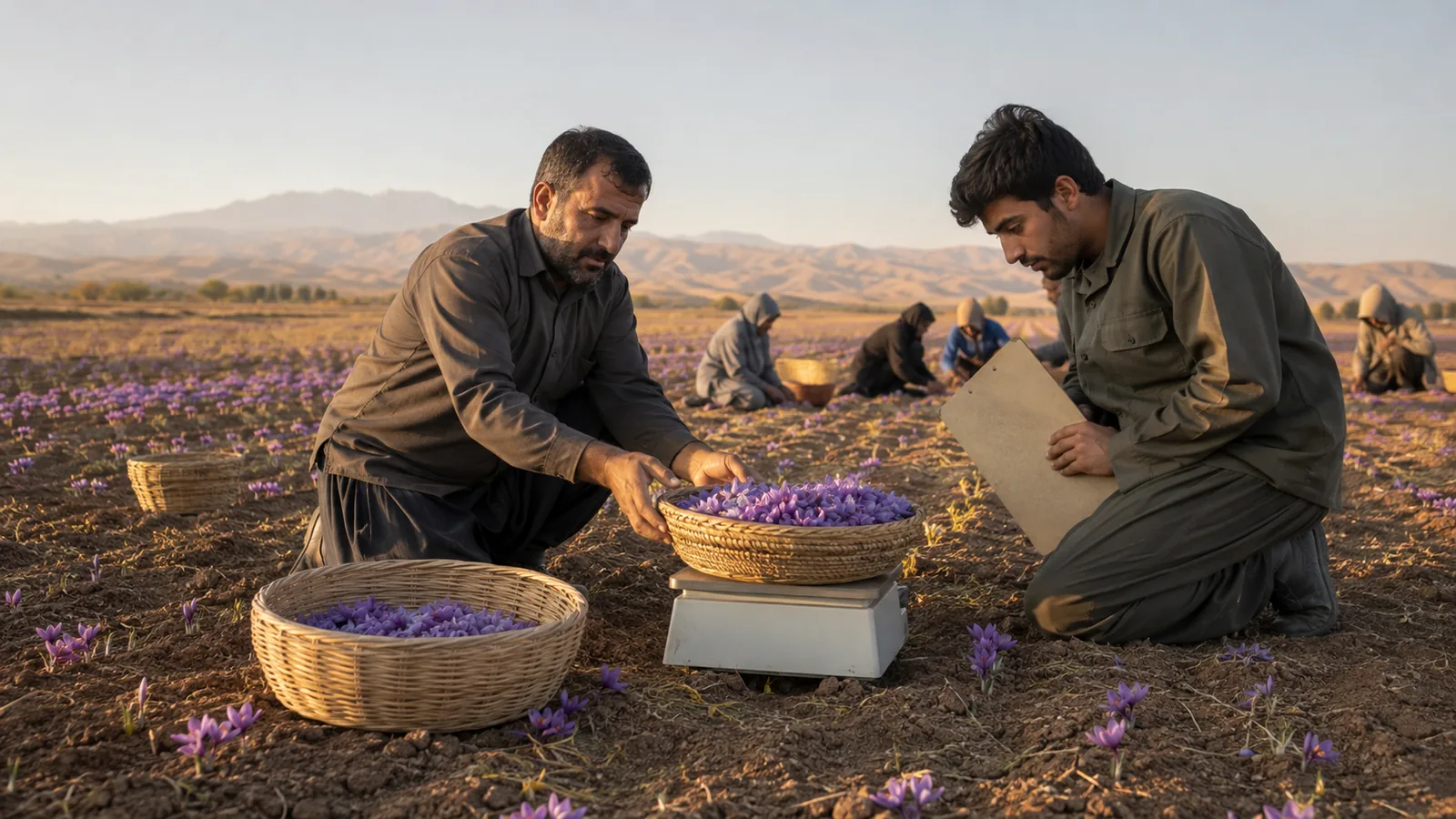
What the Sabzevar saffron forecast covered
Mansour Barghomadi, identified as the director of Sabzevar’s Agricultural Jihad office, forecast a six-ton saffron harvest for the reported year. The brief item gave 1,500 hectares as the city’s cultivated area but did not publish the final harvest, field-age breakdown or dry-versus-fresh basis.
The six tons should therefore remain a historical prediction, not a completed production result or a current figure. A forecast can be useful for planning labour and processing only when its assumptions are clear.
What four kilograms per hectare does—and does not—show
Six thousand kilograms divided by 1,500 hectares equals four kilograms per hectare. That simple calculation helps readers understand the scale, but it is not a verified average yield because some newly planted hectares may not have been fully productive.
Flower weight, dry stigma recovery and field age also matter. The strongest county report would state dry saffron harvested from measured bearing area, then list new or non-bearing fields separately.
The “sixth section” and western production center
The translation calls the “sixth section of Sabzevar city” one of the province’s main saffron centers. This appears to refer to Sheshtamad, a place name that can be confused with the ordinal word “sixth” in translation. The source did not supply the Persian spelling or administrative date, so the ambiguity should remain visible.
Barghomadi said about 80 percent of saffron land in the west of the province was located in this section. That is a substantial geographic claim, but the brief article gave no provincial acreage table or boundary definition. It is preserved as his reported statement rather than updated into a present-day share.
The report counted 3,800 saffron growers
The English sentence is broken—“3,800 saffron work”—but its clear intended meaning is that about 3,800 people cultivated saffron in the section. The number indicates a broad producer base, although the source did not define whether it counted farm owners, workers, households or registered growers.
A current count should say who is included and how many farms and hectares they represent. Without that denominator, 3,800 is useful historical context but not a measure of average farm size or employment.
Development focused on Sabzevar’s central area
Barghomadi said suitable water resources had placed further saffron cultivation in the central part of the city on the Agricultural Jihad agenda. Water availability can support expansion, but it is only one part of site selection.
Soil texture, drainage, salinity, corm health, field temperature and labour access also affect performance. Research in the FAO AGRIS database on saffron irrigation and soil texture found that both factors influenced flower and replacement-corm yield. A Sabzevar schedule should be based on local measurements, not copied unchanged from another district.
Planting and harvesting need more than a slogan
The original item ends one statement with the fragment “for the correct implementation of planting and harvesting steps.” The missing words cannot be recovered safely, but the point belongs in the article: expansion needs practical instruction from planting through post-harvest handling.
Growers need healthy corms, suitable depth and density, timely irrigation, weed and disease monitoring, enough pickers when flowers open, clean stigma separation and controlled drying. Records at each stage make it possible to explain why one field outperforms another.
Field age can change county-level yield
Saffron remains in the soil for several seasons, and a young planting can behave differently from a mature or crowded bed. A study indexed by FAO AGRIS on field age and saffron characteristics measured differences among four-, seven- and fourteen-year-old fields, including corm and stigma traits.
That does not determine Sabzevar’s yield, but it shows why the 1,500-hectare total needs an age profile. The implied four-kilogram average may hide strong and weak groups of fields.
Sabzevar’s geographical context
The historical article located Sabzevar in western Khorasan Razavi, about 220 kilometres from Mashhad. It gave an area of 20,628 square kilometres, an elevation of 977.6 metres and a highest point of 2,924 metres in the Jaghatay mountain range.
Those figures describe a large and varied landscape, not one uniform saffron climate. Elevation, soil and water can differ considerably between a central field and a mountain-edge village, which is another reason to report production by area rather than apply one average everywhere.
The old administrative list needs a date
The source listed five districts—Markazi, Sheshtamad, Rudab, Davarzan and Khoshab—along with 25 units, seven cities and 492 villages. Its English version uses “villages” twice for different administrative levels and says the area ranked first nationally by village count.
Administrative boundaries can change, and the article did not date this list. The names and figures remain here because they formed part of the original Sabzevar context, but they should not be used as a current government directory.
How a six-ton forecast should be verified
A complete season report would publish bearing and new hectares, dry saffron weight, field-age groups, number of farms, village or district totals and quality results. It would compare the forecast with the final measured harvest.
That evidence would make the six-ton prediction useful beyond a headline. It would show where Sabzevar’s saffron production was strongest, how much each bearing hectare delivered and whether the development programme improved results over time.

![Exporting Saffron to Turkey + Price Guide [Complete 0 to 100]](https://img.rowhanisaffron.com/20260827003933/saffron-export-turkey-quality-inspection.webp)



