


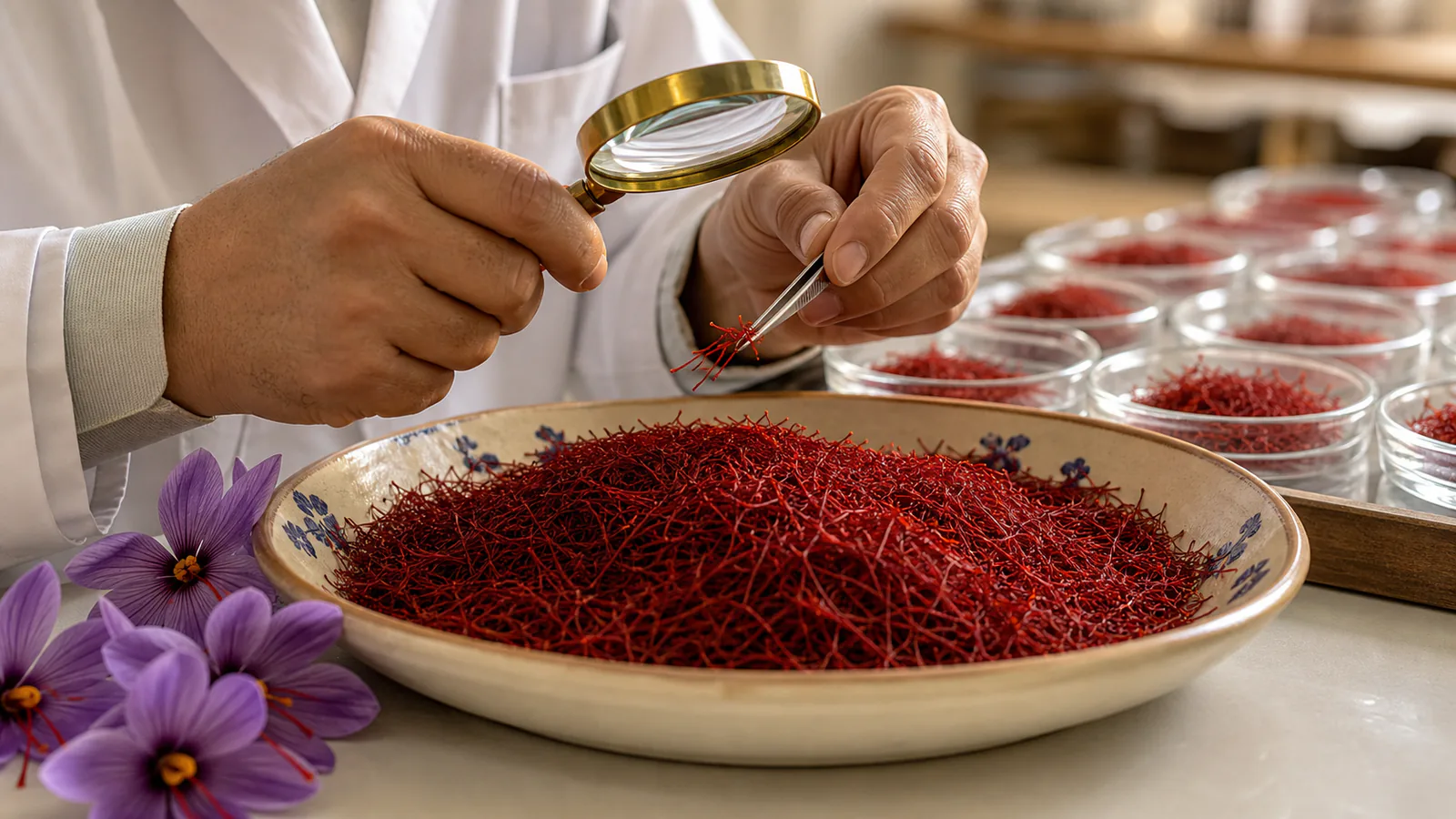
Most of saffron in Iran is more than a familiar claim: FAO currently describes Iran as the world’s largest producer, responsible for more than 90% of global output. That scale gives Iranian growers and traders a unique position. It does not make the market impossible for another origin to enter.
This page began as a 2015 comparison of Iran and Afghanistan. Its argument was that Afghanistan’s growing industry did not yet approach Iran’s volume, while Iran’s more immediate weaknesses were at home: raw or bulk trade, inconsistent packaging, limited product development, price volatility and weak coordination. The historical figures are retained with dates and caveats rather than presented as current market data.
Iran’s lead was large in the 2015 report
The study, attributed to the Planning and Economic Research Institute of Iran’s Ministry of Agriculture, put Iranian production above 250 tonnes a year at the time. It concluded that Afghanistan could not then be compared with Iran in scale and was not an immediate threat to Iran’s position as the best-known producing country.
Current FAO material still places Iran above 90% of world production. The FAO description of Iran’s qanat-based saffron system also shows why production concentration developed: saffron fits an arid landscape, works with carefully managed irrigation and supports a large rural value chain.
Production share, however, is only one measure of leadership. Buyers also judge purity, consistency, origin documentation, delivery reliability and whether a supplier offers the form they need. A country can dominate the crop while another business captures more of the value in testing, branded packing, extracts or distribution.
The packaging debate was really about value addition
The 2015 paper discussed a rule affecting exports in packs above 30 grams and said a court had invalidated it in August 1392 in the Iranian calendar. The old translation does not preserve enough legal detail to treat that as current guidance. Exporters must check the rules now in force rather than rely on this historical reference.
Its larger point remains useful: forcing saffron into small packs does not automatically create value. Some legitimate buyers need bulk lots for food manufacturing, cosmetics, research or further processing. Others need finished retail packs. The right format depends on the buyer, specification, destination rules and route to market.
The paper proposed higher-value options including purified saffron compounds such as crocin, controlled-atmosphere packaging, active or intelligent packaging and stronger monitoring of exported products. Each requires a real technical and commercial case. Extract production, for example, needs validated methods, safety controls and customers who specify the composition; it is not simply a more profitable version of dried threads.
How Afghanistan’s saffron sector was developing
Afghan saffron cultivation was concentrated in Herat. The historical article said about 90% of the country’s crop came from that province and described programmes supported by the Afghan government and international organisations. Saffron was promoted as one possible legal alternative to opium poppy cultivation.
A World Bank value-chain study provides clearer early figures than the old machine translation. It recorded Afghan saffron area rising from 16 hectares in 2004 to 310 hectares in 2009, with estimated production of 1,500 kilograms in 2009. The study said DACAAR expected high-end buyers to take greater interest once annual output reached 5,000 kilograms. Read the World Bank report for its dated evidence and limitations.
The 2015 Iranian article also reported a much broader Afghan ambition: cultivation across 26 provinces, 7,000–10,000 hectares considered suitable and a possible 50–70 tonnes if expansion succeeded. Those were projections, not achieved production. It mentioned training for about 12,000 farmers, printed cultivation guidance, dryers and quality-control facilities, although equipment counts in the archived translation are too garbled to repeat.
Early Afghan growers faced familiar value-chain problems
The World Bank analysis described weak post-harvest practice, limited access to markets, inadequate certification, insufficient scale and a thin research system. Farmers and processors needed better drying, sealed storage, market information and functioning laboratories. Those are not uniquely Afghan problems; they are common wherever a high-value crop expands faster than its supporting institutions.
Training and organisation could change the result. A later World Bank programme linked rural producers with businesses, extension advice, specifications and quality control. The programme’s Herat saffron example described one enterprise employing women seasonally and producer clusters building the scale needed to reach buyers.
Afghanistan is now recognised as a legitimate saffron origin in its own right. FAO’s regional origin-product platform lists Herat-Bastan Saffron, produced in specified Herat districts and marketed as red threads whose colour, aroma and bitterness relate to crocin, safranal and picrocrocin. That development is more informative than treating every new producer only as a threat.
Historical export destinations need a date label
The original article listed Spain as taking 30% of Afghan saffron exports, Italy 17% and France 6%, followed by Sweden, Switzerland, Argentina and the United Arab Emirates. It did not preserve a clear year or traceable dataset for those percentages. They are retained as claims from the 2015 report, not as a current market map.
The same caution applies to its statement that much Afghan saffron moved in bulk to Spain and France because quality control and packaging were limited. Trade routes, certification and domestic processing can change quickly. Anyone comparing origins today needs current customs data, consistent commodity codes and an explanation of re-exports.
What Iran can protect without dismissing competitors
Gholamreza Miri, then vice-chair of Iran’s National Saffron Council, expressed concern about international support for Afghan cultivation and the effect on Iranian markets. The 2015 paper answered that Afghanistan’s volume was too small to displace Iran. Both positions focused heavily on production.
A stronger response is to protect what buyers can verify:
- healthy corms and well-managed fields;
- clean separation, controlled drying and stable storage;
- lots that remain traceable through processing and export;
- credible testing for identity and promised quality;
- accurate origin and product-form labelling;
- reliable contracts, delivery and communication; and
- products designed around actual culinary or industrial demand.
FAO’s 2025 work in Iran now links authenticity testing with field-ready post-harvest guidance and training across Razavi, North and South Khorasan. The FAO–Mashhad University initiative reflects the practical route to leadership: preserve quality all the way from the field to the final buyer.
Price headlines do not settle the competitive question
The archived article ended with a claim that Ramadan affected saffron prices and then listed several price bands. The machine translation has lost the grades, units and number boundaries, so those prices cannot be responsibly reconstructed. They should not be used for a sale, valuation or trend comparison.
Short-term price changes can alter export orders and farmer incentives, but a country’s durable position rests on more than one season’s quotation. Buyers remember whether the product matched its specification, arrived on time and could be traced when a question arose.
Most production is a starting point, not a finish line
Iran’s share of global saffron gives it extraordinary agricultural depth, accumulated knowledge and supply capacity. Afghanistan’s growth shows that suitable regions can build credible alternatives when training, processing, quality control and market links improve.
The useful conclusion is not that Iran has nothing to worry about, or that every new hectare elsewhere threatens its market. It is that leadership must be renewed. Most of the world’s saffron may be produced in Iran; the value and reputation attached to it depend on what happens after the flower is picked.

![Exporting Saffron to Turkey + Price Guide [Complete 0 to 100]](https://img.rowhanisaffron.com/20260827003933/saffron-export-turkey-quality-inspection.webp)



