


Investment in Iranian saffron is not one opportunity but a series of very different choices. A business can finance cultivation, corm supply, drying, testing, storage, packaging, export logistics, consumer products or market development. Each choice has its own margins and risks. The fact that saffron is valuable by weight does not make every project built around it profitable.
This page began as a 2015 interview with Gholamreza Miri, then identified as vice-chair of Iran’s National Saffron Council. His central warning was about planning: a temporary opening in trade or a sudden rise in price was not a substitute for stable demand, market knowledge and an organised value chain. The old report is useful as industry history, not as current investment advice.
What the 2015 interview warned about
Miri described saffron prices rising sharply as exporters tried to complete orders and commitments. In his view, a speculative “flight” in price could discourage foreign buyers, make a return to normal pricing difficult and give competing origins, especially Afghanistan, room to gain customers.
The numeric price range in the archived English translation is internally garbled: it mixes several figures and an unreliable currency rendering. It is not repeated here as market data. The meaning is clear enough, however. Exporters who quote a price, accept an order and then face a rapid replacement-cost increase can lose money or fail to fulfil the agreement. Buyers exposed to that uncertainty may reduce orders or qualify another supplier.
Price stability does not mean fixing a commodity at one number. It means having transparent grades, dependable market information, enforceable contracts and enough working capital to manage the time between buying, processing and payment.
A trade agreement cannot create demand by itself
The interview took place around the 2015 nuclear agreement. Miri expected easier money transfers and financial exchange to help Iranian businesses, but he did not expect the agreement alone to transform saffron trade. Access and demand are different things.
His comparison with McDonald’s was deliberately practical. A restaurant chain would study an established habit, local spending and consumer taste before entering a market. Saffron businesses should do the same. Low per-capita use in many countries will not rise merely because the product becomes easier to ship.
An investor therefore needs a named customer segment and a use case. A chef buying whole threads, a food manufacturer buying a standardised ingredient and a gift buyer choosing a small retail pack do not require the same grade, documentation, packaging, price or sales channel.
Where investment can add durable value
Iran already produces most of the world’s saffron. The more useful question is where quality, trust or efficiency is being lost. Possible investment points include:
- Farm and corm systems: healthy planting material, extension support, irrigation management and harvest coordination.
- Post-harvest handling: timely stigma separation, controlled drying, hygienic storage and lot segregation.
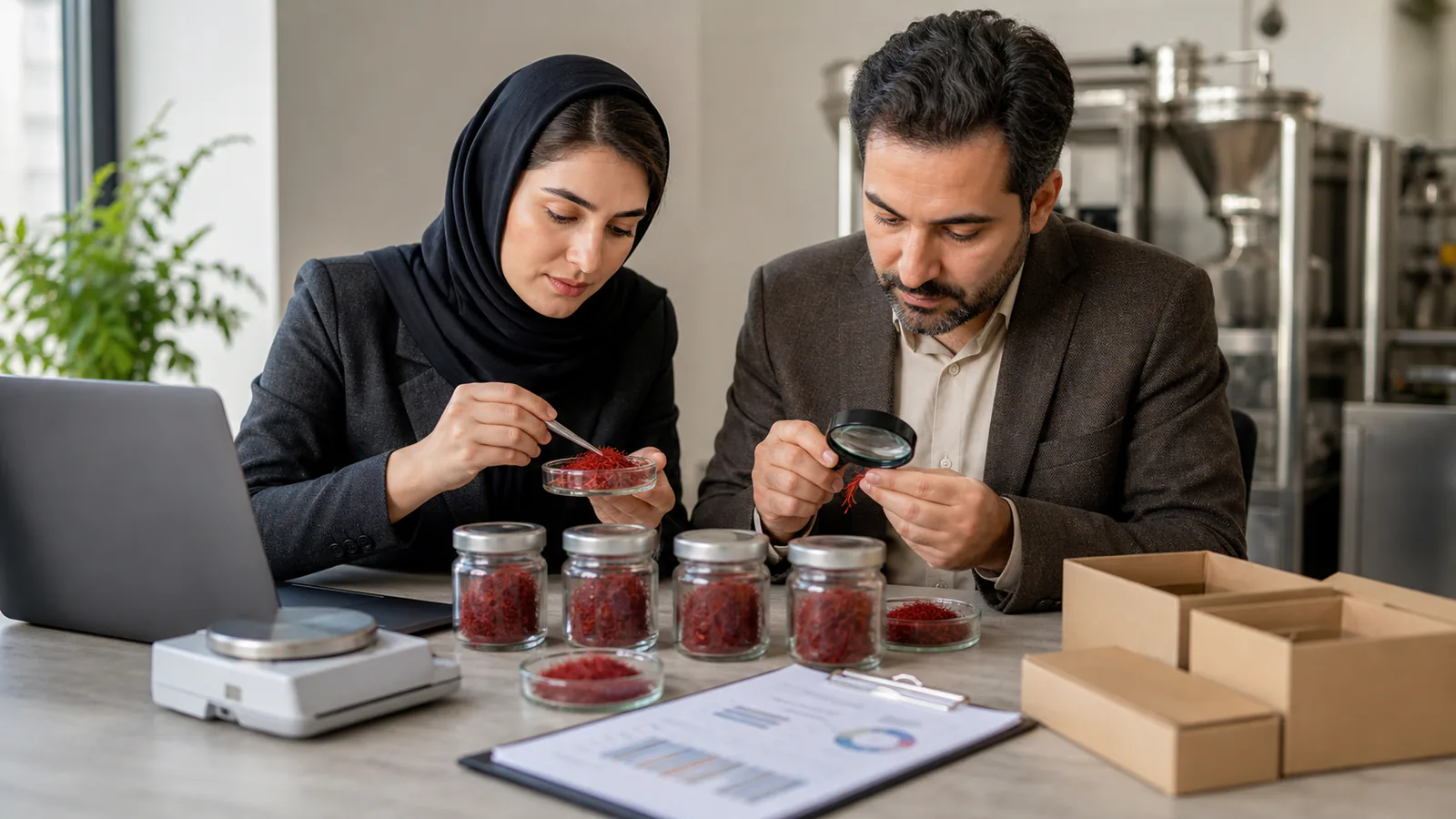
- Testing and authenticity: accessible laboratory capacity, sampling protocols and records buyers can verify.
- Processing and packaging: formats designed for a real buyer, with food-contact compliance, traceability and honest origin.
- Market development: culinary education, distributor relationships and product development tied to measured demand.
These investments can support one another. A premium pack has little value if the lot behind it is inconsistent. A sophisticated test result does not create sales if the target customer does not understand the specification.
FAO’s current work with Iran follows this connected approach. Its saffron value-chain programme brings together production, post-harvest management, safety, traceability, marketing and quality assurance rather than treating branding as an isolated exercise.
Quality control is commercial infrastructure
Adulteration and inconsistent post-harvest handling do more than create a laboratory problem. They increase the buyer’s risk, weaken repeat business and make good producers harder to distinguish from weak ones.
In 2025, FAO and Mashhad University of Medical Sciences announced work on improved saffron authenticity testing and field-ready post-harvest guidance. FAO noted that international trade commonly references ISO 3632, while routine tests may not capture every subtle difference or sophisticated adulteration. The testing initiative illustrates an investable need: credible methods, trained people and records that convert quality into buyer confidence.
A facility should still be sized for actual throughput. Expensive equipment that sits idle can increase unit costs. Shared or contract testing may make more sense than an in-house laboratory for a small processor, provided sampling, accreditation and turnaround time meet the customer’s needs.
Packaging needs a route to market
The 2015 interview mentioned Greek and Spanish businesses interested in export activity but questioned whether large corporations would invest in unbiased packaging of Iranian saffron without a stronger market case. The broader point remains sound: packaging capacity and a packaging business are not the same.
Before buying a line, define the form, pack size, destination rules, expected volume, shelf life, sales channel and buyer’s acceptable landed cost. Include testing, labels, cartons, freight, returns, distributor margin and unsold stock in the model. A beautiful container that misses the target price or sits in a warehouse is not added value.
Origin also needs honest treatment. Repacking Iranian saffron under an opaque identity may generate short-term sales, but it does little to build recognition for the producing region. Traceable origin and consistent specifications make a stronger basis for repeat trade.
Governance and price risk cannot be ignored
Miri described saffron as lacking a single effective “trustee” while ministries and market actors failed to calm volatility. He suggested that recent conditions strengthened the case for a saffron fund and better market tools. That was a 2015 policy position, not proof that any particular fund structure would work.
Fragmented responsibility can still affect private projects. Investors should map who controls food licensing, standards, export documents, foreign exchange, customs, agricultural support and market data. They should also test how a project performs when the purchase price rises, the selling price falls, payment is delayed or an export route closes.
Stockpiling in the hope of a higher price is speculation, not value-chain improvement. Working-capital finance tied to verified inventory and contracted demand is a different proposition. The distinction belongs in the business plan.
A due-diligence checklist for a saffron project
Before capital is committed, the project should be able to answer:
- Which bottleneck does this investment remove, and for whom?
- Which buyers have confirmed the specification, volume and price range?
- Can every finished lot be traced and tested?
- What happens under lower yield, higher raw-saffron cost or slower payment?
- Are the facility, staff and compliance costs based on realistic throughput?
- How are farmers and small suppliers protected from one-sided terms?
- Which claims about quality, origin and market size are independently verifiable?
The World Bank’s current agribusiness guidance makes a related point: infrastructure, finance, skills, market access and bargaining power determine whether smallholders share in value-chain gains or are excluded. Its agrifood value-chain overview is useful context for evaluating who benefits from a project.
The durable investment case
The strongest case for investment in Iranian saffron is not that the spice is expensive. It is that a specific, evidenced gap can be closed: cleaner planting material, better post-harvest control, trusted testing, traceable packing, reliable finance or a market that understands how to use the product.
Trade conditions can open a door and prices can create urgency. Neither tells a business what to build. A sound project begins with demand, protects quality from farm to buyer and remains workable when the market is less favourable than the headline suggests.

![Exporting Saffron to Turkey + Price Guide [Complete 0 to 100]](https://img.rowhanisaffron.com/20260827003933/saffron-export-turkey-quality-inspection.webp)



