


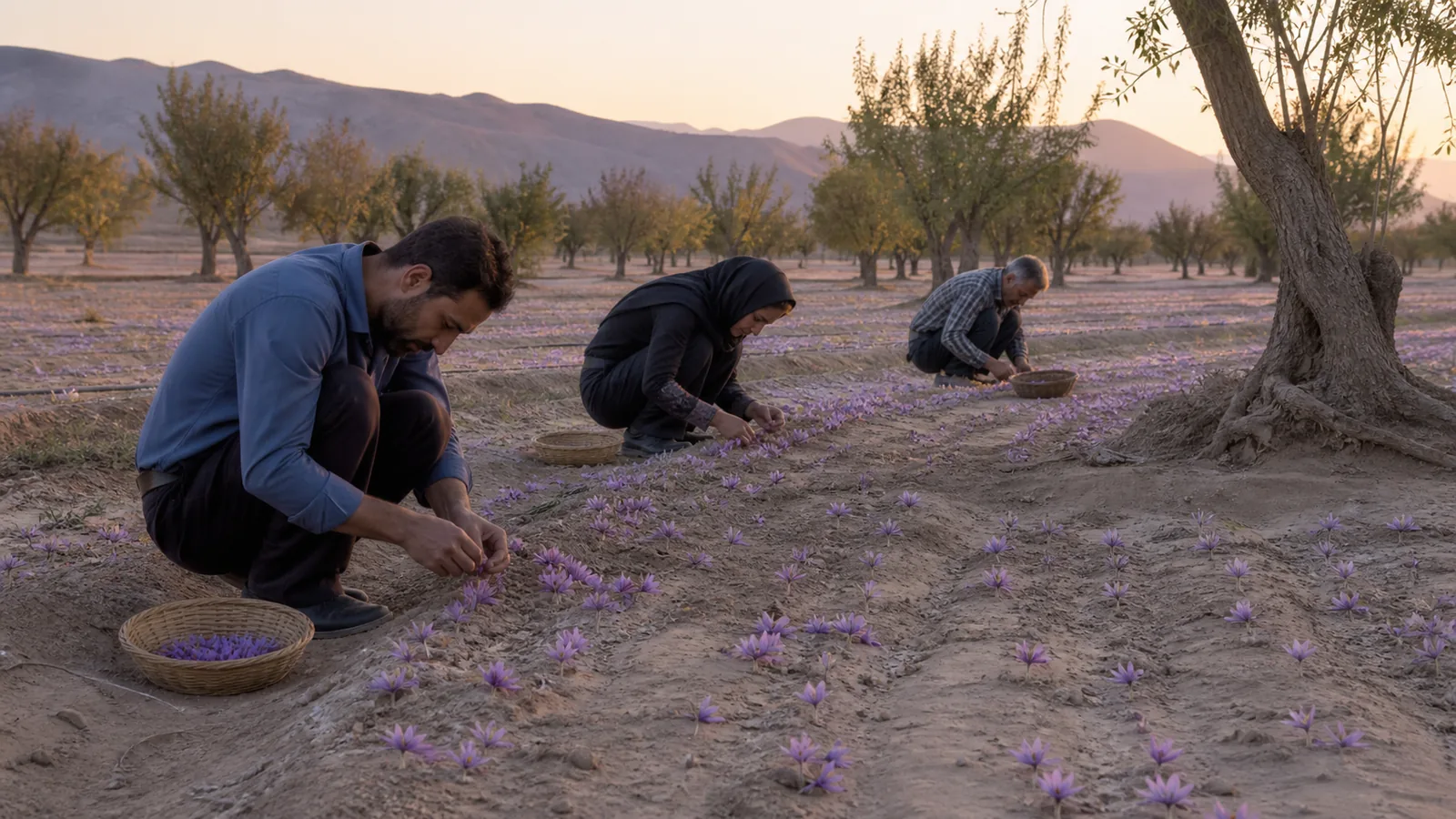
A saffron farm in Sirjan is shaped by a dry climate, a short autumn flowering season and a great deal of hand work. A local agricultural report from 2015 described about 50 hectares of saffron in Sirjan County, much of it around Homa Shahr. It also named Balvard, Pariz, Malekabad, Zeidabad and parts of the county’s outskirts as promising areas. Those details are useful as a historical snapshot, but they are not a current acreage survey or a guarantee that every field in those places will suit saffron.
What makes the report worth revisiting is the picture behind the numbers. It shows how growers were testing saffron as a lower-water alternative, fitting it into orchard land, planning around a narrow harvest window and depending on seasonal labour. It also records the practical problem that can decide whether a field is planted at all: access to finance before the planting date passes.
What the 2015 Sirjan farm report recorded
The account attributed its figures to Ahmad Masoudi, then identified as Sirjan County’s director of agricultural affairs, and cited Kerman’s Young Journalists Club. Masoudi said the county had roughly 50 hectares under saffron. Most of that area was said to be in Homa Shahr, while Balvard, Pariz, Malekabad, Zeidabad and some outlying areas were described as having potentially suitable soil and climate.
The article also made three specific operational claims. Planting ran from the second half of Shahrivar through the end of Mehr; harvest ran from the second half of Aban into early Azar; and a well-managed mature field could exceed five kilograms of saffron per hectare in its fourth, fifth or sixth harvest year. These are Iranian Solar Hijri calendar windows. In broad Gregorian terms they fall from September into October for planting and from November into early December for harvest, but weather and field condition matter more than a date copied from an old report.
The same source described some saffron growing between orchard trees, reported more than 10,000 person-days of direct and indirect work, and said 76 prospective growers had been referred for agricultural bank finance in the previous year. Because their applications came after the planting period, the facilities were reportedly not secured in time. The statement said earlier planning and payment were intended for the following season; it did not identify a permanent programme or provide a loan amount.
What a saffron farm in Sirjan needs from the site
A county name is not a soil test. Two fields a few kilometres apart can differ in drainage, salinity, irrigation-water quality, slope and cold-air exposure. Before corms are ordered, a grower needs to map the productive area, examine the soil profile and test both soil and water. A light-looking surface can hide a compacted or poorly drained layer below it.
That matters because saffron is a perennial corm crop. Waterlogging and stagnant moisture can damage the planting stock, while an under-supplied field may not build the daughter corm population needed for later harvests. A field assessment should therefore cover:
- soil texture, depth, drainage, salinity, pH and organic matter;
- the quality, volume and timing of available irrigation water;
- the previous crop and any herbicide or soil-borne disease history;
- access for early-morning picking and rapid transport of flowers;
- space for hygienic stigma separation and controlled drying; and
- a labour plan for the few weeks when flowers open quickly.
Research carried out in a semi-arid field in Sarayan found that soil texture and irrigation interval both affected flower and corm performance. It supports testing the actual field rather than treating “Sirjan climate” as a complete planting recommendation. The study is available in Scientia Horticulturae.
Planting and harvest follow the plant, not a fixed date
The 2015 calendar is valuable because it preserves the local sequence: establish the field in late summer or early autumn, then prepare for flowers later in autumn. It should still be adjusted to corm condition, soil temperature, irrigation access and that year’s weather. The wider climate requirements are covered in our guide to weather for planting saffron.
Harvest is less forgiving than planting. Flowers can emerge in waves, and a crew that is adequate on a quiet morning may be overwhelmed at the peak. Picking early helps protect the flowers from heat and handling damage. Separation and drying then need to follow without an unnecessary wait. The work is repetitive and delicate; clean containers, shaded handling space and trained hands have more value than a decorative field photograph suggests.
A useful farm calendar is therefore a list of decisions, not just dates. It assigns who will check emergence, call pickers, move flowers, separate stigmas, operate the dryer, label lots and record dry weight. It also allows for a cooler or warmer season instead of promising that harvest will begin on the same morning every year.
Why mature fields can outyield new plantings
Saffron does not behave like an annual crop replanted from seed every spring. A mother corm produces daughter corms, so plant population and corm-size distribution change as the field ages. A new planting may flower lightly. Production can build over later seasons, then become uneven if crowding, depleted soil, disease or poor water management weakens the stand.
That biology explains why Masoudi associated more than five kilograms per hectare with the fourth through sixth years. It does not make five kilograms a universal benchmark. Field experiments have found strong effects from corm size, planting arrangement, water and season, and the best year differs among sites. Our separate article on production of 5kg saffron per hectare explains how to interpret and measure that figure without turning it into a sales promise.
For farm records, “yield” should mean dry saffron from the mapped productive area, not the weight of fresh flowers and not the best patch multiplied across a hectare. Record flower weight, accepted dry stigma weight, rejected material and the drying endpoint separately. A clean number is only useful when its denominator and product form are clear.
Growing saffron among orchard trees
The old report says saffron in Sirjan was often used as a crop between trees. That arrangement can make use of open orchard ground, but it should not be assumed to work under every canopy. Tree roots and saffron corms may compete for water and nutrients. Shade changes through the season, orchard irrigation may keep the soil wet at the wrong time, and sprays used on the tree crop may be unsuitable around a spice harvested by hand.
Intercropping itself is a real field-management approach, not an oddity. Iranian experiments have tested saffron with annual companion crops and reported that the result depends on crop combination, irrigation and planting design. One multi-year study of saffron with pumpkin or watermelon found land-use and yield benefits under its particular conditions; it did not test Sirjan orchards. The distinction matters. Evidence for one companion crop cannot be used to promise the same result beneath pistachio or fruit trees. The research can be read in the Journal of Cleaner Production.
A sensible orchard trial starts with a small, mapped strip. Compare it with an unshaded strip, keep irrigation and harvest records, and inspect corm health after the season. If the tree system prevents timely picking, creates prolonged wet soil or leaves chemical-residue questions unanswered, using the space is not an advantage.
Lower water demand still requires water management
Masoudi presented saffron as a replacement option for water-constrained parts of Sirjan. That was a comparison with more demanding local crops, not a claim that saffron grows without irrigation. The plant’s cycle can suit an arid or semi-arid farming system because much of its active growth occurs during cooler months. Even so, the crop needs water at the right stages, and the correct schedule changes with soil, rain, field age and irrigation method.
The Food and Agriculture Organization describes the qanat-based saffron system of Gonabad as an adaptation to severe water scarcity, while still recognising the qanat as the farming system’s water source. Sirjan is not Gonabad, but the principle travels well: efficiency comes from matching a limited supply to crop need, not from removing water from the plan.
Growers should measure irrigation rather than describe it as “light” or “low.” Note the delivered volume, wetted depth, interval, rain and soil response. These records make it possible to compare seasons and catch either prolonged saturation or inadequate wetting before a vague rule becomes an expensive habit.
The labour figure explains the crop’s local value
The report’s “more than 10,000 person-days” is a measure of labour, not 10,000 permanent jobs and not 10,000 workers in one day. One person working for one day equals one person-day. The figure was attributed to direct and indirect activity around Sirjan’s cultivation at that time, with demand concentrated during planting and harvest.
That concentration is why labour planning belongs in the farm budget. A grower can have suitable soil, healthy corms and adequate water yet lose value if opened flowers wait too long or stigma separation is rushed. Crew availability, transport time, hygienic work surfaces and drying capacity must be sized for the peak, not the average day.
The historical figure should not be presented as Sirjan’s employment total today. Acreage, methods and workforce participation may have changed since 2015. Its lasting lesson is narrower: a saffron project transfers much of its operational pressure into short periods, and those periods need realistic staffing and pay.
Finance has to arrive before the planting window closes
The 76 finance applicants in the old account reveal a practical sequencing failure. Applicants were reportedly introduced to the Agricultural Bank, but the planting time had already passed before they obtained facilities. The article then mentioned plans to coordinate planting and provide needed finance in the next cycle.
That is historical reporting, not a current offer from a bank or government agency. A prospective grower should verify today’s lender, eligibility rules, security requirements, interest or fee structure, disbursement date and permitted use directly. The budget must cover more than corm purchase. Land preparation, testing, irrigation, labour, drying, packaging and the years before a mature harvest all affect cash flow.
If funding cannot be confirmed before the agronomic decision date, postponing a planting may be safer than forcing corms into an unsuitable or unprepared field. A late loan does not repair a missed season.
How to read this Sirjan farm record today
This article is best treated as a documented 2015 view of an emerging production area. It preserves the people, places, acreage, calendar, mature-field target, orchard practice, labour estimate and finance issue reported at the time. It does not claim that Sirjan still has 50 hectares, that every named district is suitable, or that every fourth-year field will produce five kilograms.
For someone assessing an Iranian saffron farm now, the useful questions are concrete. Is the site tested? Is water measurable and available when required? Are the corms healthy and traceable? Can a harvest crew reach the field each morning? Is there enough clean separation and drying capacity? Are yield records based on dry accepted saffron and a known area? And is the crop plan financially workable before planting begins?
Sirjan’s 2015 experience shows both the attraction and the discipline of the crop. Saffron can fit a dry-region farm and create seasonal work, but a promising location is only the beginning. A strong field is built through site evidence, timely operations, careful records and a plan that survives beyond its first flowering season.

![Exporting Saffron to Turkey + Price Guide [Complete 0 to 100]](https://img.rowhanisaffron.com/20260827003933/saffron-export-turkey-quality-inspection.webp)



