


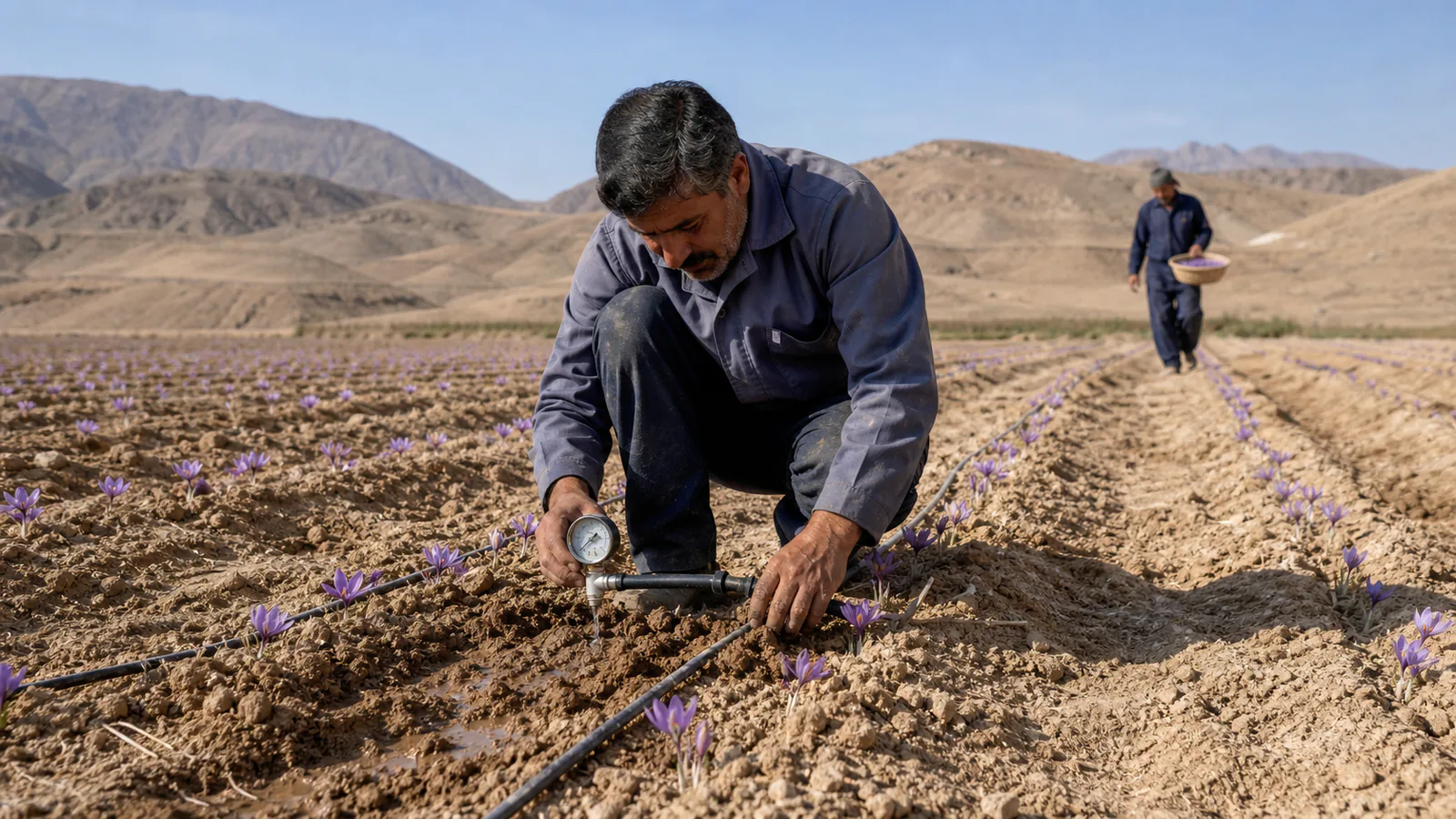
A 2015 report from Natanz called saffron “the most economical product” for local farmers facing falling groundwater. The underlying idea was more careful than that headline: where water-intensive crops had become difficult to sustain, saffron offered a possible higher-value alternative with a different irrigation pattern. It was not a promise that every saffron field would be profitable.
This article keeps the report’s Natanz and Tarq Rud figures as a historical case. It then explains what a grower would need to calculate before calling saffron an economical crop today. Prices, input costs, water availability and yields change, so the 2015 numbers should not be used as a present-day business forecast.
Why Natanz farmers were considering saffron
The original interview described a familiar dry-region problem. Groundwater levels were declining, making crops with high water demand harder to justify. Local agriculture officials encouraged farmers to consider alternatives that could produce more value from limited water, and saffron attracted interest.
That does not make saffron water-free. The crop still needs irrigation at the right stages, suitable drainage and a field plan that accounts for local rainfall, soil and salinity. Its advantage is contextual: in some arid and semi-arid systems, its seasonal water pattern and high value per unit of dried product can make it a useful option.
The FAO’s account of Iran’s qanat-based saffron system makes the same connection. It describes saffron as drought resistant and valuable under severe water scarcity, but links successful production to reliable irrigation and generations of local water-management knowledge.
What the 2015 Tarq Rud report actually recorded
The report focused on Tarq Rud in Natanz County. It attributed the information to the city’s agriculture director, rendered in the earlier English translation as Abdolmahdi Badmehdi. The figures were:
- about 175 hectares of saffron cultivation concentrated in the Tarq Rud area;
- around 20 hectares of seven-year-old fields being renewed through corm lifting;
- a forecast of roughly 20 tonnes of saffron corms per hectare from those mature fields; and
- distribution of lifted corms to applicants in Natanz, nearby cities and neighbouring provinces.
The 20-tonne figure referred to underground corms, not dried saffron spice. Confusing the two would produce an impossible yield claim. Each saffron flower supplies only three stigmas, so dried spice yield is measured in kilograms per hectare, while corm harvest can be measured in tonnes.
Field renewal is also not annual income in the same sense as selling dried stigmas. Lifting, sorting, storing and replanting corms involve labour and risk. Some corms may be sold, while others are needed to establish the next production cycle.
Economical per hectare is not the same as economical per farm
Saffron’s small volume and high unit value are attractive, but a farm budget has to include the work hidden behind a jar of threads. Corm purchase, field preparation, irrigation, weeding, flower picking, stigma separation, drying, testing, packaging and finance all affect the result.
Labour is especially important. Flowers must be collected during a short season, and the stigmas are separated by hand in many production systems. A grower with suitable family or local labour may face a different cost from a grower who has to recruit workers at the harvest peak.
Market access changes the calculation too. A strong harvest is not enough if the product is sold without grading, stored poorly or reaches the market when buyers are scarce. “High-value crop” describes market potential; it does not guarantee a high return to the person who grew it.
Water economics need more than a low-water label
The useful measure is not simply how much water a crop receives. Growers need to compare yield and net return against the quantity, quality, timing and cost of water. A field can use less water than another crop and still perform poorly if irrigation arrives at the wrong stage or salinity suppresses growth.
A long-term field study published in 2025 examined saffron yield and economic water productivity under different irrigation depths, salinity levels and planting techniques. Its value is not a universal recipe; the treatments were specific to the study conditions. It does show why water depth, water quality and planting method must be considered together. See the study record and full research article before transferring its findings to another farm.
Groundwater decline also has a collective cost. One farm’s profitable pumping decision can contribute to a larger aquifer problem. A crop choice should fit the permitted and sustainable water supply, not merely the water a pump can extract in one season.
Corm quality determines more than the first year
The Natanz report treated mature corms as both planting material and a source of income. That makes selection and traceability important. Buyers need to know where corms came from, their health, approximate size and how they were stored. Moving diseased or poorly handled material can weaken a new field before it has a chance to produce.
Large corms are often preferred for establishment because stored reserves influence early growth, but “larger” is not a complete quality test. Disease status, physical damage, dormancy handling and suitability for local conditions matter as well. A low purchase price can be expensive if emergence is poor or pathogens are introduced.
A practical farm-level calculation
Before replacing another crop with saffron, build a multi-year budget rather than comparing one season’s retail prices. At minimum, record:
- land preparation and corm cost in the establishment year;
- expected productive field life and the timing of renewal;
- irrigation volume, energy cost, water quality and legal availability;
- labour hours and wage rates for each operation;
- conservative dried-saffron yields, including a poor season;
- drying, testing, storage, packaging and selling costs;
- the farm-gate price actually available, not the price of a retail gift pack; and
- possible corm value without counting corms needed for replanting twice.
Run the calculation at more than one yield and price. If the project works only at the best yield and highest observed price, it is fragile. If it remains viable under a realistic low case, the “economical” claim has a firmer basis.
So, is saffron an economical crop?
For the Natanz farmers described in 2015, saffron was presented as a response to water scarcity and declining groundwater, with an established cultivation area in Tarq Rud and a mature corm cycle. That made it a plausible alternative, not an automatic winner.
Saffron can be economical where the climate and soil fit, irrigation is reliable and sustainable, healthy corms are available, harvest labour can be organised and the grower has a credible route to market. The final answer belongs in a multi-year farm budget. A memorable headline should never replace that calculation.

![Exporting Saffron to Turkey + Price Guide [Complete 0 to 100]](https://img.rowhanisaffron.com/20260827003933/saffron-export-turkey-quality-inspection.webp)



