


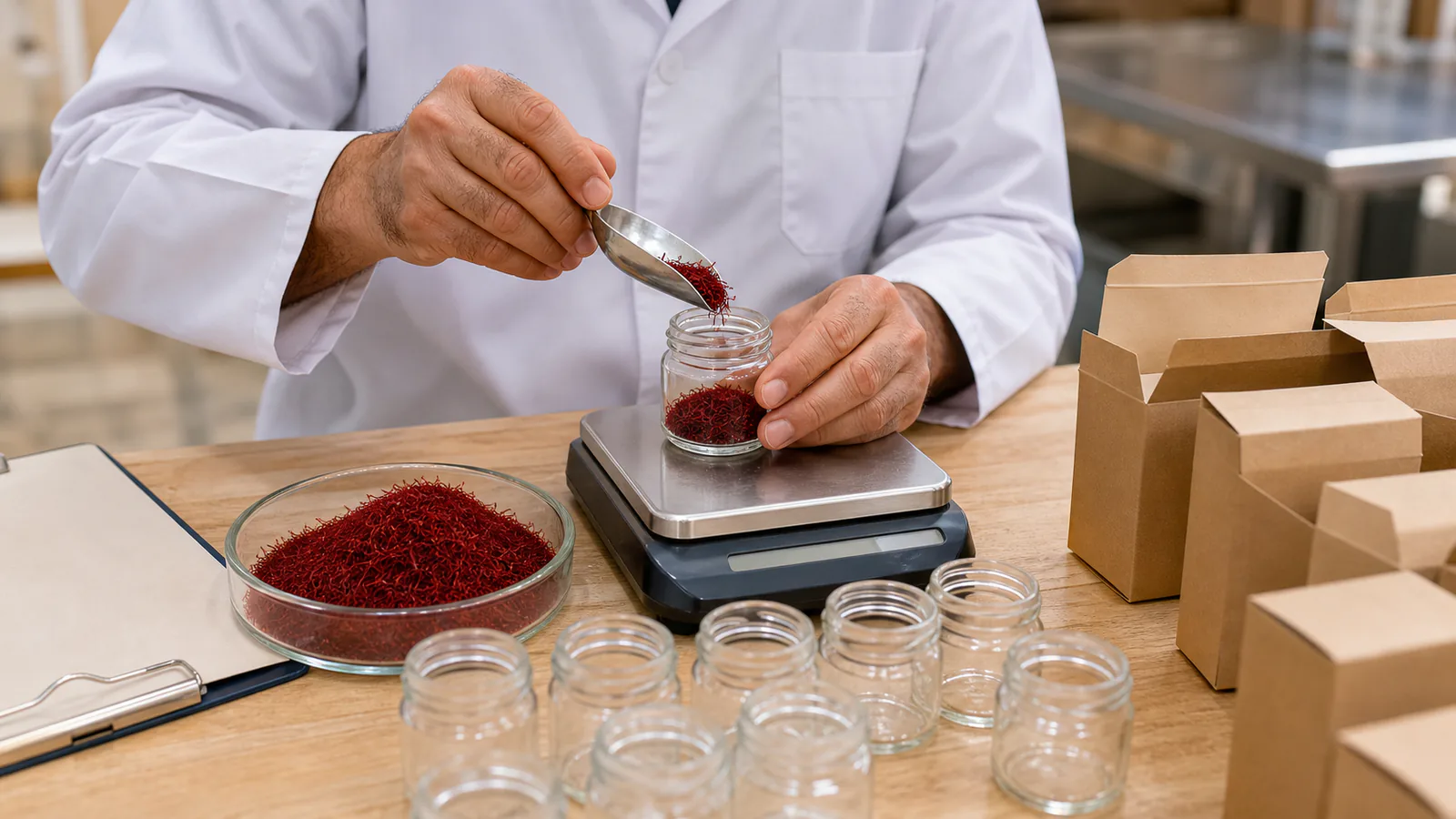
In 2015, North Khorasan was growing saffron but lacked a local saffron packaging industry, according to the provincial horticulture director quoted in the report behind this page. The practical result was that all of the crop was said to leave the province as an unpacked raw product. Farmers carried the cost and risk of cultivation, while much of the later grading, packing and market presentation happened elsewhere.
That is a historical finding, not a claim about North Khorasan today. The older figures and problems are retained here because they explain why local processing capacity matters. Anyone making a current investment or production decision should confirm the province’s present acreage, facilities and regulations with the relevant authorities.
The production picture reported in 2015
Heydar Namvar, then identified as horticulture director at North Khorasan’s Agricultural Jihad Organization, described a young but expanding saffron sector. The report recorded 540 hectares of productive saffron fields and another 100 hectares not yet bearing. It said planted area was increasing by about 50 hectares a year, with an average yield of four to five kilograms per hectare.
Those figures belong to the date of the interview. They should not be combined with current prices or presented as a forecast. Yield varies with field age, corm condition, planting density, soil, irrigation, weather, disease pressure and the timing of harvest and processing.
Namvar also pointed to employment. Saffron requires labour for planting, weeding, picking flowers and separating stigmas. That work creates rural income, but it also means growers are exposed when labour is scarce or expensive during a narrow harvest window.
The bottleneck began before packaging
The report used “packaging” as shorthand for a wider missing system. Growers were buying corms from other provinces, including Razavi Khorasan and South Khorasan, at inconsistent prices. It also identified a shortage of improved, traceable corm material and the absence of a reference laboratory able to assess product quality.
A packing line cannot repair weak planting material, poor drying or a mixed lot. A sound local value chain begins with healthy corms and field records, then follows the crop through flower collection, stigma separation, controlled drying, grading, testing, storage and final packing.
North Khorasan was described as suitable for saffron partly because the crop can work in dry regions. That advantage needs careful wording. Saffron is comparatively drought tolerant; it is not a crop that needs no water. The FAO’s account of Iran’s qanat-based saffron system connects the crop’s value in arid areas with reliable irrigation and long-developed water-management knowledge.
What a saffron packaging industry actually has to do
Packaging begins after the product has been made stable, clean and consistent. Its job is to preserve that condition and communicate it accurately. A credible operation needs to:
- keep lots separate and traceable from intake to finished pack;
- verify the material is genuine saffron and identify its commercial form;
- measure quality against the specification promised to the buyer;
- use food-contact materials that protect the threads during storage and transport;
- apply accurate weight, origin, lot and date information; and
- retain records for complaints, testing and any necessary product withdrawal.
The current international specification is ISO 3632-1:2025. ISO says it applies to dried saffron in filament, cut-filament and powder forms and includes recommendations for storage and transport. A label or laboratory result should identify the actual method and edition used rather than simply displaying “ISO” as a vague quality badge.
A good container cannot rescue poorly handled saffron
Saffron’s commercial qualities are commonly associated with colour, taste and aroma, which relate to compounds including crocins, picrocrocin and safranal. Harvesting, drying and storage can change that profile. Research comparing fresh and stored samples found that colour-related crocins declined over time while the chemical profile associated with aroma changed. The storage study is a reminder that “packed” and “protected” are not the same thing.
The pack therefore needs a dry, stable product and a sensible barrier against moisture, light, contamination and physical damage. Clear jars may look attractive, for example, but display and storage conditions still matter. Pack size should also match use: repeatedly opening a large container exposes the remaining saffron each time.
Powder deserves stricter identity controls because the buyer cannot inspect whole stigmas. Whole threads are not automatically superior in every commercial use, but they are easier to examine visually and harder to disguise with undeclared plant material.
Local testing and traceability protect farmer value
Without an accessible testing route, growers and small packers have difficulty proving why one lot should command a different price from another. Visual grading alone cannot establish every quality or authenticity measure. A reference laboratory, or a reliable relationship with an accredited outside laboratory, gives the supply chain a common language.
Traceability matters just as much. A finished pack should lead back to an intake lot, supplier, relevant test result and processing record. This protects the buyer, but it also protects careful growers from having their saffron blended anonymously with lower-quality material.
FAO’s 2025 work with Iran’s saffron sector places authenticity, quality assurance, supply-chain management and market recognition in the same programme. That quality-integrity initiative shows why local value is created by a system, not by a decorative box alone.
When local packing makes economic sense
The 2015 report treated the absence of provincial packing as value leaving North Khorasan. That can be true, but building capacity is not automatically profitable. A facility needs enough suitable product, trained staff, food-safety controls, testing access, working capital and actual buyers for its chosen pack formats.
Cooperative or shared facilities may suit small growers better than many underused individual lines. Contract packing can also be reasonable when lot identity and commercial terms are clear. The useful comparison is not “pack locally at any cost” versus “sell raw forever.” It is which arrangement preserves quality, keeps records, meets the buyer’s rules and returns a fairer share of value to the producer.
The lesson from North Khorasan’s packaging gap
The original article identified the right chain of problems even though its translation obscured them: uncertain corm supply, no nearby reference laboratory, labour-intensive production and no local packing capacity. Solving only the last item would leave the rest in place.
A durable saffron packaging industry connects field quality to verified quality. It gives growers a credible route from corm and harvest records to a protected, traceable product designed for a real market. That is how packaging can retain value in the producing region instead of merely changing the container.

![Exporting Saffron to Turkey + Price Guide [Complete 0 to 100]](https://img.rowhanisaffron.com/20260827003933/saffron-export-turkey-quality-inspection.webp)



