


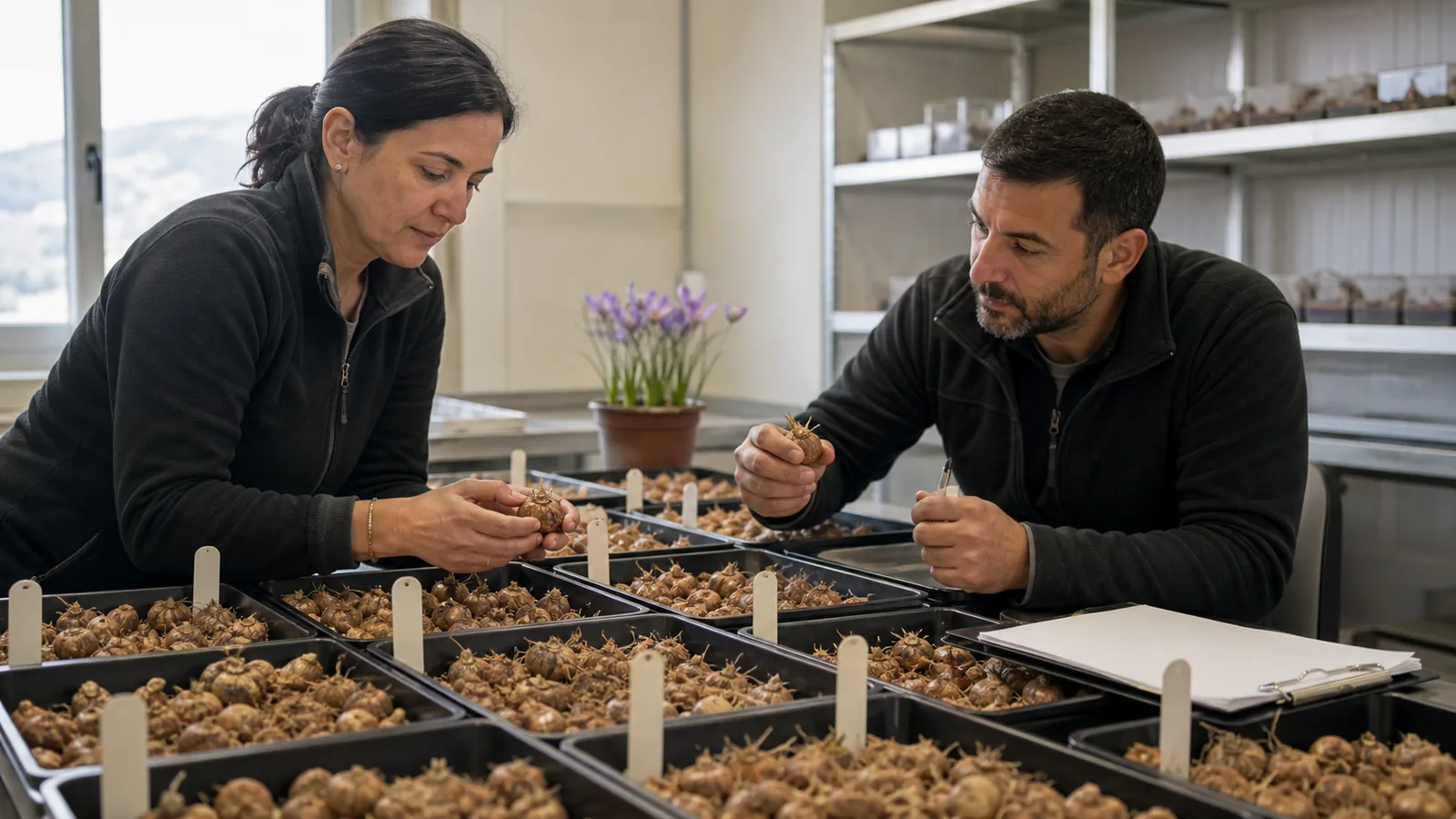
Be careful saffron genetic resources was a 2015 warning about moving saffron corms out of Khorasan Razavi and Iran. The underground planting material carries the crop forward because saffron does not reproduce through ordinary seed. Moving it can affect provenance, plant health and access to locally maintained material—but a complete conservation policy takes more than trying to stop a truck.
Ramin Esmi, then identified as head of the saffron unit in Khorasan Razavi’s Agricultural Jihad organisation, told the Khorasan branch of the Iranian Students News Agency that saffron corms should be treated as a genetic resource. He said genetic registration had been pursued during the previous two years to deter misuse. The interview also covered movement permits, production and export estimates, food safety, international competition and local processing capacity.
Those statements describe the official’s position at that time. They do not establish today’s permit rules, current production or a legal ban. The enduring point is narrower: planting stock should have an identity, a documented origin and a clean plant-health history before it is moved.
Why the corm matters to saffron genetics
The common phrase “saffron bulb” is useful in everyday conversation, but the planting structure is botanically a corm: a short, solid underground stem. Each mother corm produces daughter corms, which growers lift, sort and replant.
This matters because Crocus sativus is a sterile triploid. It does not form a normal, genetically reshuffled seed crop. A chromosome study described cultivated saffron as a clonal lineage propagated only through corms. When a grower moves a corm lot, the grower is moving living planting material that preserves the lineage.
“Clonal” does not mean every field will perform identically. Research has found limited genetic variation among saffron accessions, while somatic mutation, epigenetic differences, crop health and the growing environment can contribute to observed variation. Yield, flowering date and stigma quality may change because of corm size, field age, soil, temperature, water, pests, handling or drying even when the underlying plants are closely related.
For that reason, a place name or corm appearance cannot serve as a genetic certificate. Reliable identity comes from labelled accessions, field records and suitable laboratory characterisation. The practical guide to selecting and handling saffron corms deals with planting quality; this article deals with provenance and conservation.
What can go wrong when planting material moves
The original interview concentrated on losing a strategic resource and creating future competitors. There is another immediate concern: corms can carry soil, fungi, bacteria, viruses, nematodes, mites or other pests to a new field. A lot can look firm and still have a problem that becomes apparent only after planting.
The International Plant Protection Convention’s ISPM 36 guidance for plants for planting addresses this higher-risk pathway. It supports risk-based measures across production, inspection, testing, treatment where appropriate, packing and movement. It does not create one universal rule for saffron corms; national plant-protection organisations set the applicable import and export requirements.
A lawful movement can therefore be valuable and still need controls. Clean, traceable planting material supports research, conservation and farming. Undocumented movement creates uncertainty about origin and health. Smuggling is a legal allegation that requires evidence of the applicable rule and the actual crossing, not simply a corm found outside its traditional region. A separate article preserves the specific historical claims about saffron corm movement to Afghanistan.
Conservation is a record, not just a restriction
If a local corm population matters, it must first be inventoried. Each accession needs a stable identifier and passport information: who collected it, from which field, on what date, under what conditions and with what permission. Photographs and field traits help, but they should not replace a retained reference sample or suitable genetic analysis.
The FAO Genebank Standards cover field genebanks as well as in-vitro culture and cryopreservation for vegetatively propagated crops. They emphasise acquisition, establishment, characterisation, evaluation, documentation, distribution and safety duplication. That last point is easy to overlook. A collection held in only one field can be lost to disease, weather, land-use change or a simple labelling failure.
A serious saffron conservation programme should connect the corm to evidence:
- a unique accession or lot number and a documented chain of custody;
- collection location, field history, grower permission and acquisition date;
- corm health inspection and any validated diagnostic results;
- morphological and, where needed, molecular characterisation;
- flowering, yield and quality observations collected over several seasons;
- a clean reference collection with a safety duplicate at another site;
- rules for authorised distribution and records of every recipient.
Registration can discourage substitution and make research repeatable. It does not make a poorly maintained corm healthy, prove that a regional lot is genetically unique or guarantee commercial quality in the dried spice.
The movement-permit statement was specific to 2015
Esmi said corm movement within Khorasan Razavi required a licence. For transfers to other provinces, he described coordination with the police, road and transport authorities, and the provincial governorate. He also argued that other provinces were less alert to corms leaving the country, allowing material to move out through routes beyond Khorasan Razavi’s control.
That is a record of the process he described, not a current compliance instruction. Agency names, jurisdiction and paperwork can change. Anyone moving saffron corms now should obtain written requirements from the plant-protection and agricultural authorities at both origin and destination, then verify transport, customs and quarantine conditions before lifting the lot. A buyer’s request or an old news article is not a permit.
Documentation should travel with the corms and match the containers. At minimum, the parties need an agreed botanical identity, lot count or weight, origin, health status, destination and responsible sender and receiver. Where a phytosanitary certificate, import permit or laboratory test is required, it should be obtained through the competent authority—not recreated as a seller’s private certificate.
Historical production and export figures
The interview put combined saffron production in Khorasan Razavi and South Khorasan at 300 tonnes. It said roughly 200 to 250 tonnes were exported and argued that the two provinces could produce 500 tonnes if demand increased. These are attributed 2015 statements. The article does not identify the crop year, survey, dry-weight method or export dataset, so the numbers should not be used as current totals.
Capacity is especially easy to misread. A claimed ability to produce 500 tonnes is not a forecast, and demand alone cannot create the crop. Productive area, corm supply, water, weather, field age, labour, disease, drying capacity and acceptable quality all affect saleable output. Exported tonnage can also differ from production because stocks may move between years.
Esmi called saffron a comparative advantage of Khorasan Razavi and suggested that regions such as Kermanshah and Azerbaijan should plant crops suited to their own advantages. That policy opinion should not be turned into an agronomic prohibition. Saffron can perform outside its traditional centre where the field’s temperature cycle, drainage, water, labour and economics are suitable. A province name does not certify a field, and expansion should not come at the expense of documenting and conserving existing accessions.
European food safety does not mean “no fertiliser”
The old translation said European markets required saffron to be free from pesticides and chemical fertilisers. That wording is too absolute. Fertiliser use is not measured as a generic zero-residue condition, and pesticide compliance is governed by limits for specific residues.
The European Commission explains maximum residue levels as the highest pesticide residue legally tolerated in food or feed when the pesticide is used according to good agricultural practice. The same EU limits apply to food produced within the Union and imported from outside it. Other requirements can cover contaminants, microbiology, traceability and labelling.
A supplier cannot guarantee compliance merely by calling the product natural or healthy. The lot needs an appropriate sampling and testing plan, records of authorised field inputs, hygienic flower handling, controlled drying and protection from contamination. Test scope and acceptance limits should come from the destination market and buyer specification. The current ISO 3632-1 saffron specification supports product assessment, but it does not replace food-law obligations.
Competition, trading hubs and processing capacity
Esmi described Iran as the world’s largest saffron producer and named Spain and the United Arab Emirates as important competitors in target markets. This was a 2015 market observation. Production, processing, branding, partner-country trade and final consumer demand are different measures.
Spain has its own saffron production and processing trade. The UAE can function as a commercial and re-export hub. A customs record naming a partner country does not by itself identify the farm origin or the country where the package was finally consumed. Market analysis needs a dated dataset and must distinguish origin, consignment, last known destination and re-export.
The interview also said Khorasan Razavi had 74 saffron processing and packaging units with a nominal capacity of 350 tonnes, following development over the previous five years. It noted that packages were adapted to the preferences of destination countries. Again, nominal capacity is not evidence of actual throughput. Utilisation depends on incoming crop, plant approval, labour, equipment, quality systems and orders.
Packaging for a target market can be sensible when it changes pack size, language, mandatory labelling or presentation. It must not blur origin or break lot traceability. Every finished pack should still lead back to the processor, input lot, test records and responsible supplier.
How to handle a valuable saffron corm lot
Before moving any lot, identify why it is being moved: routine replanting, commercial sale, research, conservation or international transfer. Then check the current legal and plant-health route rather than relying on the 2015 procedure.
Keep the source lot separate until its identity and health have been assessed. Do not combine unlabelled corms from several farms and then assign them one regional name. Use containers that protect the corms without trapping damaging moisture, and keep the label with the lot through transport and receipt.
At the destination, record what arrived and isolate suspect material from established fields. Planting performance should be tracked by accession and field season. If the aim is conservation, retain a verified reference and a safety duplicate instead of distributing the last available material.
Reading the genetic-resources warning today
Be careful saffron genetic resources remains sound advice when “careful” means documented, healthy and lawful management. Saffron’s dependence on corm propagation makes planting stock important, but border control and market fear are only part of the picture.
The stronger system identifies accessions, records provenance, tests plant health, preserves clean duplicates and controls distribution with current authority requirements. That protects research value and farmers’ planting material while allowing legitimate exchange. It also keeps three questions separate: what the plant is, whether it is safe to move, and whether the dried spice will meet a buyer’s specification.
Ramin Esmi’s role, ISNA attribution, two-year registration effort, Khorasan movement procedure, 300-tonne production, 200–250-tonne export, 500-tonne capacity claim, comparative-advantage position, Spain/UAE competition, five-year processing development and 74-unit/350-tonne capacity are retained as details of the 2015 interview. They are not presented as current law or statistics. Scientific and official sources were reviewed on 29 August 2026.

![Exporting Saffron to Turkey + Price Guide [Complete 0 to 100]](https://img.rowhanisaffron.com/20260827003933/saffron-export-turkey-quality-inspection.webp)



