


The 2015 warning about significant smuggling of saffron bulbs to Afghanistan raised two separate concerns: the unauthorised movement of valuable planting stock and the long-term competitiveness of Iranian saffron. The first requires evidence, permits and plant-health controls. The second depends on farm economics, quality, origin and market access—not on the assumption that another country’s success automatically erases Iran’s place in saffron.
This article preserves what Ali Hosseini said in the historical Mehr interview, but it does not turn his warning into a current trafficking statistic. The surviving report names no consignment, seizure, weight, border crossing or court outcome. It is evidence of a public policy concern in 2015, not proof of the scale of illicit corm movement today.
What Ali Hosseini said in the original report
Hosseini, identified as a member of Iran’s National Saffron Council, told Mehr that Iranian saffron corms had been moved to Afghanistan for more than seven or eight years. He said large quantities left by different means each year around the season when growers lift and relocate corms.
He argued that the movement was helping Afghanistan expand saffron cultivation and warned that, if the trend continued, Afghanistan could become a major regional producer in place of Iran. That was his forecast at the time. The article supplied no export series, Afghanistan production series or corm-flow records with which to test it.
Hosseini called for the Ministry of Agricultural Jihad, Ministry of Interior, border guards and customs to work together. His frustration was that responsibility appeared fragmented, with each body saying the matter belonged elsewhere. The quotation is a call for coordinated enforcement; it does not establish the exact legal duty of each organisation in every present-day case.
He also contrasted two Iranian provinces. South Khorasan was said to have held roughly 10,000 to 15,000 hectares of saffron for years without expansion, with some formerly saffron-focused villages turning to barberry. Khorasan Razavi, described as once having little cultivation, was said to exceed 60,000 hectares. Those are attributed 2015 statements, not current acreage figures.
A saffron bulb is living planting material
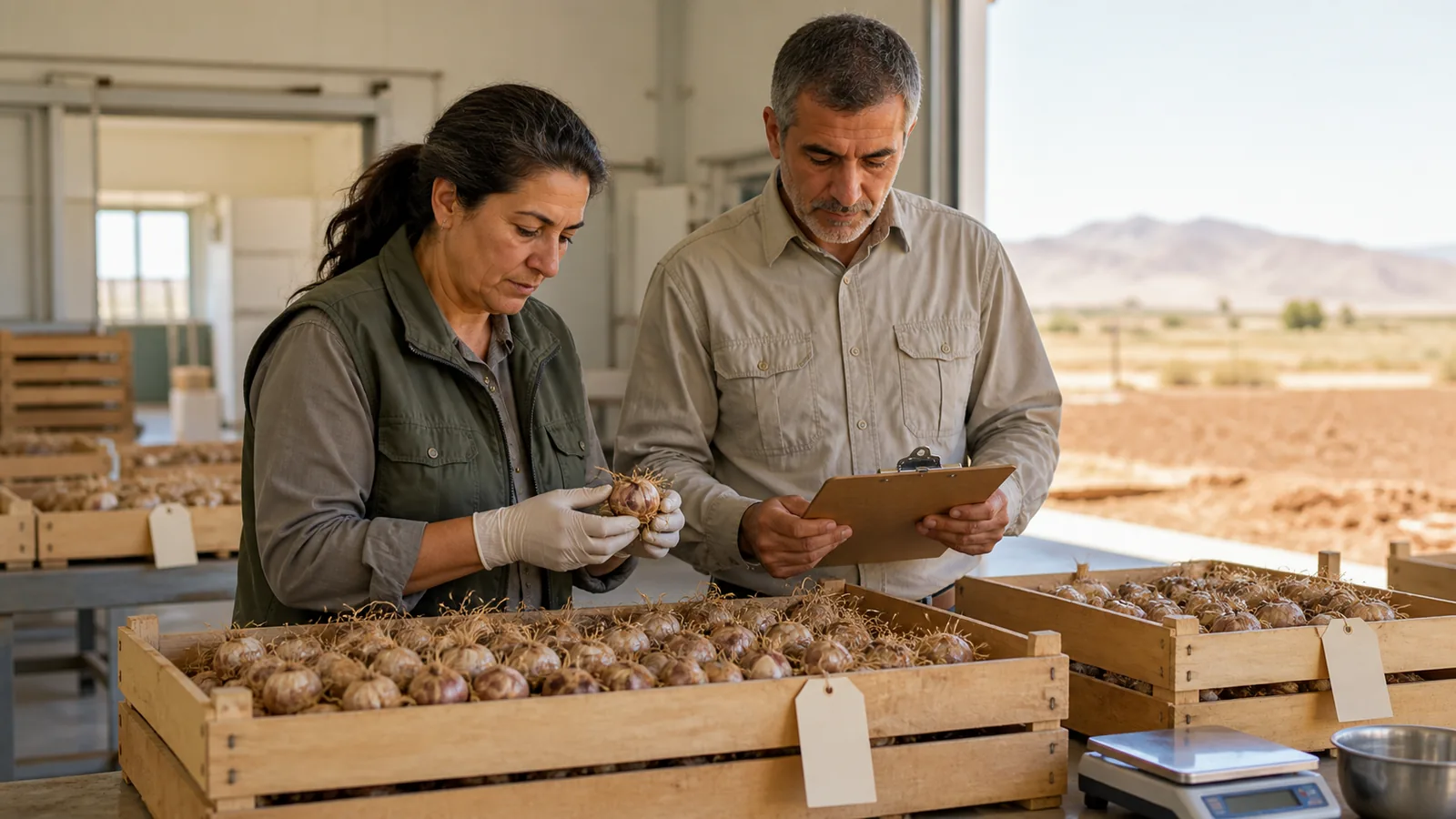
Growers commonly say “saffron bulb,” but the underground planting structure of Crocus sativus is a corm. That distinction matters because this is not a packet of dried spice. A viable corm can establish plants and produce daughter corms in later seasons.
It can also carry soil, pests or disease. International plant-health systems therefore treat plants for planting as a pathway that may need stronger control than a processed food product. The International Plant Protection Convention’s ISPM 36 on plants for planting sets out integrated measures such as production-site controls, inspection, testing, treatment, traceability and documentation. It is an international standard, not a finding about any particular Iranian or Afghan load.
Saffron-specific research shows why condition matters. An Iranian Plant Protection Research Institute study indexed by FAO AGRIS examined bulb-mite populations and corm rot in Gonabad fields. A roadside claim cannot reveal whether corms are healthy; that requires appropriate inspection and, where needed, diagnosis.
Smuggling and lawful corm movement are not the same
Planting material can move lawfully when the relevant export, import, customs and phytosanitary requirements are met. It can also be traded domestically inside another country under that country’s rules. The word “smuggling” should be reserved for movement that breaches a specific legal requirement, supported by evidence from the competent authority.
The historical interview did not identify the permits allegedly missing or provide case records. It therefore cannot justify labelling a named grower, trader, vehicle or Afghan producer as involved in an offence. Nor does it show that every Iranian corm found outside Iran arrived unlawfully.
Afghanistan has developed a recognised saffron sector in its own right. FAO’s current One Country One Priority Product profile for Afghanistan describes Herat-Bastan Saffron and links its characteristics to local environment and production practices. FAOLEX’s Afghanistan cultivated-plants record also lists a 2015 regulation concerning the purchase and distribution of saffron bulbs and the development of cultivation. These facts do not resolve Hosseini’s allegation; they show why the neighbouring industry should be discussed accurately rather than reduced to a trafficking claim.
What evidence would establish the scale of a corm case
A credible account needs more than an estimate from an interview. It should identify the date, place, authority and legal basis, then keep the following records connected:
- the measured net weight and number of containers;
- the corm’s stated farm, supplier and province of origin;
- invoices, waybills, export or domestic movement permits;
- vehicle, custody and destination records;
- plant-health inspection, sampling or laboratory results;
- the alleged breach and authority responsible for it;
- seizure, release, treatment, destruction or return decisions;
- the later administrative or judicial outcome.
Without those details, several different situations can look identical in a headline: legal domestic transport, a documentation error, prohibited export, stolen corms or a load whose plant-health status is uncertain. Quantity is particularly important. “Large amounts every year” cannot be compared with national planting capacity until measured loads and dates are available.
The site’s account of documented saffron-corm seizures and a separate saffron theft shows how named amounts, vehicles and official actions can be retained without inventing a conviction. That page owns those individual incidents. This page owns Hosseini’s broader Afghanistan warning and the policy questions behind it.
Why corm traceability protects farmers
A traceable system helps more than border enforcement. A grower buying corms needs confidence about seller, lot, quantity, condition and origin. If emergence fails or a plant-health problem appears, records make it possible to identify affected blocks and other buyers who received material from the same source.
Useful records begin before lifting. The farm and field block are identified, tools and containers are kept clean, damaged or suspicious corms are separated, and each lot remains labelled through grading, storage and transport. The buyer receives an invoice and any documents required for that movement. Our practical guide to selecting and handling saffron corms covers planting quality; legal and phytosanitary requirements still need confirmation from the competent authorities for the actual route and date.
Traceability also protects legitimate sellers from a market flooded with anonymous stock. Enforcement that stops one vehicle but leaves the lawful supply chain opaque does not solve the underlying problem. Farmers still need a practical way to buy documented, healthy planting material.
Plant health must remain separate from nationality
A corm is not healthy or unhealthy because it is Iranian or Afghan. Risk depends on its production site, pest exposure, soil or growing medium, handling, inspection and the requirements of the receiving country. National labels are not a substitute for evidence.
The same care applies to commercial quality. A country’s expanding area does not prove that every harvest reaches the same grade, and an older producing region does not receive quality by default. Dried saffron must still be assessed through traceable processing and the agreed physical, chemical and hygiene specifications.
This distinction makes policy more effective. Plant-health controls target pathways and organisms. Customs controls target declared goods and legal movement. Origin strategy helps buyers distinguish where and how the spice was produced. Blending these jobs into a single patriotic slogan makes none of them easier to audit.
Would Afghan production “replace” Iranian saffron?
Hosseini’s warning expressed a fear about lost planting stock and competition. Replacement, however, is not a simple one-for-one process. Production area is only one part of a saffron economy. Yield, harvest labour, drying, testing, packaging, finance, buyer relationships, consistent delivery and origin recognition all influence who earns value.
Iranian farmers can lose ground even if no corm crosses a border: poor farm returns, water constraints, weak working capital or unattractive alternative crops can reduce local cultivation. Hosseini’s South Khorasan comparison points toward that domestic issue. If villages moved from saffron to barberry, the useful questions are why, over what period and with what effect on household income—not simply who planted saffron elsewhere.
Conversely, preventing unlawful corm movement would not by itself guarantee stronger Iranian exports. Buyers need consistent lots and verifiable origin. The site’s explanation of saffron origin, registration and market identity shows how geographic recognition differs from ownership of the crop itself.
A stronger response than an alarming headline
A proportionate policy begins with reliable measurement. Agencies can publish compatible records for permitted movement, seizures, weights, plant-health findings and case outcomes without exposing sensitive enforcement methods. Shared definitions prevent one organisation’s “unlicensed transport” from becoming another report’s unqualified “smuggling.”
The legal supply of corms should be easier to recognise than an anonymous one. Registered sellers, lot records, clear movement documents and accessible plant-health advice give farmers a workable alternative. Border and customs action can then focus on evidence-backed risks, while agricultural agencies address corm quality and the reasons growers sell or abandon fields.
Finally, province comparisons need dates and sources. The 10,000-to-15,000-hectare South Khorasan claim and the more-than-60,000-hectare Khorasan Razavi claim should remain attached to Hosseini’s 2015 interview. New decisions require new statistics. Quietly carrying old acreage into the present would be as misleading as treating the interview’s warning as a current seizure total.
The original article was right that corm movement deserves attention. Its strongest modern reading is not that Afghanistan must be denied a legitimate saffron industry. It is that living planting material should move through a lawful, traceable and plant-health-aware chain, while Iranian growers are supported by evidence, viable farm economics and a distinct origin buyers can verify.
The Ali Hosseini, Mehr, seven-to-eight-year, Afghanistan, agency-responsibility, South Khorasan, barberry, 10,000–15,000-hectare, Khorasan Razavi and 60,000-hectare statements are retained as claims from the site’s 2015 report. IPPC, FAO, FAOLEX and FAO AGRIS material was reviewed on 29 August 2026; no historical claim is represented as a current seizure, law or acreage figure.

![Exporting Saffron to Turkey + Price Guide [Complete 0 to 100]](https://img.rowhanisaffron.com/20260827003933/saffron-export-turkey-quality-inspection.webp)



