


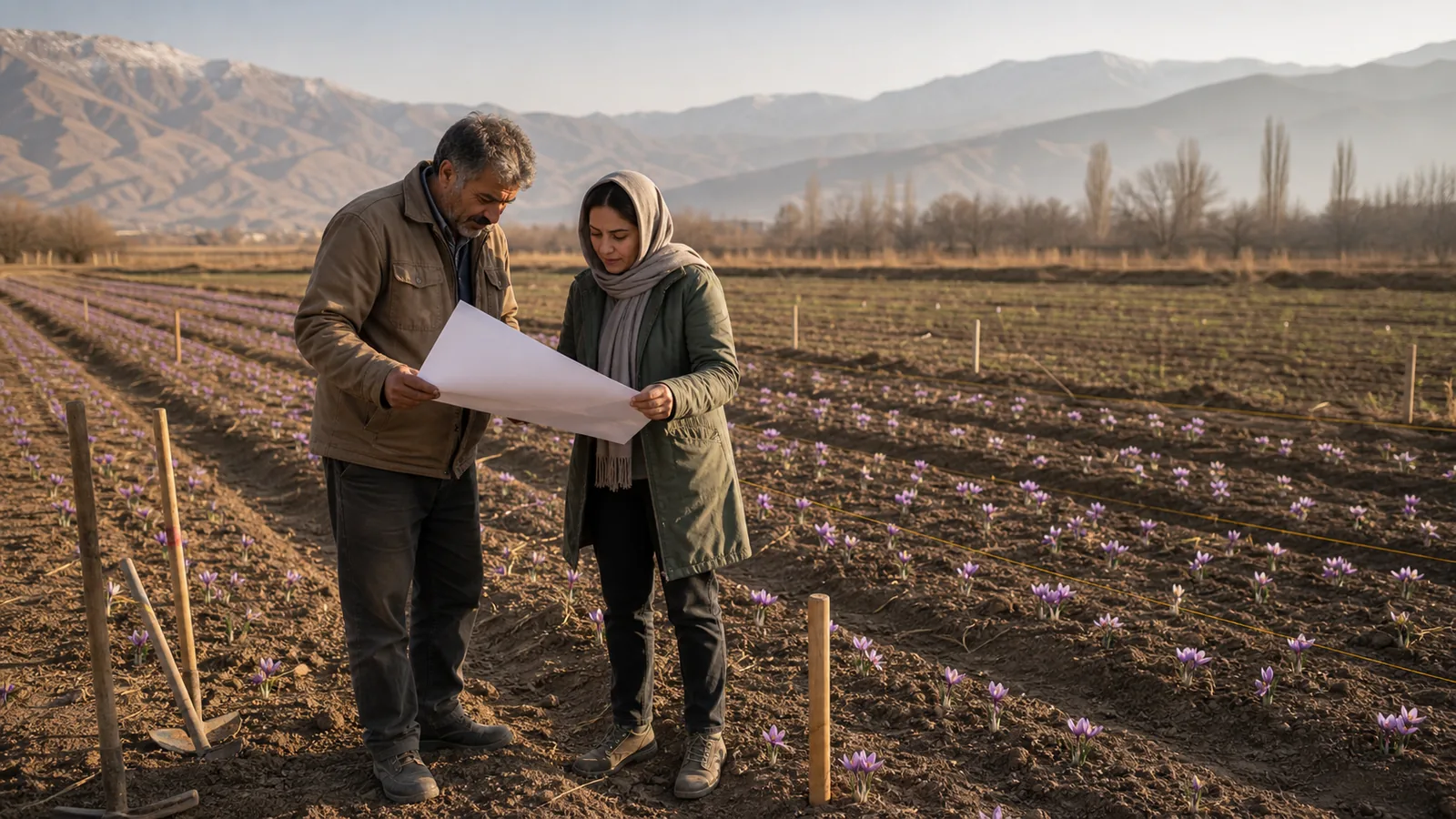
Saffron cultivation in 10 acres of agricultural land is a serious farm project, not simply a larger version of a garden planting. Before corms are ordered, the grower needs to settle the unit of area, confirm that the site can support a multi-year crop, divide the land into manageable blocks and plan labour for the short flowering season.
There is also an important correction behind this article’s title. The 2015 Malayer report preserved in the original post referred to about 10 hectares, although part of its English translation said “10 acres.” Those are not interchangeable: 10 hectares is about 24.7 acres, while 10 acres is about 4.05 hectares. Any corm, labour, water or budget calculation must start with the actual surveyed area.
What the original Malayer report recorded
The post drew on a 2015 interview by ISNA’s Hamadan service with Colonel Hatem Zandi, identified as the head of the Basij Construction organisation in Malayer. He said that roughly 10 hectares of land in Malayer were being planted with saffron for the first time. The named locations were the Central, Samen and Jowkar districts.
Zandi described the work as part of the period’s “resistance economy” programme. Corms for the planting were to come from Mashhad, and he forecast a total harvest of about 15 kilograms in Malayer that year. The surviving report does not provide a field-by-field area or say that 15 kilograms was a per-hectare yield, so it should not be used as one.
The programme also promised training, technical guidance and advice before and during cultivation. Twelve farmers had reportedly been introduced to Mehr Eqtesad Bank for loans. The stated facilities were 15 million to 30 million tomans; the old machine translation incorrectly rendered that currency as US dollars. These are historical programme details, not current loan offers or current establishment costs.
Zandi added that production from saffron corms could rise markedly from the second year and create income. That is a reasonable description of the crop’s establishment pattern, but it is not a guaranteed return. Corm condition, density, soil, irrigation, weeds, weather, harvest timing and the way the field is managed all affect the result.
First resolve the 10-acre and 10-hectare difference
A unit error becomes expensive when it is repeated across a whole plan. Write the legal or surveyed area in both hectares and acres, then use hectares or square metres consistently for agronomic calculations. Record any headlands, access tracks, drains, buildings and unplantable corners separately. Gross property area is rarely the same as net planted area.
For a 10-acre holding, multiplying a per-hectare input by ten would order almost two and a half times too much. For the Malayer project described as 10 hectares, budgeting as though it covered 10 acres would leave most of the land without corms, labour or water provision. The correction is more than editorial; it changes the entire project.
Map the field into blocks before planting. A block should have a traceable corm lot, a known planted area and its own records for irrigation, inputs, labour, flowers and dried saffron. That makes a disappointing section diagnosable instead of allowing one total figure to hide it.
Decide what the agricultural land is meant to achieve
A new field can be designed for dried-spice production, multiplication of healthy daughter corms, a commercial trial in a new district, or a mixture of those aims. The choice affects how corm stock is selected, how densely it is planted, which measurements matter and when the grower judges success.
On unfamiliar land, planting every available hectare in one season concentrates risk. A pilot block can reveal drainage trouble, unsuitable field geometry, local weed pressure, labour shortages and mistakes in irrigation timing while they are still containable. Expansion should follow evidence from the site, not the prestige of announcing a large planted area.
The general climate checks for planting saffron are a useful first screen. They do not replace local soil and water analysis or advice from an agronomist who has inspected the field.
Inspect soil, drainage and water before buying corms
Saffron remains in the ground across several seasons. A problem that might be tolerable for an annual crop can therefore follow the field for years. Walk the site after irrigation or rain and look for ponding, compacted runs, erosion, saline patches and uneven infiltration. Sample distinct soil zones separately rather than blending a weak corner into an average result.
A useful laboratory request covers texture, pH, salinity and the nutrient indicators relevant to local soils. Irrigation water should also be assessed where salinity or source quality is uncertain. The purpose is not to chase one universal “perfect” number. It is to find constraints early enough to change the layout, drainage, amendment plan or even the site.
Water planning must follow local weather, soil storage and the plant’s growth stage. Saffron’s seasonal pattern may suit dry regions, but “low water requirement” does not mean that a commercial field succeeds without well-timed water. Our broader saffron cultivation checklist explains the sequence without turning regional practice into a fixed prescription for every farm.
Build the corm plan from measured land
The Malayer report said the programme sourced planting corms from Mashhad. Origin alone does not establish quality. Each lot should be identified, inspected and documented before it reaches the field. Rejecting visibly damaged, decayed or suspect material is cheaper than distributing a problem through many hectares.
Corm size, quantity and planting density interact with establishment and flowering. A two-year experiment at Ferdowsi University of Mashhad, indexed by FAO AGRIS, found significant differences among tested densities and corm types. That evidence supports deliberate planning; it does not supply a universal density for Malayer or any other farm.
Calculate needs from net planted square metres and the locally chosen system. Add only a documented allowance for grading and handling loss. Keep the supplier, lot, inspection result, received weight, planting date, block and actual quantity together in one record. If different lots are mixed without traceability, later yield comparisons say very little.
Lay out the field for work, not just plant count
A paper design can maximise planted rows while leaving no practical way to move people, shallow flower containers or equipment during peak bloom. Access lanes, turning space and safe movement between blocks cost a little area but can protect harvest timing and flower condition.
Row geometry should suit the intended cultivation and harvesting method. If a farm expects to use mechanical assistance later, the bed width, row spacing, levelness and access route need to be compatible from the beginning. Retrofitting a mature field around a machine is usually harder than designing a workable field first.
Mark block boundaries permanently and measure the planted area after work is complete. “Ten acres ordered” is not the same as “ten acres established.” Missed runs, headlands and irregular edges matter when yield and cost are later reported per hectare.
Plan labour before flowers appear
Large-scale saffron cultivation creates a sharp labour peak. Flowers do not wait for a convenient weekly schedule, and collection is followed by transport, stigma separation, drying, cooling, inspection and storage. Counting field pickers without staffing the indoor stages simply moves the bottleneck.
Estimate capacity block by block. The plan should name who checks the field, how workers are called in, where flowers are received, how lots stay separate, how quickly separation begins and what happens when bloom exceeds the day’s forecast. Shallow, clean containers and short, traceable movements protect the flowers better than an improvised pile at the end of a row.
FAO’s technical account of saffron cultivation and processing notes both annual daughter-corm formation and the need for timely harvest during a short flowering period. Those two features explain why establishment quality and peak-season organisation have effects well beyond planting day.
Use a multi-year budget, not a first-harvest promise
A farm budget should separate establishment from annual operation. Establishment includes land preparation, corm purchase and grading, planting labour or machinery, layout, irrigation work and records. Annual costs include field care, water and energy, harvest labour, separation, drying, testing, packaging, storage and supervision. Family labour still has an economic value even when no wage changes hands.
Income scenarios need more than a headline yield. Show saleable dried weight, the proportion meeting the intended specification, the price actually available to that grade and route, and the timing of payment. Test a poor, ordinary and strong season. Do not use the 2015 Malayer forecast, or today’s retail price for tiny packs, as the revenue basis for a farm-gate plan.
Loan terms belong in the same model. Record the principal, fees, interest, repayment dates, security, grace period and the cash month in which each instalment falls due. The old 15-million-to-30-million-toman programme cannot be carried forward as current finance. A grower needs a written offer from the present lender and a budget that still works if flowering or payment is late.
Why the second year may look different
Saffron is propagated by corms, and daughter corms develop as the planting ages. Research commonly finds year effects, but the direction and size depend on the system. The Mashhad density study recorded higher flower and corm measures in its second experimental year; that is evidence from a defined trial, not a promise that every new field will reach a particular yield in year two.
A first season should therefore be reviewed as an establishment year. Record emergence, gaps, weeds, water events, flower count, fresh flower weight, dried saffron, labour hours and quality results by block. In later seasons, track the same measures so an apparent gain is not merely the result of more labour or a different drying method.
Dense planting can lift early output while creating later trade-offs. A peer-reviewed study of Gonabad saffron farms found that planting density was among the factors associated with technical efficiency and warned against treating ever-higher density as automatically sustainable. The practical lesson is to monitor the whole production cycle, not celebrate the first large flower count.
What a responsible 10-acre plan should contain
- a surveyed gross area and a separate net planted area, shown in hectares and acres;
- a block map with soil, water, access and drainage observations;
- traceable corm lots, inspection records and measured planting quantities;
- a locally justified layout, density and irrigation plan;
- labour capacity for picking, separation, drying and storage during peak bloom;
- a multi-year cash-flow model with weak-season assumptions;
- block-level yield, quality, labour and cost records;
- clear criteria for expanding, correcting or stopping after the pilot stage.
The historical Malayer project is valuable because it shows that saffron expansion involved more than distributing corms. Training, technical support and finance were part of the proposal. A durable project adds one more discipline: every area, input, forecast and outcome must be measurable. That is how 10 acres of agricultural land becomes a managed saffron farm rather than a large, expensive assumption.
The Malayer, Hatem Zandi, ISNA, 10-hectare, district, Mashhad-corm, 15-kilogram, 12-farmer and 15-million-to-30-million-toman details are retained as historical statements from the site’s 2015 report. They are not presented as current programme terms. FAO AGRIS, FAO technical material and peer-reviewed farm research were reviewed on 29 August 2026.

![Exporting Saffron to Turkey + Price Guide [Complete 0 to 100]](https://img.rowhanisaffron.com/20260827003933/saffron-export-turkey-quality-inspection.webp)



